
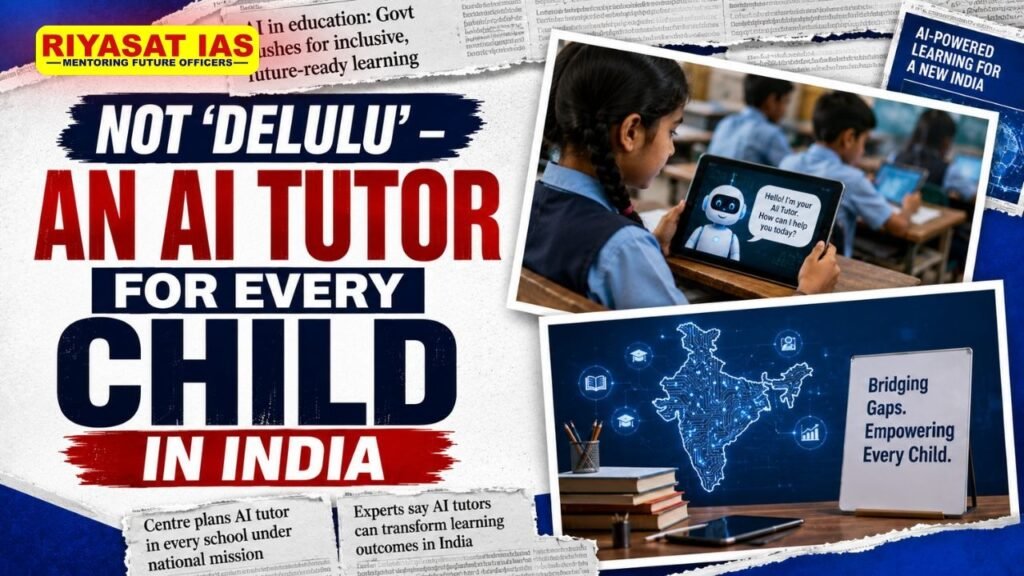
GS-II: Education | Digital Public Infrastructure | Social Justice | Human Resource Development
GS-III: Artificial Intelligence | Digital Innovation | Inclusive Growth
Context
- Rapidly Growing Market: India’s test-preparation market is estimated at $14.8 billion in FY26 and may reach $23–26 billion by FY30, with around 2 lakh coaching centres.
- High Coaching Dependence: About 27% of students were taking or had taken private coaching, according to a 2025 NSO survey.
- Large Target Group: Around 65 million students study in Classes 9–12, creating a huge potential user base.
- Access Inequality: Quality coaching remains expensive and geographically concentrated, disadvantaging students from rural and economically weaker backgrounds.
- Core Idea: Use AI + Digital Public Infrastructure (DPI) to provide every student with access to a free, personalised digital coach, without nationalising the private coaching industry.
Why a Public Digital Coaching Platform Is Needed
- High Cost: Expensive coaching can make family income a determinant of educational opportunity.
- Unequal Access: Expert teachers and reputed coaching centres are concentrated in urban education hubs.
- Quality Uncertainty: Students often cannot distinguish between effective coaching and commercial marketing.
- Fragmented Services: Content, doubt-solving, mentoring, tests and progress records remain locked within separate platforms.
- Limited Private Scale: No single ed-tech company can serve the entire national student population.
- Equity Gap: The objective should be to improve outcomes for the last student in the queue, rather than destroy private coaching.
Proposed Model: “Public Rails, Private Engines”
- Government as Platform: Government provides digital infrastructure, standards, identity, interoperability and trust.
- Private Sector as Provider: Ed-tech firms, teachers and tutors provide content, mentoring and specialised services.
- Open Competition: Multiple providers compete on a common network rather than creating closed ecosystems.
- Demand Aggregation: Government aggregates demand, reducing the customer-acquisition burden on private providers.
- No State Monopoly: Government should build the rails, not become the teacher.
- Core Principle: Convert coaching from a closed, bundled service into an open and competitive network.
Lessons from Digital Public Infrastructure
- UPI Model: Common public infrastructure can allow multiple private providers to compete while maintaining interoperability.
- ONDC Model: Open networks can unbundle services and reduce dependence on closed platforms.
- Education Application: Similarly separate:
o Content
o Doubt-solving
o Mentoring
o Assessment



o Credentialing
o Student data
- Key Principle: Open protocols + multiple providers + student choice = competitive education ecosystem.
How the AI-Education Platform Could Work
1. Open Content Registry
- National Catalogue: Create a trusted repository of accredited educational content.
- Standard Taxonomy: Map lessons, questions and tests to a common JEE/NEET topic structure.
- Multiple Providers: Teachers and ed-tech companies can upload:
o Lectures
o Problem sets
o Mock tests
o Revision material
- Metadata: Identify content by language, difficulty, medium and accessibility.
2. AI-Powered Personalisation
- Identify Weaknesses: AI analyses mock-test and learning data to identify knowledge gaps.
- Smart Recommendation: It directs students to the best-performing module, irrespective of the provider.
- Adaptive Practice: Generates questions according to individual performance.
- AI Doubt-Solver: Provides 24×7 explanations and instant feedback.
- Example: A student weak in organic chemistry can automatically receive targeted lessons, questions and revision material.
3. Student-Owned Learning Record
- Progress Ledger: Maintain a portable record of:
o Topics completed
o Mock-test scores
o Learning progress
o Topic-wise mastery
- Data Portability: Students should be able to move their learning history between providers.
- Consent-Based Sharing: A DEPA/Account Aggregator-type architecture can enable controlled data sharing.
- Structural Change: The student, not the ed-tech company, owns the learning record.
4. Discovery and Interoperability Layer
- Reference Platform: Government provides a common discovery application.
- Open APIs: DIKSHA, State platforms and other educational applications can access the same ecosystem.
- Multiple Front Ends: Different apps can provide access to one underlying network.
- No Lock-in: Switching providers should not mean losing learning history or progress.
5. Outcome-Based Ratings
- Transparent Performance: Publish provider/module-wise learning outcomes.
- Objective Indicators: Use mock-test performance, student improvement and content quality.
- Quality Signal: Replace advertising-driven rankings with evidence-based rankings.
- Accreditation: Poor-quality or misleading providers can be delisted.
Role of the AI Tutor
- 24×7 Support: Provides immediate assistance without requiring physical classes.
- Personalised Explanation: Adjusts explanations according to the student’s learning level.
- Continuous Practice: Generates customised questions based on weaknesses.
- Multilingual Learning: Can support students across different Indian languages.
- Low Marginal Cost: One AI system can potentially assist millions of learners.
- Human-AI Partnership: AI should augment teachers and mentors, not completely replace them.
Digital Infrastructure for Universal Reach
- Aadhaar/DigiLocker: Can support verified onboarding, subject to privacy safeguards.
- APAAR ID: Can potentially connect learning records with academic identity.
- DIKSHA: Can serve as an existing digital distribution channel.
- Common Service Centres: Provide access to students without adequate digital devices.
- School Computer Labs: Can become local access points.
- Offline Mode: Downloadable and data-light content is essential for low-connectivity regions.
- Automatic Outreach: Class 11–12 students can be onboarded through schools and education boards.
Benefits
- Educational Equity: Reduces the influence of family income on access to quality preparation.
- Affordable Learning: Makes quality content and basic AI tutoring free at the point of use.
- Greater Choice: Students can select among teachers and providers.
- Better Quality: Outcome-based ratings encourage genuine performance.
- Innovation: Competition encourages better pedagogy and technology.
- Data Portability: Prevents students from being trapped within one ed-tech ecosystem.
- National Scale: DPI can reach millions without replicating physical coaching centres.
Challenges and Risks
- Digital Divide: Device and connectivity gaps can exclude precisely those who need support most.
- AI Errors: Incorrect explanations can be particularly harmful in high-stakes examinations.
- Data Privacy: Student learning data requires strong consent, security and purpose limitation.
- Commercial Manipulation: Providers may attempt to influence rankings or outcome metrics.
- Quality Control: Open participation may increase low-quality or misleading content.
- Human Interaction: Excessive AI dependence may weaken mentoring and classroom discipline.
- Algorithmic Bias: Recommendation systems may unfairly favour certain providers.
- Language Barrier: AI quality must be consistent across India’s linguistic diversity.
- Accreditation: Independent mechanisms are needed to certify providers and AI systems.
Way Forward
- Open Standards: Establish common standards for content, assessment and learning records.
- Interoperability: Make student progress portable across platforms.
- Data Protection: Ensure student-controlled, consent-based use of educational data.
- Independent Accreditation: Certify providers based on content accuracy and outcomes.
- Outcome-Based Evaluation: Rank providers through learning gains rather than advertisements.
- Human Oversight: Keep teachers and mentors central to the learning ecosystem.
- Bridge Digital Divide: Expand devices, school labs, CSCs, offline content and low-bandwidth access.
- Multilingual AI: Develop reliable AI tutors in Indian languages.
- Phased Rollout: Begin with JEE/NEET, assess outcomes and then expand.
- Thin Government Architecture: Government should focus on protocols, standards, interoperability, accreditation and trust, rather than trying to build the best learning app itself.
Conclusion
An AI-enabled Education DPI can transform coaching from an expensive, closed ecosystem into an open, competitive and inclusive learning network. The government should therefore act as the platform and market-maker, while teachers and private providers compete to deliver quality learning.
UPSC Mains Practice Question
Q. “Artificial Intelligence combined with Digital Public Infrastructure can democratise access to quality test preparation in India.” Discuss the opportunities and challenges of developing an AI-enabled public education ecosystem





 Ravi Raaz
 Hassan Khan
 Shadab Ali