
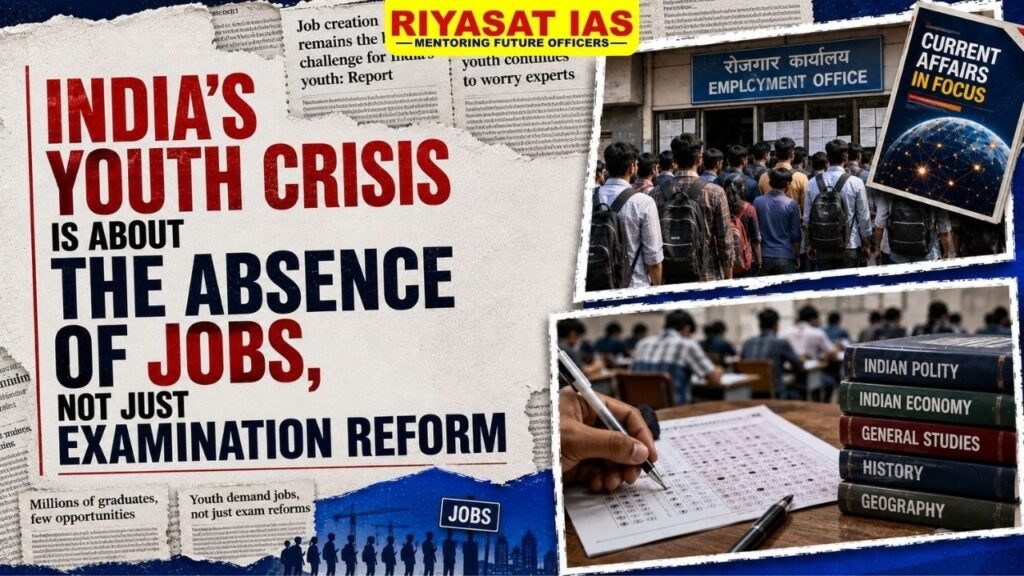
GS-II: Education | Social Justice | Government Policies & Interventions
GS-III: Employment | Inclusive Growth | Manufacturing | Investment | Industrial Development
Context
- Youth Agitation: Youth agitation forced the resignation of then Union Education Minister Dharmendra Pradhan.
- Examination Reform: The government conceded students’ demands for examination reform.
- Prime Minister’s Independence Day Address: The Prime Minister announced free online coaching for competitive examinations using India’s Digital Public Infrastructure.
- Rationale: The announcement is significant because the cost of private coaching has increased substantially for Indian families.
Rising Cost of Private Coaching
- MoSPI Survey: Private coaching accounts for 16% of what an Indian family spends on a child’s education, compared with 12.5% in 2018.
- Higher Secondary Stage: By the higher secondary years, private coaching accounts for nearly a quarter of the education budget, coinciding with the period when students prepare for competitive examinations.
- Limitation: Cheaper coaching has limited value when quality professional education remains confined to a handful of institutions.
Limited Access to Quality Professional Education
- Medical Entrance Examination: Over 22 lakh candidates appeared for around 1.4 lakh undergraduate seats.
- Top 50 Colleges: Fewer than 10,000 seats are available in the top 50 colleges.
- Engineering: A similar situation exists in the Joint Entrance Examination for engineering colleges.
- Implication: The problem is not merely the cost of coaching but the limited availability of quality professional education.
Declining Undergraduate Enrolment
- AISHE: For the first time since the All India Survey on Higher Education began in 2011, undergraduate enrolment fell by 93,322 in 2023-24.
- Young Men: The decline was particularly significant among young men.
- Uttar Pradesh: The fall was sharpest in Uttar Pradesh.
- State-Level Trend: Undergraduate enrolment fell by 1.53 lakh, even as diploma enrolment increased by 1.38 lakh.
Youth Employment Crisis
- PLFS Analysis: Of every 100 graduates aged 15–29 in 2025, only 26 were in regular salaried employment.
- Secure Employment: Only four had a salaried job with both a contract and social security.
- Two Ends of the Crisis: The youth employment crisis therefore has two ends:
- Preparation for jobs
- Jobs themselves
- Limitation of Free Coaching: Mere free coaching would address neither of these structural problems.
Structural Problems in the Indian Economy
- Economic Growth: Despite the government highlighting 6%–6.5% growth, structural employment problems remain.
- Manufacturing: Manufacturing, the job sector best placed to absorb India’s college graduates, remains at around one-sixth of Gross Value Added (GVA).
- Target: This remains far below the quarter of the economy that the government has long promised.
Declining Private Investment
- Corporate Investment: Private corporate investment has fallen from 17.3% of GDP in 2007-08 to 10.3% in 2024-25.
- Corporate Tax Cut: This decline occurred despite the reduction in corporate tax from 30% to 22% in 2019.
- Concern: The private sector has therefore been retreating from its role in generating investment at the required scale.
Steps Required from the Union Government
- Public Investment: Increase public investment in industrial capacity.
- Export Performance: Support industry while disciplining it through export performance rather than domestic protection.
- Regulatory Environment: Temper excessive regulatory and enforcement zeal that selectively targets enterprises.
- Medium-Sized Companies: Give particular attention to medium-sized companies, which cater significantly to employment generation.
- Scale of Employment: These measures have a better chance of delivering jobs for the youth at the scale required.
Way Forward
- Beyond Free Coaching: Free online coaching should not be treated as a solution to the wider youth employment crisis.
- Quality Education: Address the limited availability of quality professional education.
- Industrial Capacity: Strengthen manufacturing and industrial capacity.
- Private Investment: Encourage greater private investment.
- Export-Oriented Industry: Promote industry through export performance rather than domestic protection.
- Regulatory Balance: Ensure that regulation and enforcement do not disproportionately affect enterprises, particularly medium-sized companies.
- Employment Generation: Focus on creating jobs for youth at the scale required, as countries such as Vietnam have demonstrated.
Conclusion
The youth employment crisis has two ends — preparation for jobs and jobs themselves. Free online coaching may reduce the financial burden of competitive examination preparation, but it cannot address the deeper problems of limited quality professional education, inadequate manufacturing capacity and declining private investment.
The required response is therefore broader: public investment in industrial capacity, export-oriented industry and a balanced regulatory environment, with particular attention to employment-generating medium-sized companies. This approach has a better chance of creating employment for India’s youth at the scale required.
UPSC Mains Practice Question
Q. “Mere free coaching cannot address India’s youth employment crisis.” Discuss in the context of India’s higher education, manufacturing and private investment challenges.



 Ravi Raaz
 Hassan Khan
 Shadab Ali