
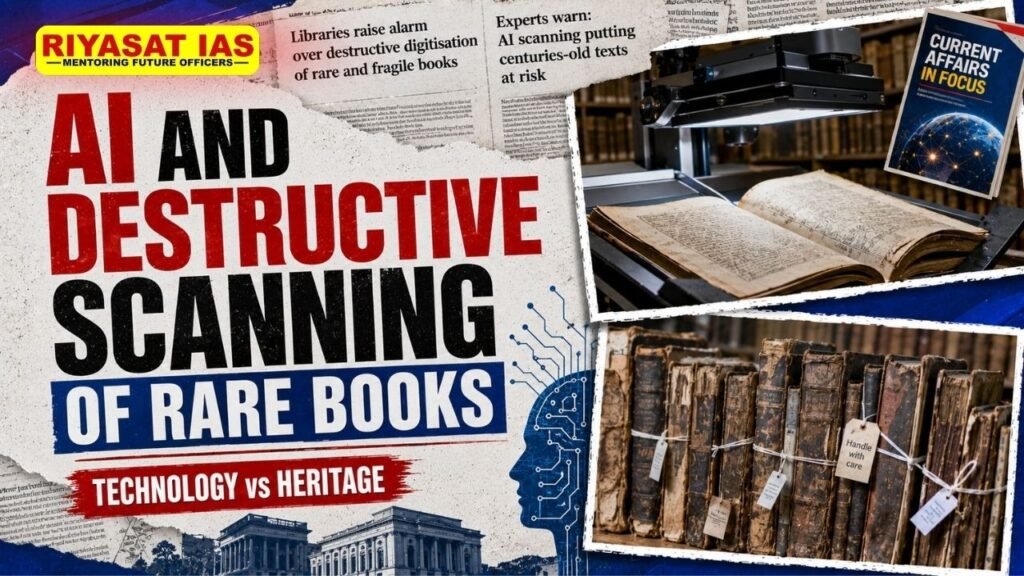
GS-III: Science & Technology | Artificial Intelligence | Intellectual Property Rights | Digitalisation
GS-IV: Ethics | Technology and Society | Cultural Heritage
Context
- 404 Media Investigation: An investigation published by the technology outlet 404 Media tracked a shipment of rare books to an Amazon facility in Las Vegas.
- Destructive Scanning: Instead of packing and mailing the books, Amazon employees reportedly cut off their bindings to scan them.
- Wider Concern: The report triggered global outrage and criticism and highlighted concerns about the use of rare and out-of-print books for AI training.
Why Are AI Companies Sourcing Physical Books?
- AI Training: AI companies seek access to more written works to develop AI models and train them on high-quality datasets containing original material.
- Internet Saturation: As the internet becomes increasingly saturated with AI-generated language patterns, rare and out-of-print books are becoming attractive sources of original textual material.
- Amazon’s Position: Amazon did not directly address the destructive scanning practices but confirmed that it bought books to improve its “products and services.”
- Not an Isolated Case: Amazon is not the only company associated with destructive scanning.
Anthropic’s “Project Panama”
- Anthropic: The Google- and Amazon-backed maker of the Claude family of models reportedly had a project known as “Project Panama.”
- Objective: It was described as an effort to “destructively scan all the books in the world.”
- Competitive Advantage: Focusing on rare books creates an additional strategic advantage.
- Data Exclusivity: The company that sources and digitises the content first can destroy the physical original, making it harder for an AI competitor to obtain and train on the same text.
Is Destruction Necessary for AI Scanning?
- Problem with Traditional Scanning: Photocopying or scanning thick and old books can be difficult because of the book’s spine.
- Risk to Rare Books: Pressing down hard to flatten a book can damage rare or delicate volumes.
- Non-Destructive Alternatives: Archivists, librarians and researchers use advanced scanners that can digitise books without damaging them.
- Robotic Scanners: Some systems can even lift and turn pages automatically.
- Cost: These technologies can be expensive and difficult to scale.
- Destructive Scanning: The binding is cut off and pages are rapidly scanned.
- After Scanning: Such books cannot easily be rebound and are generally sent for disposal.



Why Destroy the Physical Book?
- Piracy Concerns: Destruction can potentially work in a company’s favour by making it harder for authors to accuse the company of promoting piracy.
- Ownership Argument: A buyer is legally allowed to destroy a rare book that they have purchased, even if its destruction is viewed as a cultural loss.
- Contrast with Pirated E-books: An AI company can face legal action if authors find evidence that it downloaded pirated e-books without paying for them.
Copyright Litigation and Fair Use
- Anthropic Lawsuit: In July, Anthropic received approval to pay $1.5 billion to settle a class-action lawsuit in which authors alleged that their copyrighted works were illegally used for AI products.
- U.S. Court Order: In an order from the previous June, U.S. District Judge William Alsup noted that Anthropic had bought millions of print copies and destroyed each print copy while replacing it with a digital version that was not shared outside the company.
- Fair Use: This print-to-digital format change was ruled to constitute fair use.
Reaction to Destructive Scanning
- Public Outrage: Booksellers, authors, creatives, collectors, readers and academics have reacted with anger and disgust to reports of AI companies destroying books.
- Alternative View: Some are not opposed to destructive scanning itself but object to companies being permitted to destroy rare books to create private digital copies inaccessible to the public.
- Public Access Debate: This creates a contrast with media-preservation platforms and shadow libraries that make digital versions of rare books publicly accessible.
Booksellers’ Dilemma
- Commercial Incentive: Global booksellers face a dilemma because they can profit, at least temporarily, by supplying rare and out-of-print books for destruction.
- Australia: Sellers in Australia have reportedly begun scrutinising bulk orders and unusual requests for rare books more carefully.
- Underlying Concern: Booksellers must balance commercial interests against the possibility that rare books are being acquired specifically for destructive scanning.
Alternative Approach: Preserving Rare Books
- Elon Musk: Elon Musk, whose AI company is developing the Grok family of models and tools, rejected potential accusations that his company was destroying rare books.
- Preservation Approach: He stated that the team had been asked to preserve rare books in a library and scan them without cutting off the spine.
- Key Principle: This demonstrates that AI development and physical preservation of cultural material need not necessarily be contradictory.
Broader Concerns
- AI Transparency: The process of building AI models continues to lack transparency.
- Shift in Data Sources: AI firms may be moving from downloading popular books towards sourcing and scanning rare and out-of-print books.
- Cultural Heritage: Destructive scanning raises concerns about the loss of undiscovered works of literature.
- Public Access: Another concern is whether culturally valuable material should remain locked inside private AI datasets after digitisation.
- Ethical Question: The issue is therefore not merely about technological efficiency but also about preservation, ownership, copyright and access to cultural knowledge.
Key Concerns
- Cultural Destruction: Destruction of rare physical books can result in an irreversible loss of cultural heritage.
- Copyright: AI training raises continuing questions concerning the use of copyrighted works.
- Transparency: Limited disclosure about training datasets makes accountability difficult.
- Private Control: Digitised cultural material may become inaccessible to the public when held exclusively by private AI companies.
- Competitive Exclusivity: Destroying the original may make it harder for competing AI companies to access the same material.
- Commercial Incentives: Booksellers may face incentives to supply rare books for destruction.
Way Forward
- Non-Destructive Digitisation: Prefer advanced scanning technologies that preserve the physical book.
- Rare-Book Protection: Give special consideration to rare and culturally significant books.
- Transparency: Improve transparency regarding the sources of AI training datasets.
- Copyright Compliance: Ensure that AI development respects applicable copyright protections.
- Preservation: Digitisation should complement, rather than replace, preservation of physical cultural heritage.
- Public Interest: Develop mechanisms that balance AI innovation with cultural preservation and public access.
Conclusion
The controversy over destructive scanning highlights a deeper tension between AI development and the preservation of cultural heritage. While physical books may provide high-quality and original training material, destroying rare works to create private digital copies raises questions of copyright, transparency, cultural preservation and public access.
The challenge is therefore not to prevent AI companies from digitising books, but to ensure that technological advancement does not come at the cost of irreversible cultural loss. Non-destructive digitisation, greater transparency and stronger preservation practices can help reconcile AI innovation with the protection of literary heritage.
UPSC Mains Practice Question
Q. “The rapid development of Artificial Intelligence is creating new tensions between technological innovation, copyright protection and cultural heritage.” Discuss in the context of the destructive scanning of rare books.




 Ravi Raaz
 Hassan Khan
 Shadab Ali