
GS-II | Indian Polity | Representation of the People Act, 1951 | Electoral Reforms | Accountability and Transparency | Judiciary
Introduction
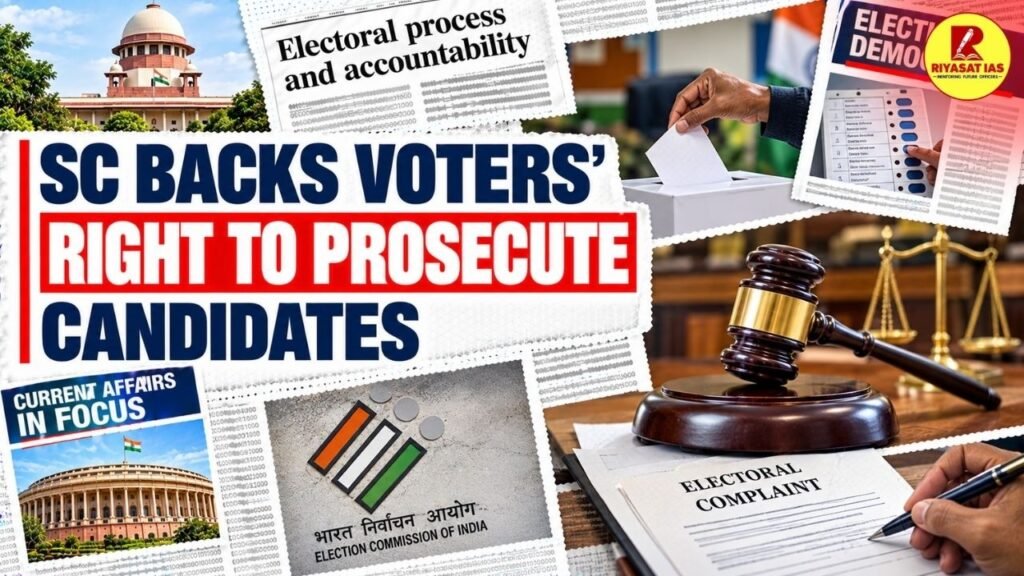
- Supreme Court ruling: The Supreme Court of India ruled in a recent decision that average private citizens are allowed to initiate a criminal complaint against election candidates who provide false or misleading information when filling out their nomination forms to run for office.
- Judgment by the Bench: The judgement of the bench of Justices Dipankar Datta and Sheel Nagu indicated that there is no requirement in law for only public servants or other competent authorities to make complaints against individuals running for election.
- Significance of the decision: The decision of the court provides the individual who is a vigilant citizen-voter the ability (locus standi) to initiate direct action against fraud within the process of elections and provide transparency to the voting process starting at the time that nomination papers are submitted.
Personal Affidavits
- Filing of personal affidavits: The filing of personal affidavits by candidates is a requirement of the process of submitting their nomination papers.
- Purpose of Affidavits: Senior Advocate Sanjay Nuli, representing the petitioners, stated that these affidavits were filed as part of legislative measures to ensure the integrity of the election process and the preservation of a democratic system.
- Voter Awareness: Voters should have knowledge and understanding of the competing candidates; this would include knowledge of each candidate’s wealth, level of education and past criminal activity.
- Offence under Section 125-A: Under section 125-A of the Representation of People Act, 1951, providing false details or concealing personal information to mislead voters, will be considered as a non-cognisable and bailable offence.
- Punishment: A guilty person is subject to being imprisoned for up to 6 months, fined, or both under the Section.



Interpretation of Section 195 of the Code of Criminal Procedure (CrPC)
- Scope of Section 195 of CrPC: The scope of section 195 of CrPC is interpreted as follows; Justice Datta has stated that section 195 of CrPC which states that only a complaint filed by a public servant can be taken cognisance of by a court of law does not apply to section 125-A of the 1951 Act.
- Legislative intent: The Court stated that, “If the legislature had intended that a court can only take notice of an offense committed in connection with providing false information in an affidavit filed by a candidate during an election for the purpose of getting elected, when the complaint is made by a public servant, it would have been possible for the legislature to amend Section 195 CrPC.”
Interpretation
- Right of Individuals to Lodge Complaints: “No court would be restricted from entertaining a complaint filed against a person for having committed an offense under Section 125-A, even if that complaint is made by a private individual. This view is further supported by the fact there is no law which provides that a complaint regarding an offense under Section 125-A may only be filed by a public servant,” Justice Datta, the author of the judgment, ruled.
Way Forward
- Empower the active citizen voter: Empower the active citizen voter to have standing to take action directly against dishonesty in election politics.
- Promote voter awareness: Voters should have knowledge of and understanding regarding the competing candidates. This includes the candidates’ assets, educational background and criminal record.
- Ensure transparency: Ensure transparency in polls right from the stage of filing nominations.
Conclusion
- The court’s decision gives the watchful citizen/voter the ability to directly challenge dishonesty in political elections and provide transparency in voting procedures from the time that candidates are nominated.
- The affidavits used to support legislative action were intended to help ensure the integrity of our election process, which is essential to the health of our democracy.
UPSC Mains Practice Question
Q. Discuss the significance of the Supreme Court judgment allowing private citizens to file criminal complaints against electoral candidates for furnishing false information or concealing information in their nomination papers.
Improve your essay writing with the UPSC Essay Foundation Course by Riyasat IAS Mentorship. Learn structured answer presentation, develop analytical thinking, and prepare effectively for UPSC Mains 2027–2028.




 Ravi Raaz
 Hassan Khan
 Shadab Ali