
GS-III | Indian Economy | Macroeconomic Policy | Investment
Introduction
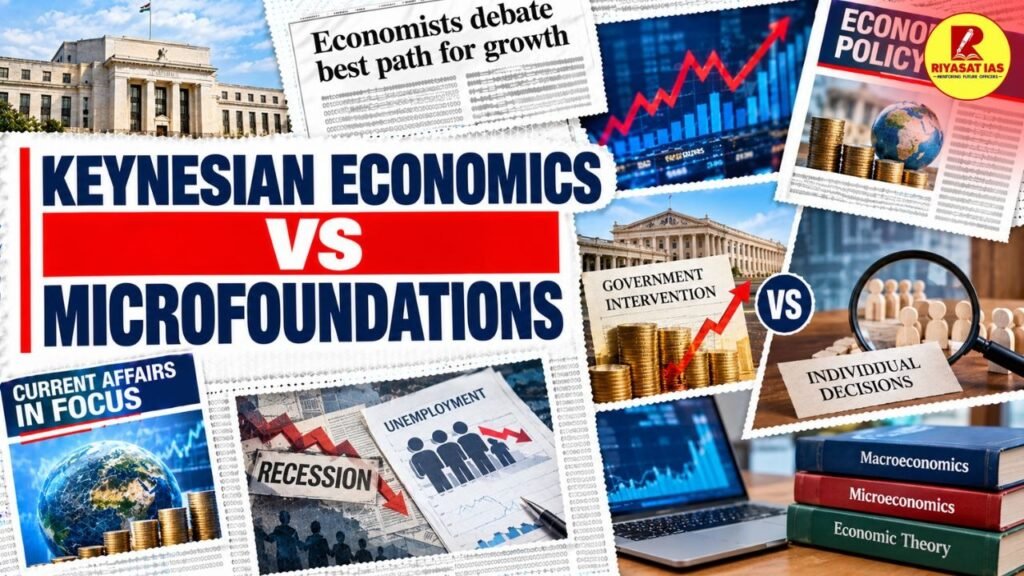
- Robert Hall and Michael Woodford used models of individual agents’ decisions to represent the macro-economy.
- The aggregate economy can’t be explained by looking at what every single person does, according to Keynes.
- Heterodox economics examines the structure of the overall economy as opposed to its individual parts.
1. Investment and Interest Rates
- Microeconomics: Focuses on how individuals make choices that are best for them, whereas macroeconomics looks at how all of those choices add up.
- Hall & Woodford:
- Made a connection between interest rate changes and the amount of money spent on goods/services today and how much is saved for later.
- High interest rates cause people to save more now, which means they spend less on goods/services now.
- Limitations: The microfoundational approach was able to relegate highly variable investment expectations to the background, and it made the assumption that saving would result in an increase in consumption demand in the future.
- Keynes’s Argument: In addition to the fact that not all saving is done to fund future consumption, Keynes also argued that investment decisions made by business owners are based upon their expectations of profit.
- Savings and Investment:
- The level of income determines whether saving equals investing.
- An increase in investment increases income which in turn results in an equal increase in saving.
- Policy Implications: It is business investment (not just consumer spending) that drives the economy’s output and employment levels.



2. Class and Macroeconomic Policy
- Economic Instability: The uncertain nature of an economy’s stability causes investors to act like animals in a herd, putting money into investments when the economy is booming and pulling it out when the economy is in a recession.
- Financial Behaviour: The explanation of the role played by the financial behavior of businesses in causing both the housing boom and the 2008 recession was provided by Hyman Minsky and Jan Kregel.
- Individual Well-being: Keynes’ view of how profit expectations drive business decisions could negatively impact individuals’ well-being.
- Class Structure: Mainstream microeconomic models assume that individuals differ on a small number of characteristics, ignoring differences in capital ownership and individual investment choices.
- Heterodox Economics: Analyzes the relationship between the larger economic system and its dynamic characteristics.
Way Forward
- Examine companies’ investment behaviour to understand economic instability.
- Recognise the role of business investment in output growth and employment.
- Consider the wider economy and how capital is distributed among individuals or groups within the context of macroeconomics.
Conclusion
- The way that the economy functions is determined by the form it takes.
- Uncertainty regarding the future of businesses and their investment choices, according to Keynesian economics, affects the stability of the economy and the well-being of individuals.
UPSC Mains Practice Question
Q. “Macroeconomic stability depends not merely on individual choices but also on business investment and the structure of the economy.” Discuss.
Prepare smarter for UPSC 2027–2028! Strengthen your understanding of Economics and current affairs with expert guidance through our UPSC Mentorship Program. Start your preparation today!





 Ravi Raaz
 Hassan Khan
 Shadab Ali