
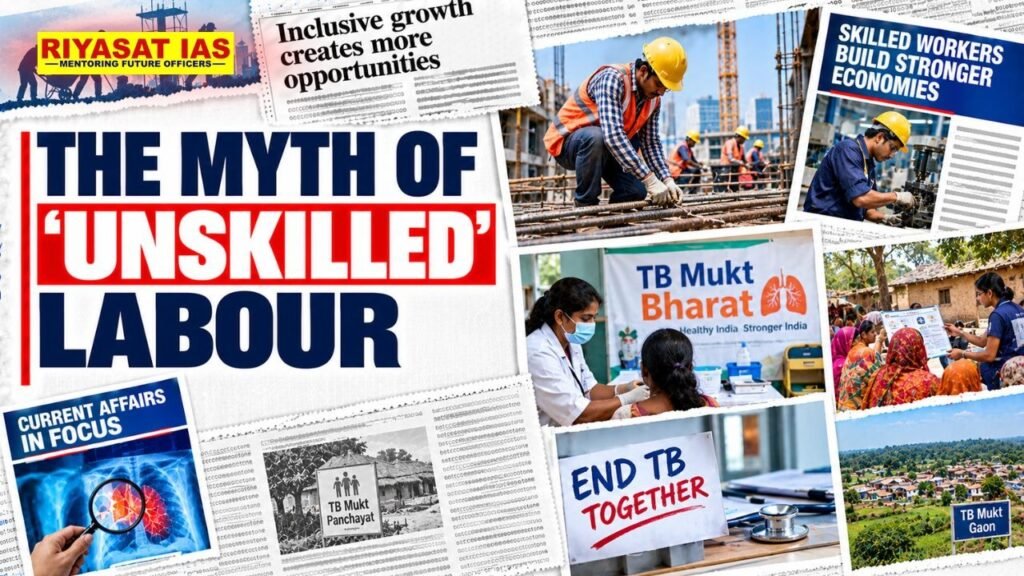
GS-II | Social Justice | Vulnerable Sections | Labour Rights | Government Policies and Interventions
Why in News?
- According to the Safe in India Foundation, in 2024, unskilled employees with monthly earnings of less than ₹8,000 in the automobile industry had an average of 2.27 fingers injured per accident, compared to 1.54 fingers for skilled employees earning more than ₹20,000 per month.
- In early 2018, thousands of workers in the manufacturing sector protested against wage increases that were not happening or had been frozen in Noida and New Delhi.
- The Uttar Pradesh Government responded by offering an immediate pay raise of ₹13,690 per month to “unskilled” workers and ₹16,868 per month to “skilled” workers, even though both groups were experiencing the same inflationary pressures.
Exploitation of ‘Unskilled’ Workers
- Wage Theft: The International Institute of Migration and Development (IIMD) in Thiruvananthapuram, India, found that unskilled migrant workers in Kerala’s construction and hospitality industries experienced 40% greater wage theft than their skilled counterparts. This finding was based on its assessment of migrant workers employed in these two industries.
- Denial of Benefits: Factories use the label “unskilled” to deny employees annual salary increases, healthcare benefits and training on workplace safety.
- Workplace Injuries: According to the Safe in India Foundation’s report, “unskilled” workers experience more severe injuries because employers frequently require them to operate hazardous power presses while providing little or no training and protective equipment.
- Contractual Exploitation: Contractors refuse to provide construction workers with proper protective clothing or pay their last month’s salary because they know that workers do not have access to legal assistance.
- Occupations with Hazards: Sanitation workers have no protection against injuries in hazardous occupations.
The Nature of ‘Unskilled’ Work
- State-Maintained Status of Unskilled Labour: The state maintains the status of “unskilled” labour, which does not naturally occur within society.
- Practical Skills: Employers across many industries expect employees who may be referred to as “unskilled” to possess a variety of practical skills, including:
- Working with construction materials and coordinating the work of others.
- Finding errors or inconsistencies in completed products.
- Operating hand and power tools efficiently and placing materials accurately.
- Adhering to established specifications while producing the same item repeatedly.
- Solving routine production problems and responding appropriately when a process problem arises.
- Disposing of human waste appropriately.
- Performing tasks safely in confined areas and being aware of hazardous gases and other potentially harmful situations.



Stratified Labour Market
- Occupational and Social Category: Skill in India is now both an occupational and a social category. Workers acquire considerable knowledge through experience, but institutions continue to regard them as “unskilled” because they lack the educational credentials required to identify and compensate for their skills.
- Social Stratification: India’s labour force continues to be divided on the basis of caste, class, gender and, increasingly, migration. These factors affect how “skilled” jobs that pay well are defined.
- Rise of the Informal Sector: The rise of informal employment, such as cities using private contracting companies to employ sanitation workers, has weakened the connection between an individual’s skills and their level of employment.
- Economic Production and Job Security: Economic production relies on the efforts of millions of workers, but this process does not enhance their employment security.
Minimum Wages and Skill Classification
- Code on Wages: The Code on Wages states that governments must consider a worker’s skill level and geographical area, as well as whether the job is physically demanding or dangerous, when determining minimum wages.
- Minimum Wage Floor: The Union’s wage schedules provide a minimum floor for employees performing similar tasks.
- Agricultural Wage Rates: In September, daily wages in urban areas with a high cost of living were ₹528 for unskilled labour, ₹578 for semi-skilled labour, ₹627 for skilled labour and ₹694 for highly skilled labour.
- Classification of Unskilled Agricultural Labour: The government defines unskilled agricultural labour as tasks involving manual irrigation of crops and weeding, requiring “only” manual labour without skill, experience or decision-making.
- Highly Skilled Jobs: Highly skilled jobs require the use of sophisticated technology to solve problems. For example, a person with highly skilled training would know how to calibrate a combine harvester or manage a pest-related problem.
- Agricultural Skills: Weeding and watering are learned skills that require workers to identify weeds, evaluate soil conditions, use equipment without damaging plants and plan their work according to the weather.
Consequences of Skill Classification
- Concentration in the Informal Sector: India’s focus on formal institutional recognition results in an excessive concentration of “unskilled” workers in the informal job market.
- Limited Access to Qualifications: Workers with lower earnings may find it difficult to acquire educational credentials from an institution or move away from unstable employment.
- Precarious Employment: Employers are less likely to provide training or ensure safety for workers in precarious jobs.
- Self-Reinforcing Classification: Lower wages reduce workers’ opportunities to acquire institutional qualifications and avoid precarious work. At the same time, employers are less likely to invest in the education and safety of employees in precarious jobs.
Way Forward
- Recognition of Skills: Workers acquire considerable “embodied knowledge” through work experience, but many organisations continue to view them as “unskilled” because they lack formal credentials that would allow their skills to be recognised and compensated.
- Fair Wage Requirements: The Code on Wages states that governments must consider workers’ skill levels when determining fair wages. Other factors include geographical location, the physical demands of the job (arduousness) and the potential dangers associated with the work (hazard).
- Workplace Safety: Employers should not allow employees to operate dangerous power presses without adequate training or safe ways to use them.
- Protection from Exploitation: Contractors must provide construction workers with the required personal protective equipment and pay their last month’s salary.
- Training and Safety: Employers are less likely to provide training or invest in employee safety when employment is precarious.
- Employment Security: Economic output depends on the employment of millions of workers, but their jobs do not have a higher level of security.
Conclusion
- The stratification of India’s labour market by caste, class, gender and increasingly, migration, determines which types of labour are classified as “skilled” and thus well-paid.
- Wage classifications can create a vicious cycle: low wages prevent workers from affording institutional training or finding stable employment. At the same time, an unstable work environment creates less incentive for employers to spend money on employee training and safety.
UPSC Mains Practice Question
Q1. In what ways does the categorisation of “unskilled” employees contribute to labour market stratification and the exploitation of workers at work in India?
Turn UPSC Current Affairs into Mains-Ready Answers!
Understand important issues such as labour rights, informal employment, skill development, and inclusive growth with a structured UPSC preparation strategy. Join the Riyasat IAS UPSC Mentorship Program 2027–2028 to strengthen your GS preparation and improve your answer-writing skills.
Explore the program: UPSC Mentorship Pogram 2027




 Ravi Raaz
 Hassan Khan
 Shadab Ali