
GS-III | Agriculture | Food Security | Nutrition | Technology | Inclusive Growth
Why in News?
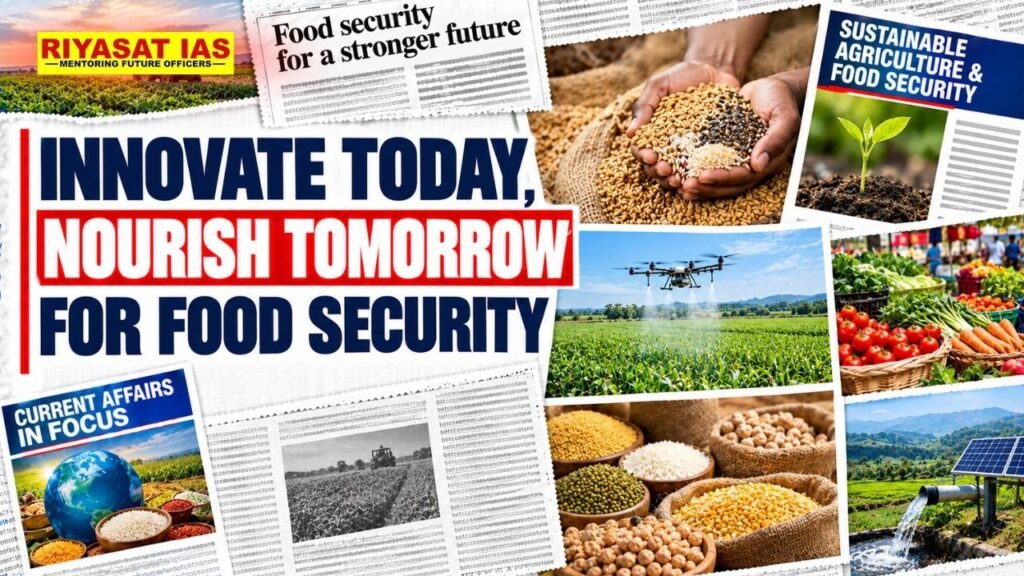
- World Food Day will be celebrated annually on October 16th and its theme for 2026 is “Innovate Today, Nourish Tomorrow.”
- There are 645 million people experiencing hunger today, and 33 percent of the global population does not have enough money to purchase a healthy meal.
- Hunger is caused by major drivers including climate related risks, economic shocks and food-price inflation, and conflicts that disrupt agricultural production and supply chain.
From Scarcity to Surplus and Nutrition
- Green Revolution: The Green Revolution produced higher-yielding crops, provided irrigation systems, and guaranteed farmers a set price for their produce, which greatly expanded cereal production in India and formed the foundation for India’s public distribution system (PDS) and nutritional program.
- National Food Security Act (NFSA), 2013: The National Food Security Act of 2013 is intended to provide subsidized food grains to up to three-quarters of the country’s rural population, and one-half of its urban population. This means that a total of about 810 million people across the nation will receive subsidized food grains.
- Pradhan Mantri Garib Kalyan Anna Yojana (PMGKAY): The Pradhan Mantri Garib Kalyan Anna Yojana (PMGKAY) has distributed free food grains since Jan 2024. The duration of this program was extended through 2028.
- Targeted Public Distribution System (TPDS): Strengthened through digitalized ration cards, Aadhaar seeding and the One Nation One Ration Card program, allowing migrant workers to receive their food grains anywhere in the country.
- Emerging Areas of Interest: Technology, Data and Finance Will Help Farmers Become More Resilient, Resource Efficient, Viable and Have Better Access To Food Distribution.
Role of International Organisations
- Food and Agriculture Organization (FAO): The Food and Agriculture Organization (FAO) develops advisory Roadmaps to support Digital Agriculture and provides training to Front-Line Extension Workers. In addition, the FAO has developed the Clean Milk Scorecard which enables farmers to evaluate their practices for Cattle Management, Hygiene and Milk Production.
- FAO – Food Loss Management: Measures food losses, assesses their environmental impact and promotes composting, bioenergy and recycling as ways to increase resource efficiency and farmer income.
- International Fund for Agricultural Development (IFAD): The International Fund for Agricultural Development (IFAD) uses what is called “finance plus,” which combines production, access to markets, financing, and small-scale infrastructure development as a means of attracting investments from both the public and private sectors in developing countries.
- IFAD — Investment Impact: For each dollar that IFAD invests into India it attracts over three dollars of other investments. Projects that are supported by the private sector yield a 64 percent increase in income for participants, which is four times greater than projects that are not supported by the private sector.
- The World Food Programme (WFP): Works on improving the way that public food is distributed by working with Grain ATMs, optimizing supply chains and developing solutions in collaboration with the Public Services Lab of IIT Delhi.
- WFP-Nutrition: Promotes a variety of foods in people’s diets; increases the quality of the food people eat (the “basket”); and incorporates nutrient rich millets and other nutri-cereals, especially for children and pregnant women.



India’s Blueprint
- Global South: India’s experiences can provide flexible approaches for other countries that are experiencing climate change, conflict, and economic instability.
- Climate Resilient Agriculture : Support the growth of climate-resilient and bio-fortified crop varieties for improved food security and nutrition.
- Beyond Food Sufficiency: The shift from being able to feed oneself to having a diet that provides proper nourishment, includes variety in foods consumed and creates a more fair food system.
- Smallholder Centered Development: Develop value chains which provide rewards to smallholders and increase market access for smallholders.
- Women-Centric Innovation: Make certain that all innovations continue to be both supportive of smallholders and positive toward women.
- Traditional Knowledge and Science: The combination of traditional knowledge and scientific advancement will help create large scale agricultural solutions.
Way Forward
- Expand on Innovation: Utilize new technologies, data and scientific breakthroughs to increase productivity in farming and make our food system more resilient.
- Strengthen food distribution: Enhance the performance, availability and convenience of food benefits.
- Promote Climate Resiliency: Support Climate Resilient and Bio-Fortified Crops to help reduce the impact of Climate-Related Agricultural Risks.
- Reduce Food Waste: Increase tracking of waste; monitoring of waste; composting of waste; energy generation from organic wastes; recycling of packaging and other items.
- Improve Nutrition: Promote dietary diversity and nutrient dense millets and other nutri-cereals to improve nutrition.
- Mobilise Investment: Mobilize investments; combine financing, infrastructure development, manufacturing processes, and markets for products to encourage investment from both government and private sectors.
- Ensure Inclusiveness: Build upon smallholder farmer income, increase women’s involvement, and develop equitable value chains.
Conclusion
- In celebration of World Food Day, we renew our commitment to working together with India to develop innovative solutions now, which will help us produce food for generations to come.
UPSC Mains Practice Questions
Q. Although India has made significant strides towards increasing foodgrain production, it continues to face issues with both food security and nutrition. How can innovation help create resilient and fair food systems?
Prepare smarter for UPSC with Riyasat IAS Mentorship! Strengthen your GS Paper 3 preparation with current affairs, agriculture, food security, and answer-writing practice. Join our UPSC Mentorship Program 2027 to build conceptual clarity and improve your Mains answer-writing skills.




 Ravi Raaz
 Hassan Khan
 Shadab Ali