
GS-III: Employment | Skill Development
Why in News?
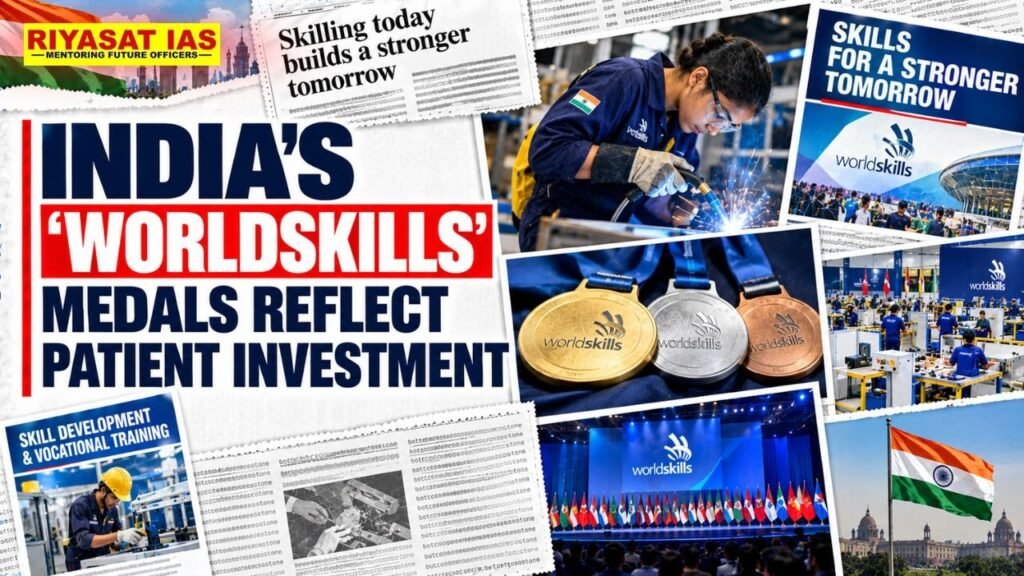
- WorldSkills Competition 2026: Prime Minister Narendra Modi recently met India’s medal winners at the 48th WorldSkills Competition, held in Shanghai, China, in September 2026.
- India’s Achievement: India secured 10th position for the first time, with six silver medals and 20 Medallions for Excellence — 26 medals in all, its largest haul ever.
- Recognition of Skills: The achievement has encouraged Indian families to reconsider skilling as a career path deserving the same honour as any other.
Importance of Skill Development
- Dignity of Labour: As we read in the Bhagavad Gita (18.46), sva-karmana tam abhyarchya siddhim vindati manavah — a person attains perfection by worshipping through his own work.
- Place of Craftsmanship: A workbench, kitchen, or workshop floor can be a place of devotion. A craft done with care is itself a virtue rather than just a source of income.
- Equating Skilled Professions: Skilled professions are at par, and a podium won at the workbench is every bit as tall as that earned in the exam hall.
- Transforming Societal Attitudes: WorldSkills achievers from India have been a catalyst for the acceptance of vocational education and have demonstrated to families that it is heroic in nature.
IndiaSkills: The Talent Development Process
- Active Participation: More than 3.65 lakh youth registered under IndiaSkills in this cycle and across 63 skills.
- Regional Competitions: Five regional competitions led to around 650 national finalists.
- National Finals: 70 competitors were selected from the national finals in Greater Noida, UP, to represent India.
- Inducing Importance: The Ministry of Skill Development and Entrepreneurship, the National Skill Development Corporation and States, along with industry experts, have focused on upskilling youth.
- Whole-of-Government Approach: The achievements are reflective of a process that is strategic and integrated to identify and cultivate talent all the way from district levels, through various State and regional rounds, to the national finals.



Skill-Ex: The New Paradigm of Investment
- Capital Expenditure (Capex): Since time immemorial, nations have been measuring their growth through investment in roads, ports and factories.
- Operational Expenditure (Opex): Opex is the cost to operate these assets.
- The Third Dimension — Skill-Ex: India is adding a third dimension through intentional investment in the people behind every successful asset.
- Complementary Investment: Capex builds assets, Opex keeps them running, and Skill-Ex creates the human energy that keeps those assets productive.
- PM-SETU Scheme: The Pradhan Mantri Skilling and Employability Transformation through Upgraded ITIs scheme is Skill-Ex at scale.
- Spending: Under the ₹60,000-crore scheme, 1,000 government Industrial Training Institutes (ITIs) are being upgraded.
- Hub-and-Spoke Model: ITIs will be developed along 200 hubs and 800 spokes and managed by industry partners for the clusters.
Need for Greater Industry Participation
- Role of Industry: Industry needs to participate in this skilling exercise and invest in Skill-Ex with the same kind of seriousness that it invests in its Capex and Opex.
- Productivity: A factory is only as good as the people in that factory.
- Robust Human Capital: Investment in skills creates the human resources necessary to keep assets working.
- Dignity of Work: A country is created not only through people who design and govern, but also through the work of those who weld, bake, paint and wire with care.
- Social Recognition: Move skilling on par with degrees, and youth can invest wherever they want to grow.
Conclusion
India’s success at WorldSkills bears testimony to the returns from decades of careful cultivation of human capital through enablement and sustenance, directed policies with institutional participation and a hands-on training approach. PM-SETU and greater industrial participation are schemes that can cement the relationship between skills and productivity through the Skill-Ex route. The recognition of the dignity of labour and the spirit of valuing skills as much as a degree are what can make India emerge on its way to becoming the skilling capital of the world.
UPSC Mains Practice Question
Q. It is not just another 50–100 billion USD market opportunity for employment generation, but an investment in human capital and increasing productivity of India as a nation. Elaborate in the context of what India has achieved in WorldSkills and via the Skill-Ex approach.
Prepare Smarter with UPSC Current Affairs Mentorship
Stay updated with important national and international developments and learn how to connect current affairs with the UPSC syllabus, Prelims, and Mains answer writing.
👉 Join the UPSC Current Affairs Mentorship Program for structured current affairs analysis, expert guidance, answer-writing support, and personalised preparation.
[Explore UPSC Mentorship program 2027 →]




 Ravi Raaz
 Hassan Khan
 Shadab Ali