
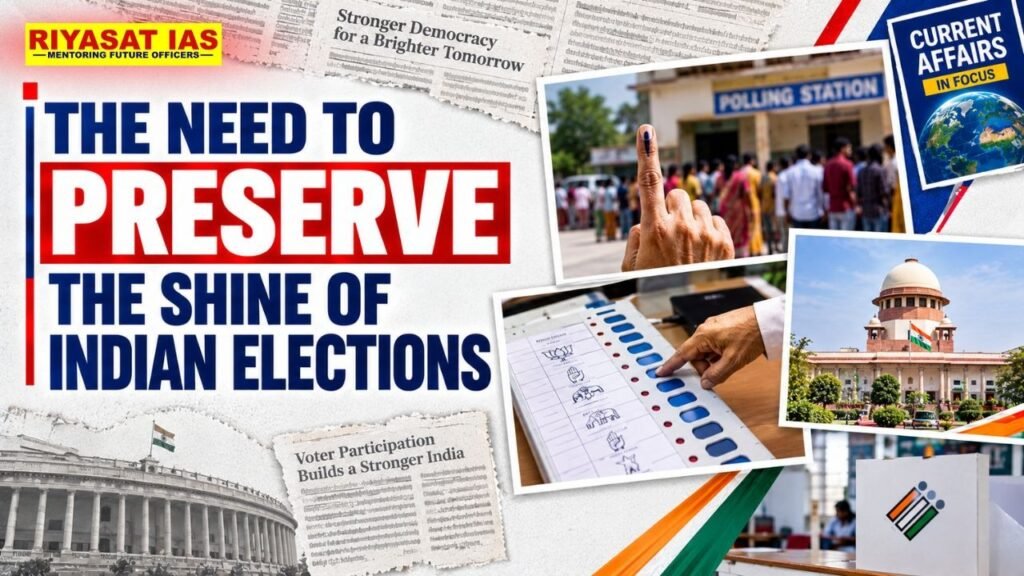
GS-II | Indian Polity and Governance | Election Commission of India | Electoral Reforms
Core Concern
- The ongoing and relentless protest in front of the Election Commission of India (ECI) has led to an even larger question: is the highly acclaimed Indian election process beginning to lose its luster?
- During the past year, the Special Intensive Revision (SIR) of electoral rolls and the way they were managed has generated considerable controversy, as well as being subject to scrutiny, legal action, and protest.
- The disease affecting the Indian electoral process is much larger.
- The long-standing perception that elections in India are one of its top soft powers seems to be losing its luster.
- Not only election managers, but the executive branch, legislative branch, judicial branch, winners of elections and losers of elections, and all members of the voting public have a responsibility to act as remedies to these problems.
Election: India’s Best Asset
- Stable Democracy: The Indian nation has been able to establish stable democracy through popular and credible elections that provide the basis for effective governance, post-colonial reconstruction, economic growth, and the ability to defend itself from external threats.
- Equal Franchise: The voting rights exercised by people with illnesses, elderly people, and people with different social and economic status than others is an essential element of the electoral history of India.
- Women’s Participation: The current trend of female participation in voting has contributed to strengthening India’s election system.
- Public Confidence: Even though there was a great deal of poverty and illiteracy in India when it became an independent nation, most common people came to understand how much power their vote had, and they developed confidence in the election system.
- Constitutional Basis: Dr. Bhimrao Ambedkar and the other members of the constitutional committee formed a framework for the establishment of a system of government that was based on the principles of parliamentary democracy.
- Role of ECI: The credit for the success of the process goes to the entire ECI system, which begins with Nirvachan Sadan in New Delhi and ends with over one million polling booths throughout the country.
- Scale of Elections: There were approximately 98 crore eligible voters throughout India’s diverse geographical regions during the 2024 general election.
- Global Recognition: The size of the job, the amount of money spent on transport, and the skill with which it is disposed of has amazed many advanced countries.
- IIIDEM: The ECI has established the IIIDEM, or the India International Institute of Democracy and Election Management, as a place for learning about how to conduct a perfect election.
Concerns in the Future: Decreasing Confidence in the Voting System
- Partisan Allegations: There are long-standing allegations regarding the partisan behavior of the electoral commission, and there have been strong complaints, even bordering on non-acceptance of the election outcome.
- Decline of Democratic Values: The argument that the loss of democratic values in general is a worldwide phenomenon, including losses within some of the most advanced democracies like the United States, does not provide any relief.
- Changing Public Response: While elections have always been highly competitive, the outcome of elections in the past was generally accepted by the public without much protest. That is no longer true.
- Institutional Distrust: Distrust of institutions, as expressed through the rhetoric of highly polarized political groups, may be transmitted to average citizens and lead to feelings of despair.
- Trust Gap: Although Sukumar Sen (the Chief Election Commissioner) had to overcome a tremendous amount of logistics when he ran the very first election in independent India in 1951, he did not experience a problem with trust.
- Current Situation: After 75 years of experience with ever-expanding resources, the logistical challenges involved in organizing large-scale elections are now commonplace; however, there is an increasing loss of confidence among the public.
Changing Nature of Electoral Malpractices
- Digital Fraud: As election processes become increasingly digitalized and automated, electoral fraud will continue to evolve into new forms that have never been seen before. While many traditional methods of electoral fraud may be phased out due to the ease with which digital systems can prevent them (e.g., electronic voting machines make it very difficult for someone to physically alter a ballot), new types of digital fraud will emerge.
- Digital Vulnerabilities: Digital systems are inherently vulnerable to hacking and manipulation; therefore, as elections are conducted digitally, there is a greater risk of fraudulent activity occurring online.
- Foreign Interference: This includes not only the potential for individuals to hack into election systems to manipulate votes, but also for foreign governments to use disinformation campaigns to influence elections in other countries.
- Corporate-Sponsored Disinformation: In addition to digital fraud, there is an increased likelihood of corporate-sponsored disinformation campaigns designed to influence voters in a particular direction. These corporate-sponsored campaigns would likely focus on promoting specific candidates or issues that align with the interests of the sponsoring corporation.
- Digital Transformation: Ultimately, as election processes become increasingly digitalized, we can expect to see a shift from physical forms of electoral fraud to digital ones.
- Digital War: The “digital war” has replaced ground level campaigning, such as door-to-door campaigning, as the main form of campaign battle. Digital wars include the use of rapid fire disinformation, and deepfake technology.
- Traditional Malpractices: The booths captured by those who intimidated voters, as well as the fraudulent votes cast during past decades, were confined to specific geographic areas.
- Electoral Roll Manipulation: At a greater scale, there is a risk that the electoral rolls could be manipulated by improperly giving people the right to vote or denying them that right.
- Money Power: Money power has a large amount of influence on the way elections are conducted. It can even take away from the fair playing ground that should be available to everyone in an election.
- Unreported Campaign Spending: Candidate expenditure reports filed with the ECI after an election and official party spending represent only a fraction of the total amount spent on elections, as unofficial estimates of election-related expenses are far greater than these reported amounts.
- Freebies and Cash Transfers: Free handouts (freebies) and direct payments to citizens (cash transfers), which are being promoted as “welfare” programs, have impacted both the integrity of elections, as well as the management of public funds.
- Economic Survey 2026: It is estimated that States will have a total of ₹1.7 lakh crore in additional costs due to these unconditional cash transfers.
- Impact: The bold use of money in elections via the front door is undermining the election process, as well as the candidates themselves; which is why the ECI and Supreme Court are concerned.
Subverting Elections after They Take Place and Switching Parties
- Wholesale Defection: Increasing defections weaken the public’s support of a candidate and party.
- Anti-Defection Law: The Anti-Defection Law, which was intended to control the behavior of members of political parties who switch sides or “jump ship”, has instead created a trend where large groups of legislators are moved from one side of parliament to another due to exemptions provided under the 10th Schedule.
- Opportunistic Realignments: They are the reason for making such a farce out of voter’s choices without a recall process.
- Party Switching: The frequency with which members of parliament (MPs) can leave their respective party platforms and principles behind as they switch from one political party to another, makes the “Aya Ram Gaya Rams” of the past appear to be tame angels.
- Institutional Concerns: The Speaker’s identification of parties and allocation of symbols by the ECI is a continuation of these changes that have also been subject to allegations of partisanship.
Issues Related to Institution of Election Administration
- Special Intensive Revision (SIR): The SIR was initiated 1 year prior, and has created a cloud of dust as it nears completion.
- Appointment of Election Commissioners: The appointment of Election Commissioners by means of a collegium, as provided for in the 2023 law, has had no positive impact on this issue and remains under examination by the Supreme Court.
- Regulatory Responsibilities: The regulatory role of an election commission can be seen as having four main components: the creation of voters’ lists (electoral rolls), the enforcement of the Model Code of Conduct, the publicizing of election results and the internal management of its own operations. All of these areas have been increasingly contested by political parties.
- Judicial Support: The persistence of these issues is in spite of the support provided by many of the most senior courts.
- Public Confidence: The credibility of the public’s confidence in the electoral system is threatened by both organizational conflicts and political cynicism.
Urgent, Collective Necessity
- Democratic Foundations: Elections represent, with extreme organization, the expression of “we, the people,” and therefore must never be permitted to fail.
- Avoid Political Speech: It will not help solve problems.
- Collective Responsibility: In addition to being too important to use as political footballs, collective responsibility for managing the election process should also not be used as an excuse for individual parties’ shortcomings during the campaign period.
- Systemic Fortification: The political parties must come together as an unbiased group to work towards strengthening the Indian election process through the implementation of safeguards, accountability and closing any existing structural or legal gaps.
- Three-Member Commission: The three-member commission was created to replace the single chief election commissioner in 1993, and it had the exact same purpose.
- Political Funding: The regulation of political funding should be improved; the issue of “freebies” needs to be addressed.
- Criminalization: There needs to be protection of the electoral process against being criminalized.
- AI-Enabled False Stories: AI enabled false stories need to be dealt with.
- Protection from Inducements: Voters and candidates should have protection from any inducement when performing their democratic duties.
- Beyond Party Lines: To prevent additional decline requires a joint effort that extends beyond partisan interests.
- Restoring Confidence: First and foremost, confidence must be restored to the system.
Conclusion
Elections are the most organized way for “we, the people” to express our will and have given India stability, government and a way forward toward progress. But as the issues of electoral rolls, money power, defections, digital disinformation, and institutional distrust threaten the credibility of elections, restoring public confidence in them will require a collective, non-partisan effort to establish stronger protections against abuse of power, accountability and electoral integrity.
UPSC Mains Practice Questions
Q1. The Indian election process has provided a stable foundation for democracy in India as well as an important aspect of India’s soft power. Concerns regarding the credibility of elections and the trustworthiness of institutions that are responsible for conducting elections pose a serious threat to the history of the Indian electoral system. Please examine the problems with the Indian electoral system and provide solutions to regain public confidence in the electoral system.
Prepare Smarter for UPSC with Riyasat IAS Mentorship!
Stay updated with current affairs, strengthen your GS Paper 2 preparation, and improve your Mains answer-writing skills with personalised guidance from Riyasat IAS Mentorship.
👉 Join the UPSC Mentorship Program and take a structured step towards your UPSC CSE 2027 preparation.


 Ravi Raaz
 Hassan Khan
 Shadab Ali