
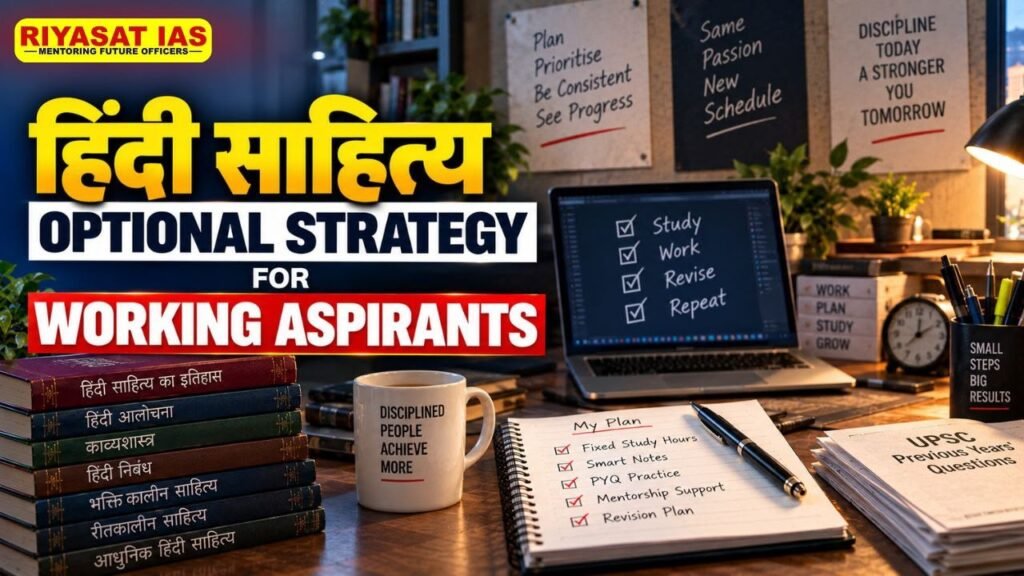
Preparing for UPSC while holding a job is hard. Preparing an optional as text-heavy as Hindi Sahitya (हिंदी साहित्य) on top of GS, Essay and Prelims can feel impossible. But many working aspirants choose Hindi Literature precisely because it suits their situation: the syllabus is static, the reading can be done in small blocks, and good answers depend on consistent practice rather than daily updates.
This guide is part of our complete guide to the Hindi Literature optional. If you are working, the Hindi Sahitya optional course with recorded classes and flexi tests at Riyasat IAS is designed to fit around a job.
This article gives you a realistic strategy — a weekly timetable, a phase plan, and the kind of course support that actually helps someone with a job.
Quick answer: Working aspirants should give Hindi Sahitya a fixed 8–12 hours a week, use weekday slots for reading texts and short answers and weekends for class recordings and longer writing, follow a phase plan that finishes the syllabus before the Prelims period, and choose a course with recorded classes, flexible tests and scheduled mentorship.
Why Hindi Sahitya Suits Working Aspirants
- Static syllabus: What you study this year remains useful in every attempt. There is no daily current-affairs load for the optional.
- Reading in small blocks: A pad of Kabir, a doha of Bihari or a chapter of Godan can be read during a commute or a lunch break.
- Overlap with Essay and GS Paper 1: Literary and social themes give you quotations and examples for the Essay paper.
- Hindi-medium advantage: If Hindi is your strongest language, you write without the extra effort of translation.
The Three Rules for Working Aspirants
(For balancing the optional with GS in general, also read how to balance the optional subject and General Studies.)
- Consistency over intensity. Ten hours every week for a year beats sixty hours in one month followed by nothing.
- Write from the first week. With limited time, you cannot afford to delay answer writing until the syllabus is finished.
- Protect the weekend. Your weekend is your main study block. Plan it in advance.



A Sample Weekly Timetable (8–12 Hours for the Optional)
| Day | Time | Optional task |
| Monday | 45–60 min | Read the original text taught in the last class |
| Tuesday | 45–60 min | Paper 1 reading (language or literary history) |
| Wednesday | 45 min | Write one short answer |
| Thursday | 45–60 min | Read critical notes on the current author |
| Friday | Rest or catch-up | Revise one-page notes |
| Saturday | 3–4 hours | Watch class recording or attend live class; make notes |
| Sunday | 2–3 hours | Write 2–3 answers or a test; review feedback |
Adjust it to your job, but keep the pattern: small weekday tasks, larger weekend blocks, and writing every week.
A Phase Plan for a Working Aspirant
Confirm exam dates on the official UPSC calendar and plan backwards.
Phase 1 — Foundation (roughly months 1–6)
- Complete Paper 1: the history of the Hindi language and Nagari script, then the history of Hindi literature.
- Start the Paper 2 poetry texts.
- Write at least two answers a week.
Phase 2 — Texts and topic-wise tests (roughly months 7–9)
- Finish all Paper 2 poetry and prose texts.
- Write the topic-wise tests for each unit you complete.
- Prepare one-page notes for each author.
Phase 3 — Prelims period
- Give most of your time to Prelims, but spend 3–4 hours a week revising the optional so it stays fresh.
Phase 4 — Mains
- Take leave if you can for the final weeks.
- Write sectional and full-length tests, rewrite weak answers, revise quotations.
What Kind of Course Support Helps Working Aspirants
Not every course is suitable for someone with a job. Our guide to the best online Hindi Literature coaching explains live versus recorded classes in detail. Look for:
- Recorded classes, so a late office day does not mean a missed topic.
- Live classes you can join when possible, for discipline and doubt clearing.
- Flexible test dates, because a fixed Sunday test will clash with office work sooner or later.
- Printable notes, so you can study away from a screen.
- Scheduled mentorship, to keep your plan realistic.
- Small batches, so the faculty knows your situation.
How the Riyasat IAS Course Fits a Working Schedule
The Riyasat IAS Hindi Sahitya optional course includes several features that match these needs:
- Online and offline modes — live sessions are streamed and all class recordings stay on the student portal.
- Flexi test format — take any of the 14 tests on any day and at any time after its scheduled date, so tests never clash with your job or GS preparation.
- 14 evaluated tests — 8 Mini Mock, 4 Sectional and 2 Full Length — with margin comments, weakness analysis, and grammar and spelling checks.
- 200 hours of teaching covering Paper 1 and Paper 2 completely, so you do not have to piece the syllabus together yourself.
- Unit-wise printable handout notes.
- 2 live mentorship sessions a month with Riyasat Ali Sir (mentoring UPSC aspirants since 2011) and Dr. Puneet Chaturvedi Sir (Ph.D. in Hindi Literature, cleared NET four times).
- Only 50 seats per batch.
Smart Habits That Save Time
- Carry a text. Keep the current prescribed text or your one-page notes with you for commutes and breaks.
- Use voice notes. Record yourself summarising a poet or a literary movement, and listen during travel.
- Keep a quotation diary. Collect two or three key lines from each author — useful for Paper 1, Paper 2 and the Essay.
- Batch your writing. Write answers in one sitting on the weekend rather than scattered across the week.
- Review before you read more. Twenty minutes revising last week’s notes is worth more than a new chapter you will forget.
Mistakes Working Aspirants Should Avoid
- Waiting for a “free month” to start the optional.
- Buying too many books and reading none completely.
- Watching recordings at double speed without making notes.
- Skipping tests because the date is inconvenient — use a flexible format instead.
- Studying alone for months without any feedback.
Frequently Asked Questions
Can a working professional prepare Hindi Literature optional?
Yes. The static syllabus and text-based nature of Hindi Sahitya make it well suited to steady, part-time preparation, provided you study every week and write regularly.
How many hours a week should a working aspirant give to the optional?
Around 8–12 hours a week during the foundation phase is a practical target for most working aspirants, with more time after Prelims.
What if I cannot attend live classes?
At Riyasat IAS, recordings of all classes are available on the student portal, and tests can be taken on any day and time after their scheduled date.
Plan Your Preparation With a Mentor
Book a free counselling session to build a timetable around your job and target year.
- Course page: Hindi Sahitya Optional — Online, Recorded and Flexi Tests
- Call or WhatsApp: +91 93196 12575 / +91 80905 28260
- Office hours: Monday to Saturday, 10 am to 7 pm



 Ravi Raaz
 Hassan Khan
 Shadab Ali