
GS-III | Science & Technology | Artificial Intelligence
AI as an Emotional Confidant
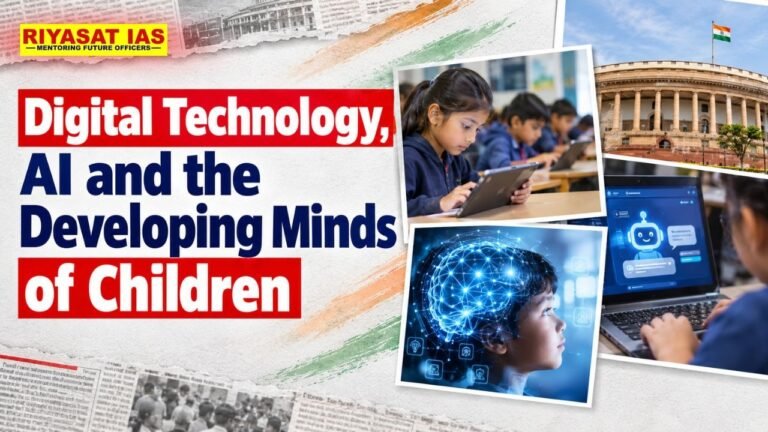
- Today’s World: However, in today’s world, that confidant is increasingly becoming an AI chatbot.
- AI Companions: Such AI companions are unwittingly forging a place in the emotional lives of children because, unlike parents and friends, these apps are always available (24/7), seem sympathetic and entirely responsive.
- Responsibility: But who takes responsibility when that relationship becomes toxic?
- Ramifications: It has corporate and political ramifications, regulatory implications and further extends to who certifies the authenticity of an AI companion.
India’s Regulatory Gap
- Digital Landscape: An army of young users marching into its digital landscape with AI based applications/chatbots are bound to change the way they interact.
- Digital Legislation: Yet, on the other hand, comparatively speaking, a lot of digital laws treat it as primarily traditional cybercrime.
- Regulatory Landscape: Although the Information Technology Act, 2000 and the Digital Personal Data Protection Act, 2023 and the Protection of Children from Sexual Offences Act, 2012 prohibit certain forms of digital danger they do not provide a comprehensive framework for identifying regulation with respect to imaging behavioural expectations that stem from AI companions.
- Emotional Dependency: A chatbot imitating a child for an extended period can be especially troubling in terms of emotional dependence, psychological manipulation, and dangerous suggestions to contribute.
- Psychological Harm: The psychological damage related to AI is particularly relevant because, unlike traditional cybercrime, when an event occurs you can trace the culprit.
- Effects: Its effects can emerge through thousands of seemingly innocent exchanges, mediated by design and algorithms.
- Investigation: India’s current laws does not enable the investigation of this new area of harm.
- Platform Accountability: This issue goes beyond government; it is about platform accountability — as the products these platforms create are finding their way into children’s emotional lives for better and worse.
Child Safety is Paramount
- Article 21: This article gives the right to life and personal liberty & article 39(f) directs that state shall in particular, direct its policy towards securing that children are not abused and that childhood and youth are protected against exploitation.
- Constitutional Principles: These constitutional principles take on new resonance in the age of AI.
- Individual Rights: These constitutional principles take on new resonance in the age of AI.
- Digital Space: Protecting children also has to involve their lives in the digital space, where their physical safety may be disturbed not only by accessing personal data but also from use of AI chatbots.
- Regulation: On the other hand, regulation needs to be tailored.
- Stifling Innovation: An overly targeted system could limit innovation, create compliance red tape for start-ups and hinder the realisation of true AI advancement.
- Environmental Impact: The goal is not to stop technological progress, good or bad, but for it to shoulder that responsibility with dignity.
Way Forward
- Age-Appropriate Protections: Reforms include age-appropriate protections, crisis-response mechanisms, independent safety audits, and active parental supervision.
- Privacy & Autonomy: Those conditions must also take into account children’s privacy, and changing capacity for autonomy.
- Regulatory Priorities: California Legislative Response Gives India Opportunity to Re-examine its Regulatory Priorities.
- India-Specific: The goal must not be to copy the U.S. law but structure a generic framework that works with India’s on-the-ground institutional strengths and digital realities.
- Investigation of Cybercrimes: Policymakers should also ask whether existing mechanisms for cybercrime investigation are suited to carry out examination of algorithmic behaviour that occurred on, and from, interactions with a chatbot — and even use those interactions as evidence find methods to impose accountability if the consequences of proximal engagement in digital spaces produce harm.
Conclusion
- Central Question: The question is no longer if children will interact with AI; they already do.
- Protection of Institutions: Whether the institutions that are responsible for their protection can keep up with technologies that are changing children and childhood.
UPSC Mains Practice Question
Q. India’s regulatory framework must meet the challenges posed by Widespread AI Companionship . Discuss.
Make Current Affairs Work for Your UPSC Mains Preparation
Connect current affairs, PYQs and answer writing with a structured UPSC mentorship plan.



 Ravi Raaz
 Hassan Khan
 Shadab Ali