
- India’s metropolitan cities are replete with:
- High compound walls.
- Podiums.
- High-rise buildings of varying heights.
- These are often clumped together without adequate spacing, affecting the wind’s speed — rougher surfaces have a greater slowing effect — and direction.
- When a wind’s flow is interrupted by tall buildings, it can instead be funnelled through narrow spaces, where it accelerates and builds up into a gust before reaching the pedestrians walking around the buildings.
- This phenomenon is called the Venturi effect and has been observed in London and Jaipur, among other cities.
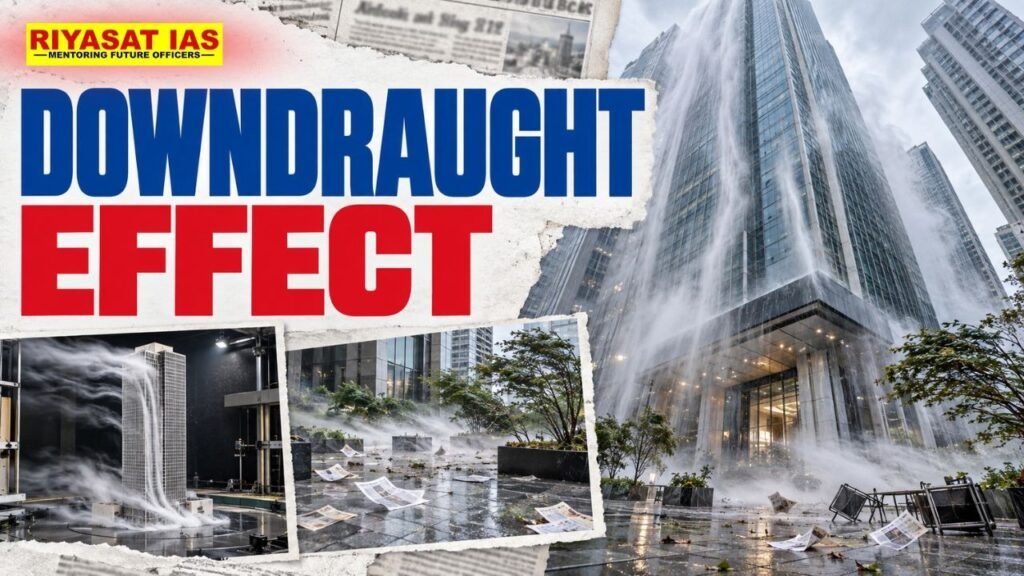
- When winds slam into high-rise buildings, they can be forced downwards along the structures in a phenomenon called the downdraught effect, which further pushes the wind lower down into stronger gusts.
Prelims Question
Q. Consider the following statements regarding the Downdraught Effect:
- It occurs when winds hitting high-rise buildings are forced downwards along the structures.
- It can push wind towards the lower levels of buildings into stronger gusts.
- It is the phenomenon in which wind accelerates while passing through narrow spaces.



Which of the statements given above is/are correct?
(a) 1 and 2 only
(b) 2 and 3 only
(c) 1 and 3 only
(d) 1, 2 and 3
Answer: (a) 1 and 2 only
- Statement 3 describes the Venturi effect, not the Downdraught effect.





 Ravi Raaz
 Hassan Khan
 Shadab Ali