
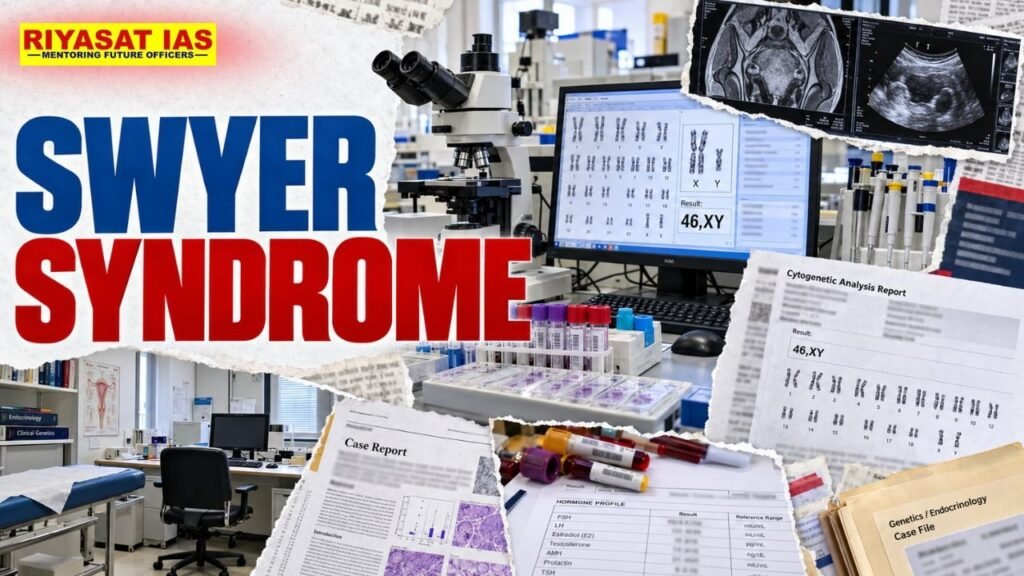
· Swyer Syndrome is a rare disorder of sex development (DSD).
- It is associated with 46,XY chromosomes but female external genitalia.
- The condition involves non-functional/underdeveloped gonads (streak gonads).
- Due to impaired testicular development, there is inadequate production of testosterone and Anti-Müllerian Hormone (AMH).
- Individuals usually have:
- Female external genitalia.
- Underdeveloped or absent secondary sexual characteristics.
- Primary amenorrhea.
- The uterus and fallopian tubes are generally present because of insufficient AMH production.
- It is associated with an increased risk of gonadal tumours, so medical management may include removal of the streak gonads.
- Hormone replacement therapy may be used to induce and maintain secondary sexual characteristics.
UPSC Prelims Question
Q. With reference to Swyer Syndrome, consider the following statements:
- It is associated with a 46,XY chromosome complement.
- Individuals generally have female external genitalia.
- Functional testes produce normal levels of testosterone in this condition.
- It may be associated with an increased risk of gonadal tumours.



Which of the statements given above is/are correct?
A. 1 and 2 only
B. 1, 2 and 4 only
C. 2 and 3 only
D. 1, 3 and 4 only
Answer: B. 1, 2 and 4 only
Explanation: Swyer Syndrome involves 46,XY sex chromosomes with impaired testicular development, resulting in female external genitalia and streak gonads. The streak gonads carry a risk of gonadal tumours.





 Ravi Raaz
 Hassan Khan
 Shadab Ali