
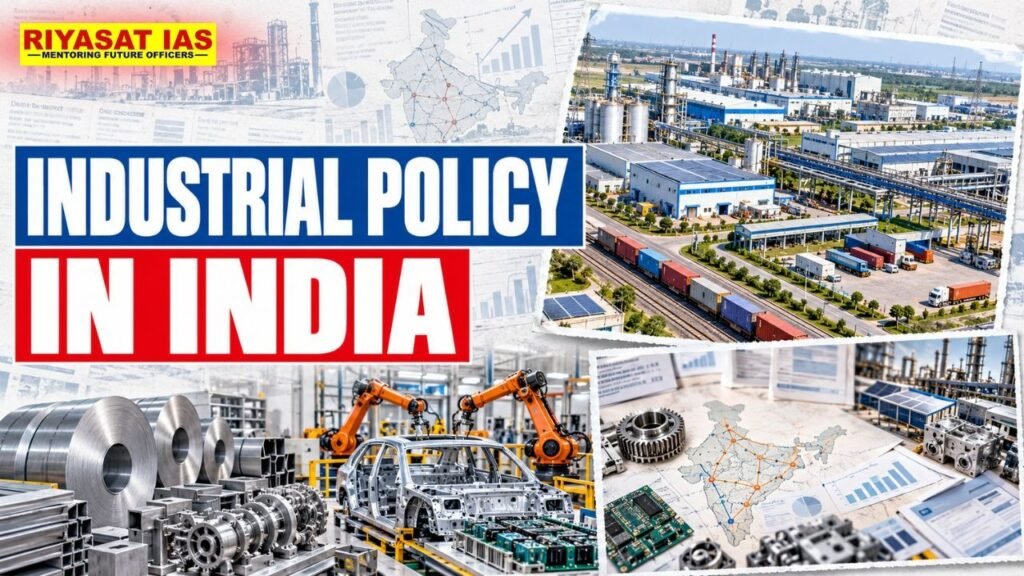
Industrial policy refers to the government’s approach towards industrial development, regulation, and the roles of the public and private sectors. Industrial policy in India has gone through phases of evolution, ranging from state planning and control to liberalization and free-market reforms.
Industrial Policy in India: Evolution and Reforms
Industrial Policy Resolution, 1948
The Industrial Policy Resolution of 1948 was the first industrial policy of independent India. The policy emphasized a mixed economy model which gave importance to both public and private sectors.
Classification of Industries
Industries were categorized into four groups:
- State monopolies: Defence, atomic energy, and railways.
- Controlled industries: Coal, iron and steel, shipbuilding, aircraft, telecommunications, and mineral oils.
- Regulated industries: Automobiles, cement, fertilizers, chemicals, and textiles.
- Private industries: The rest of the industries.
The government was assigned the responsibility of planning, regulation, and control of industries.
Industrial Policy Resolution, 1956
The Industrial Policy Resolution of 1956 focused more on public-sector participation in state planning and economic development. It is regarded as the Economic Constitution of India.
Key Features
- Socialistic pattern of industrialization
- Emphasis on the leading role of the public sector
- Classification of industries into three categories
Classification of Industries
Schedule A:
17 industries were exclusively reserved for the public sector.
Schedule B:
These industries were permitted for both the private and public sectors, but with a tendency towards greater public-sector participation.
Schedule C:
Industries not included in Schedules A and B were generally left to private initiative, subject to government regulation and the prevailing industrial licensing framework.
Other important features included:
- Emphasis on heavy industries and capital goods.
- A licensing mechanism was introduced to regulate industrial investment and capacity in accordance with national planning objectives.
- The broader industrial strategy was also associated with import substitution.
- Development of industries in backward areas received special attention.
- Efforts were made to promote small-scale industries through the reservation of certain products for them.
- The policy also aimed to minimize regional disparities.
Industrial Policy, 1977
The Industrial Policy of 1977 focused more on employment generation and emphasized the decentralization of industries.
Important Features
- Reservation of more than 800 items for small-scale industries.
- Promotion of village and cottage industries and development of District Industries Centres for technical and financial assistance.
- Incentives to locate industries in rural and backward areas.
- Small-scale industries were encouraged to set up, while large industrial houses were discouraged from setting up industries in areas reserved for small-scale industries.
Industrial Policy, 1980
- The Industrial Policy of 1980 focused on promoting industrial growth by overcoming the stagnation of the previous period.
- Modernization and expansion of existing industries were given importance. The policy introduced the concept of economic federalism, where nucleus plants were to be set up to provide the much-needed infrastructure for the growth of small-scale industries in the vicinity.
- Relaxation in small-scale industry investment limits and the revival of sick industrial units were also given importance.
Industrial Policy, 1991
The Industrial Policy of 1991 was formulated in the wake of the Balance of Payments crisis and ushered in an era of Liberalization, Privatization, and Globalization (LPG).
Key Features of the 1991 Industrial Policy
De-reservation of Industries
- The number of industries reserved exclusively for the public sector was substantially reduced, opening several areas to private-sector participation.



De-licensing
- Industrial licensing was dismantled except for a few industries, thus removing many regulatory restrictions regarding the expansion, diversification, and establishment of industries.
Public Sector Reforms
- Selected Public Sector Undertakings (PSUs) were subjected to disinvestment, while greater autonomy, efficiency, and accountability were emphasized for public-sector enterprises.
- Later, PSUs were classified into categories such as Maharatna, Navratna, and Miniratna based on their size, performance, and other criteria.
Liberalization of FDI
- Foreign Direct Investment (FDI) policy barriers were relaxed to allow FDI to flow into the Indian economy.
Competition Reforms
- The 1991 reforms reduced the emphasis on prior government restrictions under the Monopolies and Restrictive Trade Practices Act (MRTP) framework and shifted the focus towards promoting competition.
- The Competition Act, 2002 was subsequently introduced to establish a competition-centric regulatory regime, while the MRTP Act was formally repealed in 2009.
- Thus, the focus shifted towards promoting competition in the market instead of regulating the size of enterprises.
Impact of the 1991 Industrial Reforms
Both positive and negative impacts were created by the 1991 reforms.
Positive Impacts
On the positive front, the reforms:
- Opened up the Indian economy to foreign competition and investment.
- Brought in new technology and management practices.
- Created a more open economic environment that contributed to the rise of the information technology revolution and modern service sector.
Negative Impacts
- However, the benefits of reforms were not evenly distributed, thus creating disparities.
- Traditional small-scale industries were unable to meet the competition from large-scale industries, both Indian and foreign.
- Further, in some sectors, greater mechanization and capital intensity limited employment-generation opportunities in the Indian industrial sector.
- Moreover, globalization exposed the Indian economy to greater international economic and financial volatility.
Industrial Policy Post-1991
India did not have a comprehensive industrial policy post-1991. However, industrial reforms continued through various statutes and policies, such as:
- Liberalization of industries through removal of industrial licensing, except in a few cases.
- Introduction of the automatic route for FDI in a large number of sectors.
- Disinvestment and strategic sale of public-sector undertakings.
- Enactment of the Competition Act, 2002 and establishment of the Competition Commission of India.
- Special Economic Zones (SEZs) and the SEZ Act, 2005.
- National Manufacturing Policy, 2011.
Major Industrial Initiatives After 1991
Make in India
- The Make in India campaign was launched in 2014 with the objective of positioning India as a global manufacturing hub.
- The original initiative focused on 25 sectors, while Make in India 2.0 subsequently expanded the focus to 27 sectors, including manufacturing and services.
The sectors include areas such as:
- Automotive
- Electronics
- Pharmaceuticals
- Defence
- Capital goods
Startup India
Startup India was launched in 2016 to promote entrepreneurship in the country by providing extensive support, such as:
- Regulatory ease
- Tax benefits
- Funding facilities
Goods and Services Tax (GST)
- GST was introduced in 2017 to substitute multiple indirect taxes with a uniform indirect-tax framework at the national level.
- It helped in removing barriers to free trade and commerce and contributed to the development of an integrated national market.
Major Industrial Policy Initiatives Since 2020
Since 2020, India has been focusing on strategic industrial initiatives such as:
- Production Linked Incentive (PLI)
- PM Gati Shakti
- National Logistics Policy
- Semiconductor Mission
- Promotion of defence indigenization
Production Linked Incentive Scheme
The Production Linked Incentive (PLI) Scheme covers 14 sectors, such as electronics, pharmaceuticals, textiles, battery storage, and solar.
Under this scheme, incentives are provided to:
- Promote domestic value addition
- Attract investment
- Reduce import dependence
PM Gati Shakti
- PM Gati Shakti National Master Plan was launched in 2021 as an integrated planning framework for multimodal infrastructure connectivity.
- It initially brought together 16 ministries to make infrastructure planning more cohesive and integrated.
It aims to reduce logistics costs by improving connectivity among:
- Roadways
- Railways
- Waterways
- Airports
- Other infrastructure
National Logistics Policy
The National Logistics Policy was announced in 2022 to transform India into a logistics-friendly nation and improve the efficiency of the logistics sector.
Semiconductor Mission
The Semicon India Programme, supported by an approved outlay of about ₹76,000 crore, was launched to promote the development of India’s semiconductor and display-manufacturing ecosystem.
It aims to promote domestic capabilities in:
- Semiconductor design
- Manufacturing
- Packaging
Defence Industrialization
India is promoting defence indigenization through:
- Positive indigenization lists
- Allowing higher FDI in defence, subject to applicable conditions
- Setting up defence industrial corridors in Uttar Pradesh and Tamil Nadu
Challenges Before Indian Industry
Despite many reforms, Indian industry faces many challenges, such as:
- Low share of manufacturing in GDP
- Capital-intensive growth with limited employment generation
- High logistics costs
- Limited integration into global value chains (GVCs)
- Reliance on imports
- Regional imbalances
- Regulatory hurdles
- Limited access to modern technology among Micro, Small, and Medium Enterprises (MSMEs)
Way Forward:
- India needs a new industrial policy to promote manufacturing growth and employment, with emphasis on labour-intensive manufacturing, MSMEs, and service-led manufacturing.
- Further, India should invest more in research and development (R&D), as well as innovation, to promote indigenous technologies.
- It is also important to create manufacturing clusters to promote regional connectivity and make India a preferred destination for manufacturing.
- Further, India needs to leverage the “Assemble in India” strategy to benefit from the China+1 strategy and integrate itself into global supply chains.
- Moreover, trade policy and Free Trade Agreements (FTAs) need to be rationalized to reduce trade deficits, reduce unnecessary import dependence, and promote exports.
Industrial Policy in India: FAQs
What is industrial policy?
Industrial policy refers to the government’s position on matters concerning industrial development, regulation, investment, production, and the roles of the public and private sectors.
Which was India’s first industrial policy?
India’s first industrial policy was the Industrial Policy Resolution of 1948.
What was the focus of Industrial Policy of 1956?
The emphasis of the Industrial Policy of 1956 was on public-sector participation, heavy industries, capital goods, import substitution, and planned industrialization.
Why was the Industrial Policy of 1991 important?
The Industrial Policy of 1991 was important because it signalled the shift from planning, state ownership, and control towards a more competitive and liberalized market economy.
What is the PLI Scheme?
PLI stands for Production Linked Incentive Scheme. It focuses on promoting domestic manufacturing and attracting investment in 14 priority sectors.
What are the major challenges facing Indian industry?
The major challenges facing Indian industry are:
- Low share of manufacturing in GDP
- Capital-intensive growth with limited employment generation
- High logistics costs
- Limited integration into global value chains
- Reliance on imports
- Regional imbalances
- Regulatory hurdles
- Limited access to modern technology among MSMEs


 Ravi Raaz
 Hassan Khan
 Shadab Ali