
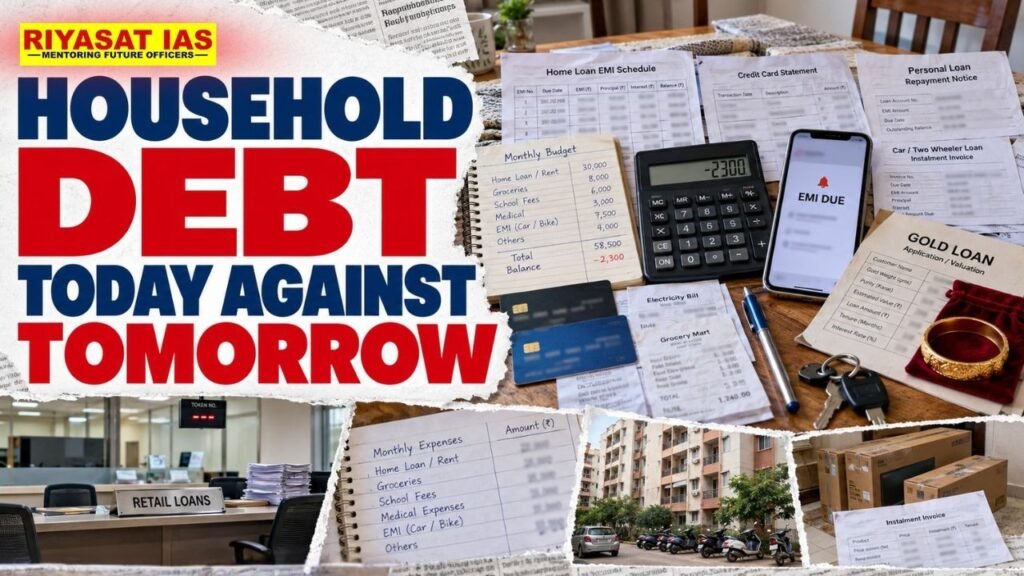
GS-III – Indian Economy | Banking & Financial Sector | Household Debt | Financial Inclusion | Economic Growth
- Household borrowings: A staple of current consumption via credit cards, other consumer loans, consumer durable loans/financing loans and digital lending /buy-now-pay-later (BNPL), bringing future income to bear today.
- Low household debt: According to RBI, household debt stood at 45.5% of GDP in September 2025, compared with 42% in June 2023 and 39.2% in March 2021.
- Concern: While the overall level of borrowing is relatively small compared with some other developing economies, the composition and pace should raise concern.
The Household Savings Transition
- Transitioning a savings model: Traditional Indian household wealth building was centered on savings.
- Net financial savings: Plummeted from elevated Covid-19-era ranges, however latest information sign a restoration.
- Recent improvement: Household net financial savings as share of GDP rose from 5.2% in 2023-24 to ≈6% in 2024-25.
- The takeaway: This is not about an everywhere swoon in household saving.
Changing Composition of Household Debt
- Housing loans: Normally a big portion of household debt, this type of borrowing also leaves an asset in its wake and can, therefore, be perceived differently to funding routine consumption credits.
- Unsecured borrowing: This trend in personal loans, credit-card borrowing and other unsecured loans raise various concerns.
- Commitment to the future: Such loans allow households to smooth their consumption when current income is insufficient, but put a stake in future income.
- The variation of risk: Salaried households with regular monthly earnings are able to comfortably service most types of loans, while self-employed and informal-sector workers as well as casual labourers face a very different kind of risk.
- RBI said: Consumption-oriented borrowing still continued to be significantly high, but growth has moderated and productive-focused borrowings have shown an increasing trend.
- Distributional dimension: The change in structure of household debt should not overshadow its distributional aspects.



Why Are Households Borrowing?
- Productive borrowing: If higher borrowing is because incomes are increasing (for example, some of the figures below) and households are investing in new houses, education or some other productive asset then increased debt may not be too grave a worry.
- Distress borrowing: Borrowing pays for food, health care, education, housing rents, durable goods or routine expenditure when current incomes fall short; the use of debt only postpones the income constraint rather than resolving it.
Digital Lending and Affordability
- One stop solution: Digital lending platform, instant personal loans: app-based credit & consumer finance Online have minimized the transactions costs of borrowing.
- The line between what a household can afford and what it can borrow starts to fade.
Household Debt and Social Protection
- Aggregate demand: Macroeconomically, consumption funded by borrowing can be an important support to aggregate demand.
- Repayment obligations: The same process at the household level gives rise to future repayment obligations.
- Health care, education, housing or old-age needs: Borrowing can be a good substitute if social protection is weak.
- Household debt is consequently not just a result of personal financial decisions; it is influenced by the economy’s institutional structure.
Macroeconomic Implications
- In the short run, credit expansion can promote consumption and contribute to economic growth.
- Over-leveraged: New debt servicing burdens will drive households to extract money spent on discretionary consumption.
- Sensitivity: Consumption increasingly sensitive to interest rate and staffing conditions.
Debt Cycle
- Income stagnation → Consumer credit growth (borrowing to sustain consumption) → Rise in debt service → Fall in disposable income → Export incentives push consumption → Very weak consumption → Even more dependent on credit.
- Instructed cycle: Credit stops to be a instrument of helpful investment decision – and starts to turn into a car for gratifying consumption precisely where cash flow improvement is insufficient.
- Credit-led vs income-led demand: Credit-led consumption growth can create a short-term surge of demand, while income-led expansion serves as a more sustainable basis.
Policy Response
- Do not go for the easy route of limiting credit: Credit is a fundamental piece of economic progress and by expanding access to formal credit household welfare would increase.
- Main challenge: Separate productive credit from distress credit and asset-building borrowing from consumption smoothing in times of income pressure.
Central Issue
- Beyond headline numbers: India’s household debt story is more complicated than the headline number suggests.
- Government position: Household leverage remains below that of many emerging-market peers and household net financial savings have improved.
- Core concepts: Who has debt, who do they owe, at what interest rate, and on what income.
- Fundamental risk: Confusion between degrees of credit access and broader national welfare.
- The fifth and last point: More unequal and uncertain wages fuel the temptation to borrow against future income in order to sustain consumption.
- Third policy challenge: Construct an economy where households actually take home incomes that allow them to thrive without living in anticipation of future earnings.
UPSC Mains Practice Question
Q. “The rise in household borrowing is not merely a question of how much households owe, but why they owe it and against what income.” Discuss the changing nature of household debt and its macroeconomic implications.




 Ravi Raaz
 Hassan Khan
 Shadab Ali