
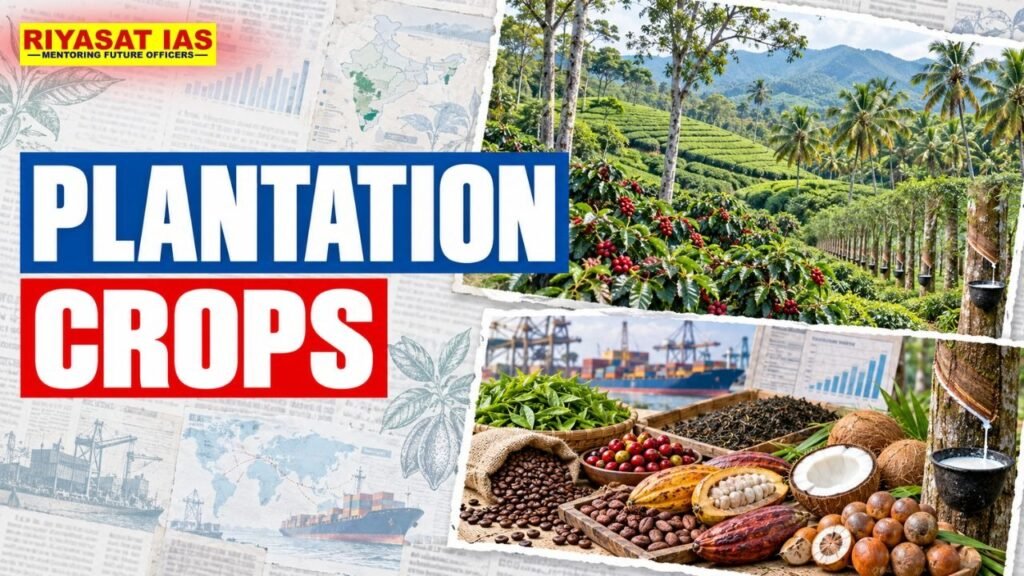
Cash crops and commercial farming constitute a significant economic input in rural India as they not only supply raw material to domestic industries but also add to the livelihood of millions of people employed on their supply chains and augment export earning potential and farmer income. Commercial farming in India comprises sugarcane, oilseeds, horticultural crops, tea, coffee, rubber, cotton, and jute.
The distribution pattern of commercial crops in India is influenced by temperature, rainfall, soil, irrigation, topography, technology, and market demand, and state and central governments’ policies.
Major Cash Crops in India
Sugarcane
Sugarcane is one of India’s important agro-industrial crops. It is an important raw material for India’s sugar industry. It is used to produce jaggery (gur), khandsari, molasses, and power-generating bagasse. Sugarcane is a significant input for the domestic biofuel economy.
- Temperature: 21–27°C; Hot & Humid
- Rainfall: 75–100 cm annually; Crops are also grown in canal and tubewell irrigation
- Soil: Deep, fertile, and well-drained loams are ideal. Grown extensively on various textures like sandy loam, clay loam so long as root waterlogging is avoided.
- Major producing states: Uttar Pradesh, Maharashtra, Karnataka, Tamil Nadu, and Bihar.
India enjoys the second-largest sugarcane production in the world, second only to Brazil. During 2024–25, the country’s sugarcane production stood at around 454.61 million tonnes. Uttar Pradesh leads in terms of area and production, followed by Maharashtra. Sugarcane cultivation is very labor-intensive and requires human intervention for settling, weeding, earthing, and harvesting.
Besides producing sweeteners, sugarcane is the major source of molasses and cane juice for distilleries to manufacture ethanol.
Government initiatives towards sugarcane and sugar industry
The government takes initiatives to balance the books of mills and growers, including the statutory Fair and Remunerative Price (FRP), state-specific SAP arrangements, financial assistance to clear cane dues, and remunerative pricing under the National Policy on Biofuels 2018, which encourages diversion of surplus cane and B-heavy molasses into ethanol blending.
Oilseeds
Oilseeds are commercial crops that provide edible oil for Indian consumption, oilcake/meal for animal feed, and essential industrial raw material for soap, cosmetics, paint, and lubricant manufacturing industries.
- Temperature: 15–30°C; varies in specific oilseeds
- Rainfall: 30–75 cm; several oilseeds are drought-resistant and are grown in rainfed conditions
- Soil: Well-drained loams, sandy loams, and light black soils are suitable
India grows a rich variety of oilseeds, such as groundnut, rapeseed-mustard, soybean, sunflower, sesame, castor, linseed, safflower, niger, and cottonseed. Domestic production of oilseeds has been on the rise, registering an increase from 396.69 lakh tonnes in 2023–24 to 429.89 lakh tonnes in 2024–25.
Major oilseed-producing states
There is a high degree of year-to-year variability in oilseed production, which directly influences the state-wise rankings. For the nine major oilseeds in 2024–25 production, Rajasthan was the largest producer, accounting for about 21.4% of the country’s total production, followed by Madhya Pradesh, Maharashtra, Gujarat, and Uttar Pradesh.
Important oilseed crops and their seasons
Groundnut is mainly a monsoon (kharif) crop in western and southern belts like Gujarat and Andhra Pradesh. There is also a winter (rabi) crop in the south. Rapeseed and mustard are mainly cool-season (rabi) crops grown in Rajasthan, Haryana, and northern India. Sesame is a kharif crop in the north and a rabi crop in the south. Castor cultivation is done in both kharif and rabi seasons. Gujarat is the biggest producer and exporter of castor. Soybean is a major kharif crop across Madhya Pradesh, Maharashtra, and south-eastern Rajasthan, grown under rainfed conditions.
Government initiatives for oilseeds
Initial public initiatives in the form of the Technology Mission on Oilseeds (Yellow Revolution) and the Integrated Scheme of Oilseeds, Pulses, Oil Palm and Maize (ISOPOM) led to the country’s present position. Further, the government approved the National Mission on Edible Oils – Oilseeds (NMEO-OS) in October 2024 to boost domestic seed production, promote the use of high-yielding mini-kits, bring fallow lands under cultivation, and reduce reliance on imported cooking oils.
Horticulture Crops
Horticulture encompasses the cultivation of fruit, vegetable, flower, plantation, spice, and medicinal and aromatic plants. Horticulture has emerged as an important growth sector in Indian agriculture, contributing significantly to crop diversification, nutritional security, income, and employment generation and high-value exports.
India is the second-largest producer of fruits and vegetables in the world. Horticultural production stood at 370.74 million tonnes in 2024–25, with an estimated/Second Advance Estimate of 377.78 million tonnes for 2025–26.
Major Fruits and Their Producing Regions
India is endowed with a wide range of agro-climatic zones ideal for growing a rich variety of tropical, subtropical, and temperate fruits:
| Fruit | Major producing states / regions |
| Mango | Uttar Pradesh, Andhra Pradesh, Telangana, Maharashtra, Gujarat |
| Banana | Maharashtra, Andhra Pradesh, Tamil Nadu, Karnataka, Gujarat |
| Litchi | Bihar, West Bengal, Uttar Pradesh, Jharkhand |
| Guava | Uttar Pradesh, Madhya Pradesh, Bihar, Andhra Pradesh |
| Pineapple | West Bengal, Assam, Tripura, Meghalaya, Kerala |
| Grapes | Maharashtra, Karnataka, Telangana, Andhra Pradesh |
| Apple | Jammu & Kashmir, Himachal Pradesh, Uttarakhand |
| Orange / Mandarin | Maharashtra, Madhya Pradesh, Rajasthan, Assam |
| Walnut | Jammu & Kashmir, Himachal Pradesh |
Major Vegetables
India produces a variety of essential kitchen vegetables, including potato, onion, tomato, cabbage, cauliflower, brinjal, green peas, and okra. Vegetable production stood at around 217.80 million tonnes in 2024–25, with an estimated production of 221.00 million tonnes in 2025–26.
Government initiatives towards horticulture
- Mission for Integrated Development of Horticulture (MIDH): It is a centrally sponsored scheme that promotes protected (polyhouse) farming, quality planting material, and regional infrastructure.
- Project CHAMAN: Utilizes satellite remote sensing and GIS tools to estimate horticultural acreage.
- National Horticulture Mission: Emphasizes supply clusters and post-harvest management.
- Infrastructure Support: Provides capital subsidy for integrated cold chain, cold storage, transport, primary pack houses, and food processing parks.



Plantation Crops
India’s plantation crops are largely high-value commercial perennial crops that grow on large-scale estates in specialized microclimates. Plantation crops of commercial importance in India are tea, coffee, and rubber.
Tea
Tea is one of India’s most prominent plantation crops and a foreign exchange-earning crop.
- Temperature: 20–30°C; Severe cold and dry heat restrict leaf growth
- Rainfall: 150–300 cm; Well distributed throughout the year without waterlogging
- Soil: Deep, well-aerated, fertile loams with organic matter; pH 4.5–5.5
- Major producing states: Assam, West Bengal, and Tamil Nadu.
India ranks second in tea production in the world. Tea plantations were developed during the colonial period. They flourish in the Brahmaputra Valley, Darjeeling, the Dooars, and the Nilgiris. Since tea bushes cannot withstand waterlogging, tea cultivation is done in undulating hills and slopes. Tea cultivation is highly labor-intensive and requires skilled personnel, mostly women, for delicate plucking. Processing units are situated on or close to the plantations to avoid loss of leaf freshness before the curing process commences.
Government initiatives for Tea
The Tea Board of India implements the Tea Development and Promotion Scheme, funding for factory modernization, rejuvenation of old tea bushes, and worker welfare, along with international marketing schemes.
Coffee
Indian coffee is renowned globally for its production method almost exclusively under two-tier shade trees of pepper and spices, yielding high-quality shade-grown coffee beans.
- Temperature: 15–28°C; Sensitive to frost and prolonged heatwave
- Rainfall: 150–250 cm; Blossom showers in spring
- Soil: Deep, porous, humus-rich loamy soils with good drainage on hill slopes
- Major producing states: Karnataka, Kerala, and Tamil Nadu
Karnataka is the leading coffee-producing state, contributing over 70% of the total coffee production. There is a legend about the origin of Arabica coffee in India, which goes back to the famous 17th-century Sufi saint Baba Budan. It is believed that he brought seven coffee beans from Yemen and planted them in the Chikmagalur hills, giving India its rich coffee culture. India grows two commercial varieties of coffee: Arabica and Robusta. Arabica is generally valued for its distinctive flavour, while Robusta is known for its stronger body and is widely used in blends. Coffee production is estimated at around 3.63 lakh tonnes in 2024–25, with 4.03 lakh tonnes expected in 2025–26 after blossom.
Government initiatives for Coffee
The Coffee Board of India implements programs for white stem borer management, weather-index insurance, sustainable certifications, processing upgrading, and international branding of Indian single-origin coffees.
Rubber
Natural rubber, which is an essential industrial raw material, is used in the manufacture of automobile tires and tubes, industrial belts, footwear, and medical equipment.
- Temperature: Warm and humid conditions above 25°C
- Rainfall: More than 200 cm annually; Well distributed throughout the year without prolonged dry spells
- Soil: Deep, well-drained, and fertile alluvial or lateritic soils
- Major producing states: Kerala, followed by Tripura and Tamil Nadu
Rubber cultivation is an equatorial crop concentrated in the southern belt of India. However, it has expanded to other non-traditional areas such as Tripura and Assam. Natural rubber production stood at 8.75 lakh tonnes in 2024–25 against 8.57 lakh tonnes in 2023–24.
Government initiatives for Rubber
The Rubber Board provides financial assistance to replant rubber trees, set up quality rubber sheet processing units, and control diseases and disorders with improved training for latex tappers.
Fibre Crops
Fibre crops are natural fiber sources used in spinning mills, carpet weaving, geotextile, and biodegradable packaging. Fibre crops play a critical role in the textile and apparel industry in India. India’s fibre crops include cotton and jute.
Cotton
Cotton, also called the “White Gold,” is India’s foremost natural fibre and the backbone of the domestic textile and apparel sector.
- Temperature: 21–30°C; Requires plenty of bright sunshine and at least 200 frost-free days
- Rainfall: 50–100 cm; Dry weather is required during boll-opening and harvesting to ensure lint cleanliness
- Soil: Deep black soils (regur) of the Deccan Plateau is ideal due to its water-holding capacity; Alluvial soils in the north also yield good results under canal irrigation
- Major producing states: Maharashtra, Gujarat, Telangana, Karnataka, and Rajasthan
Cotton is primarily a kharif crop. India ranks first globally in cotton cultivation area and second in cotton production. India’s cotton production stood at 297.24 lakh bales (about 5.06 million tonnes) in 2024–25.
Major cotton-producing states
For the 2024–25 season, Maharashtra is the leading cotton-producing state, followed by Gujarat, Telangana, Karnataka, and Rajasthan.
Bt Cotton
Bt cotton incorporates genes from the soil bacterium Bacillus thuringiensis to protect the cotton crop from pests, mainly bollworms. Bt cotton, approved for commercial cultivation in 2002, is the only genetically modified crop approved for commercial cultivation in India and constitutes more than 90% of the country’s cotton cultivation.
Jute
Popularly known as the “Golden Fibre” for its shiny yellowish-brown sheen, jute is a durable, biodegradable packaging fibre that is exported globally.
- Temperature: 25–35°C with high relative humidity
- Rainfall: 150–250 cm; Availability of freshwater ponds and rivers for stem “retting”
- Soil: Fertile silt found in active river basins
- Major producing states: West Bengal, Bihar, and Assam
India is the world’s leading producer of raw jute and jute products. The jute industry is concentrated in the fertile Ganga-Brahmaputra delta. Jute fibers are processed into gunny bags, twines, hessian fabric, carpets, and eco-friendly geotextiles. West Bengal accounted for around 80% of the country’s total jute and mesta production in 2024–25, with Bihar and Assam contributing most of the remaining production. Despite the competition from synthetic plastic sacks, there is a need for biodegradable jute sacks to meet the demand for eco-friendly packaging.
Government initiatives towards Jute
The Jute Packaging Materials Act (JPMA), 1987, makes it mandatory to use traditional jute sacks for packing food grains and sugar. The Jute Corporation of India (JCI) provides price stability through Minimum Support Price (MSP) operations and offers state support schemes for modern retting practices and diversified jute manufacturing.
Changing Cropping Patterns in India
A cropping pattern refers to the proportion of cultivated land dedicated to growing different crops at any given time. It is a dynamic concept influenced by a wide range of social, economic, geographical, and political factors, including climate, demand, and government policies.
Factors Affecting Cropping Patterns
Indian farmers make their decisions based on the following factors:
- Climate and Weather: Temperature, monsoon, and total rainfall
- Irrigation Infrastructure: Canals, tubewells, and drip irrigation systems
- Economic Returns & Prices: Realization price, profitability, and market demand
- Policy Signals: Minimum Support Prices, public procurement, and import duties
- Technological Access: Hybrid seeds, tillers, harvesters, and fertilizers
- Socio-Economic Conditions: Holding size, capital, tenant-farming, and dietary requirements
- Urban Expansion: Improved transportation and middle-class demand for fresh produce
- Environmental Realities: Declining groundwater, degraded soils, and climate change
Impact of the Green Revolution
The Green Revolution ushered in a new era of agricultural growth in the mid-1960s through the introduction of high-yielding semi-dwarf seeds, canal irrigation, fertilizers, and assured public grain procurement. Punjab, Haryana, and western UP witnessed the transformation of their cropping patterns into rice-wheat cropping systems, which impacted the production and cultivation of traditional pulses, coarse cereals, and dryland oilseeds.
Shift towards Commercial and High-Value Crops
There is a growing trend among Indian farmers to diversify their farm holdings from traditional staple food crops to commercial and high-value crops, primarily driven by rising incomes and urban expansion, supported by a growing cold-chain network. Such a shift can offer farmers higher returns per unit area planted, although it varies between regions based on local market demand and irrigation availability.
The Impact of Urbanisation and Population Growth
Urbanization has had two major effects on India’s agricultural sector:
- Changing consumption habits: Urban expansion has led to a dramatic rise in fresh vegetables, fruits, dairy, and poultry consumption, offering farmers a stable market for their produce.
- Farmland conversion: Urban expansion, roads, and industrial development have increasingly converted cultivable land on the fringes of urban centers. Remaining farmers resort to intensive cultivation techniques like polyhouse farming and drip irrigation to extract more produce from the limited land.
Impact of Climate Change
Climate disruptions have affected India’s cropping patterns by
- Delaying the onset of monsoon, affecting kharif sowing
- Scorching wheat grain in the northern plains during the hot spring
- Destroying open bolls of cotton and soybean fields during post-monsoon showers
- Reducing groundwater tables in many areas unsuitable for water-intensive crops
Farmers and states are responding to climate change by
- Shifting to short-duration seeds
- Planting drought-resistant millets
- Using precision drip irrigation
Major Trends in India’s Cropping Pattern
| Trend | Major Change on the Ground |
| Food crops to commercial crops | The gradual shift towards producing oilseeds, fruits, vegetables, spices, and industrial crops wherever water is available |
| Traditional to high-yielding varieties | Adoption of HYV varieties of cotton, maize, millets, and vegetables |
| Rain-fed to irrigated agriculture | Expansion of tubewells, canal, and micro-irrigation systems has enabled multiple cropping in rainfed areas |
| Single crop to diversification | Transition from growing a single crop to intercropping, agroforestry, and mixed cropping systems to hedge against price fluctuations |
| Climate-sensitive to climate-resilient agriculture | Shifting towards heat-tolerant crops, water-efficient drip systems, and direct seeded rice and millets |
| Farm production to value-chain integration | Higher value-addition through cold storages, contract farming, agro-processing, and organized retailing |
India’s Cash, Plantation, and Fibre Crops: An Integral Connect Between the Farms and the Modern Industrial Supply Chain, Employment, and International Trade
India’s cash, plantation, and fibre crops play a crucial role as an integral connector between the farms and the modern industrial supply chain, employment, and international trade. Sugarcane cultivation fuels the domestic sweetener and bio-ethanol sectors; oilseeds are a source of cooking oil; horticulture provides high-value income and dietary diversity; tea, coffee, and rubber cultivation sustains plantation belts; while cotton and jute feed the natural fibre industries. At the same time, India’s cropping patterns are ever-evolving in response to consumers’ demands, state incentives, urbanization, and climate change, requiring farmers to continuously adapt their land use patterns to reap sustainable benefits.
FAQs on Major Cash Crops and Cropping Patterns in India
What are the major cash crops of India?
The major cash and commercial crops include sugarcane, oilseeds (like groundnut, mustard, and soybean), cotton, jute, tea, coffee, natural rubber, along with high-value fruits, vegetables, and spices.
Which state is the largest producer of sugarcane in India?
Uttar Pradesh is the leading sugarcane-producing state in India by total volume and acreage, followed by Maharashtra.
Which state is the largest producer of oilseeds in India?
State rankings shift from year to year. For the nine major oilseeds in 2024–25, Rajasthan was the leading producer—producing over 21% of the national total on the strength of its mustard crop—followed by Madhya Pradesh, Maharashtra, and Gujarat.
Which state is the largest producer of cotton in India?
For the 2024–25 season, Maharashtra produced the highest volume of cotton, followed closely by Gujarat and Telangana.
Which state is the largest producer of tea in India?
Assam is the leading tea-producing state, contributing more than half of India’s total output, with West Bengal and Tamil Nadu serving as the other major producers.
Which state is the largest producer of coffee in India?
Karnataka produces over 70% of India’s coffee, followed by Kerala and Tamil Nadu.
Which state is the largest producer of natural rubber in India?
Kerala is the leading natural rubber-producing state, accounting for the vast majority of national production. Tripura and Tamil Nadu are other major producing states.
Why is jute called the golden fibre?
Jute is known as the “golden fibre” because of its distinct shiny golden-brown color and its commercial importance.
What is cropping pattern?
Cropping pattern refers to the proportion of total agricultural land allocated to different crops in a given area at a specific point in time. It changes dynamically in response to climate, irrigation, market prices, technology, and government policy.
How is climate change affecting cropping patterns in India?
Changing temperatures, erratic monsoon timing, unseasonal downpours, and falling water tables are prompting farmers to adopt shorter-duration seed varieties, revert to climate-hardy millets, and install drip irrigation and diversify their cropping systems.





 Ravi Raaz
 Hassan Khan
 Shadab Ali