
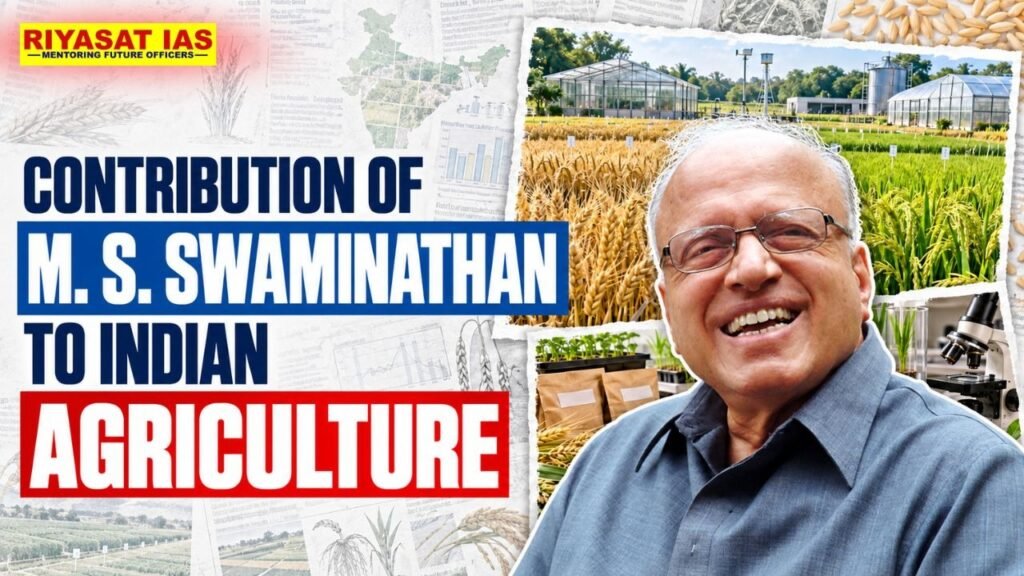
M. S. Swaminathan is one of the most revered personalities in contemporary India. Regarded as one of the chief architects of the Indian Green Revolution, his contributions extended beyond the granaries—for Swaminathan, science was never a sterile academic pursuit, but a means to an end—securing India against famine, protecting the ecological balance and improving the condition of the Indian farmer.
By integrating the latest developments in plant genetics with grassroots-level extension work and policy formulation, M. S. Swaminathan took India through the narrow corridor of chronic food insecurity and into a position of self-sufficiency.
Who was M. S. Swaminathan?
Early Life and Inspiration
Born on 7th August 1925 in Kumbakonam, Tamil Nadu, Mankombu Sambasivan Swaminathan’s family initially wanted him to pursue medicine. However, he studied Zoology and later turned to agriculture. During the Bengal Famine of 1943, seeing hundreds of people die due to a systemic failure and not natural causes, the young student realized that the country’s future depended upon its food security and switched his focus to agriculture.
After studies at the Indian Agricultural Research Institute (IARI), New Delhi, he studied genetics at Wageningen University, Netherlands, and went on to receive his PhD from the University of Cambridge, UK, in 1952.
Career and Institutions
Over the ensuing six decades, Swaminathan guided and advised many policy and research institutions across the world, including:
- Director, Indian Agricultural Research Institute, New Delhi (1961–72)
- Director General, Indian Council of Agricultural Research (ICAR) and Secretary to the Government of India (1972–79)
- Principal Secretary, Union Ministry of Agriculture (1979–80)
- Member, Planning Commission of India (1980–82)
- Director General, International Rice Research Institute, Philippines (1982–88)
- Independent Chairman, Food and Agriculture Organization (FAO) Council (1981–85)
- President, International Union for Conservation of Nature (IUCN) (1984–90)
- And many more.
M. S. Swaminathan’s Contribution to the Green Revolution
- In the early 1960s, while food grain reserves were at their lowest ebb, India was surviving by virtue of the U.S. PL-480 programme. With two consecutive bad monsoons, there were near-famine conditions in the country. According to Swaminathan, the problem was exacerbated by the type of wheat plant that was in use in India—tall plants that proved highly susceptible to lodging (falling over) under the stress of fertilizers.
- The solution lay in the semi-dwarf wheat varieties that had been developed in Mexico by Dr. Norman Borlaug, which had a higher response to fertilizers and irrigation. Swaminathan brought Borlaug to India in 1963 and worked in tandem with Borlaug and a team of Indian scientists to develop high-yielding dwarf wheat varieties that could be locally adapted and acclimatized.
- The challenge was to convince the farmers about the superiority of the new wheat variety over the traditional ones. Swaminathan conducted a number of field demonstrations to prove the efficacy of the new wheat seed and showed farmers that they needed to use recommended doses of fertilizer and proper irrigation—the yield of wheat would increase manifold.
- By 1968, India’s wheat production had risen to around 17 million tonnes, compared with about 12 million tonnes four years earlier—an increase of about 5 million tonnes. This heralded the start of the Green Revolution in India.
Development of High-Yielding Crop Varieties
- Swaminathan’s expertise in cytogenetics and plant breeding proved vital in the development and adaptation of high-yielding crop varieties. By working with and adapting improved plant types, he contributed to the use of dwarfing genes (Rht genes) in wheat and semi-dwarf genes (Dee-geo-woo-gen) in rice. This resulted in sturdy plants with tough stems that could support the increased yield without bending or falling over.
- Besides semi-dwarf wheat varieties, Swaminathan played a significant role in developing and adapting high-yielding rice varieties like IR8 and others, in partnership with the International Rice Research Institute (IRRI).
Contribution to Food Security in India
Swaminathan was one of the first men in India to realize that food security did not lie merely in increasing the production of food grains. He argued that even in years of abundance, if the granaries of the country were not properly managed, a large part of the population would continue to remain hungry and food-insecure.
He advocated a multi-tiered approach based on:
- Physical availability of grain
- Economic and financial accessibility
- Nutritional content—since, for a long time, the country’s focus remained on cereals and not on combating hidden hunger. The concept also included provisioning of safe water and sanitation, and making sure that people had a diverse diet. In fact, Swaminathan went so far as to say that without nutritional security, the country’s food security was at risk.
- Livelihood security, especially of marginal farmers.



Swaminathan’s far-sighted prescriptions influenced national policy-making on food security and nutrition.
Contribution to Farmer Welfare
- Swaminathan always believed that the financial and social well-being of the farmer was intricately linked to the success of any agricultural venture. As the Chairman of the National Commission on Farmers (2004–06), Swaminathan spent two years touring the country to understand the problems of Indian farmers.
- The reports of the Commission and the recommendations made on farmers’ welfare—particularly the C2 + 50 per cent formula—came to be known as the Farmers’ Manifesto. It recommended that the Minimum Support Price (MSP) of any agricultural commodity must be at least 50 per cent more than the comprehensive cost of production (C2).
- This recommendation continues to be an important part of discussions on MSP policy and was considered revolutionary even by many progressive economists.
Protection of Plant Varieties and Farmers’ Rights
- With the advent of global agreements on intellectual property rights, there was a dire need to pass legislation to protect the interests of farmers who saved seeds. Swaminathan was one of the most vocal proponents of this legislation, and his efforts contributed to the development of the Protection of Plant Varieties and Farmers’ Rights (PPV&FR) Act, 2001, which recognizes and protects the rights of both farmers and plant breeders.
- Under the Act, farmers have the right to save, use, sow, re-sow, exchange, share or sell farm produce, including seed, subject to the provisions of the Act. However, farmers cannot sell branded seed of a protected variety.
- The Act is unique in that it provides a balance between the protection of breeders’ rights and farmers’ rights.
Contribution to Sustainable Agriculture
- Swaminathan was deeply concerned with the impact intensive cultivation techniques were having on the ecology. Seeing the deepening water crisis in the Punjab-Haryana belt, caused by overuse of groundwater, he proposed what came to be known as the Evergreen Revolution.
- It called for sustainable increases in agricultural production through enhancing soil organic carbon content and recycling nutrients back into the soil, instead of relying solely on chemical fertilizers and pesticides. Other measures included judicious use of groundwater and conservation farming.
Contribution to Rural Development
- In order to give effect to his vision of sustainable rural development, Swaminathan spent the proceeds of the World Food Prize 1987 to found the M. S. Swaminathan Research Foundation (MSSRF) in Chennai in 1988.
- The philosophy of the MSSRF is encapsulated in the motto of ‘pro-poor, pro-women and pro-nature’.
- The Foundation takes up model projects like setting up village knowledge centres and community seed banks, and coastal bio-shield projects, all of which focus on using scientific research for the benefit of the rural poor.
Swaminathan’s Contributions to Kuttanad and the Conservation of Agricultural Heritage
- Swaminathan had an abiding interest in conservation of indigenous agricultural practices. He was particularly fascinated by the unique farming practices of Kuttanad in Kerala—one of the few places in the world where farming was done below sea level.
- After the ecological crisis in the Vembanad wetlands, the MSSRF came out with a comprehensive development plan for Kuttanad in 2007. It was this report that formed the basis of the Kuttanad Package announced by the central government.
- Swaminathan’s efforts bore fruit when the Food and Agriculture Organization (FAO) designated the Kuttanad Below Sea Level Farming System as a Globally Important Agricultural Heritage System (GIAHS) in 2013.
Contributions to Biodiversity and Conservation
- Throughout his career, Swaminathan stressed the need to conserve our biodiversity and natural heritage. He believed that wild species and landraces were the most valuable resources for future plant breeding, and worked tirelessly to have community gene banks set up across the country to conserve biodiversity.
- Swaminathan also played a key role in promoting the cultivation of alternate crops like millets as well as rehabilitating coastal mangroves.
International Contributions
- Swaminathan’s work in India is only one facet of his contribution to the wider cause of scientific advancement and rural development across the world.
- As the Director General of the International Rice Research Institute (IRRI) from 1982–88, besides facilitating germplasm exchange, he organized and participated in a number of meetings on women in rice growing.
- As the Independent Chairman of the Food and Agriculture Organization (FAO) Council and the President of the International Union for Conservation of Nature (IUCN), Swaminathan worked closely with developing-world counterparts to ensure that biodiversity conservation did not become a pincer around the developing nations.
Major Awards and Honours
Swaminathan’s contributions to national development and the empowerment of the rural poor have earned him many accolades, awards and honours, including:
National Awards
- Padma Shri (1967)
- Padma Bhushan (1972)
- Padma Vibhushan (1989)
- Bharat Ratna (2024)
International Awards
- Ramon Magsaysay Award for Community Leadership (1971)
- Albert Einstein World Science Award (1986)
- World Food Prize (1987) – Swaminathan was the first recipient of the World Food Prize, and the proceeds from this prize were used to found the M. S. Swaminathan Research Foundation.
Legacy of M. S. Swaminathan in Indian Agriculture
| Focus Area | Key Impact & Contribution |
| Green Revolution | Adaptation and rollout of high-yield semi-dwarf varieties of wheat and rice, heralding the advent of the Green Revolution. |
| Plant Genetics | Advancements in cytogenetics and contribution to the development and adaptation of lodging-resistant, high-response crop varieties. |
| Food Security | Advocated a multi-tiered approach to food grain security at the national level that took into account nutritional, economic and ecological factors. |
| Farmer Welfare | Chairmanship of the National Commission on Farmers and advocacy of the C2 + 50% formula for the Minimum Support Price (MSP). |
| Farmers’ Rights | Strong advocacy of farmers’ rights and contribution to the development of the farmers’ rights framework reflected in the Protection of Plant Varieties and Farmers’ Rights Act, 2001. |
| Sustainable Agriculture | Conceptualization and advocacy of the principles of the Evergreen Revolution, emphasizing sustainability. |
| Biodiversity Protection | Gene bank advocacy, conservation of landraces and wild species, and promotion of alternate crops. |
| Sustainable Rural Development | Founded the M. S. Swaminathan Research Foundation (MSSRF) to take up model pro-poor research projects, including coastal bio-shield projects and village knowledge centres. |
| Agricultural Heritage | Advocated the conservation of traditional farming systems, and helped the Kuttanad Below Sea Level Farming System get recognition as a Globally Important Agricultural Heritage System by the FAO. |
| Global Contributions | Directed the International Rice Research Institute, and served as the Independent Chairman of the Food and Agriculture Organization Council and President of the International Union for Conservation of Nature, championing developing-world causes. |
Conclusion
M. S. Swaminathan transformed Indian agriculture twice—once, by leading the country through the narrow waist of famine and into the age of abundance. And then, realizing that abundance could not be sustained without ecological and human consciousness, he spent his remaining years spreading this vision across the world.
By moving beyond the ivory tower of the plant breeder, he demonstrated that national security is not achieved through armories alone, but through the soil, the seed, the plant, the harvest and the prosperity of the person who reaps the harvest.
FAQs on M. S. Swaminathan
Who was M. S. Swaminathan?
M. S. Swaminathan was an eminent Indian geneticist and administrator whose scientific and policy interventions contributed significantly to the Green Revolution in India, helping transform it from a food-deficit nation towards food self-sufficiency and surplus.
What was M. S. Swaminathan’s major contribution to Indian agriculture?
Swaminathan’s contribution lies in the development, adaptation and promotion of high-yielding, semi-dwarf wheat and rice varieties in Indian agriculture. In tandem with field demonstrations and improved agricultural practices, this helped increase grain yields substantially.
What is M. S. Swaminathan known for?
Besides being one of the chief architects of the Green Revolution, Swaminathan is known for advocating the C2 + 50% formula for the Minimum Support Price (MSP) and strongly supporting farmers’ rights reflected in the Protection of Plant Varieties and Farmers’ Rights Act, 2001. He is also known for conceptualizing the Evergreen Revolution and founding the M. S. Swaminathan Research Foundation.
What did the Swaminathan Commission recommend about MSP?
The National Commission on Farmers, or the Swaminathan Commission, recommended that the Minimum Support Price (MSP) of agricultural commodities should be at least 50 per cent more than the comprehensive cost of production (C2).
What is the Evergreen Revolution?
The Evergreen Revolution is Swaminathan’s vision of sustainable agriculture that emphasizes long-term increases in agricultural productivity without harming the ecosystem.
When was the M. S. Swaminathan Research Foundation established?
The M. S. Swaminathan Research Foundation was established in 1988 in Chennai, with funds provided from the proceeds of Swaminathan’s World Food Prize, 1987.
What was Swaminathan’s contribution to Kuttanad?
Swaminathan played a key role in the conservation and development of Kuttanad, and the Kuttanad Below Sea Level Farming System was recognized as a Globally Important Agricultural Heritage System (GIAHS) by the FAO in 2013.
Which awards did M. S. Swaminathan receive?
Some of the awards and honours conferred upon Swaminathan were:
- Ramon Magsaysay Award (1971)
- Albert Einstein World Science Award (1986)
- World Food Prize (1987)
- Bharat Ratna (2024)
When did M. S. Swaminathan receive the Bharat Ratna?
Swaminathan was conferred the Bharat Ratna in March 2024, posthumously.




 Ravi Raaz
 Hassan Khan
 Shadab Ali