
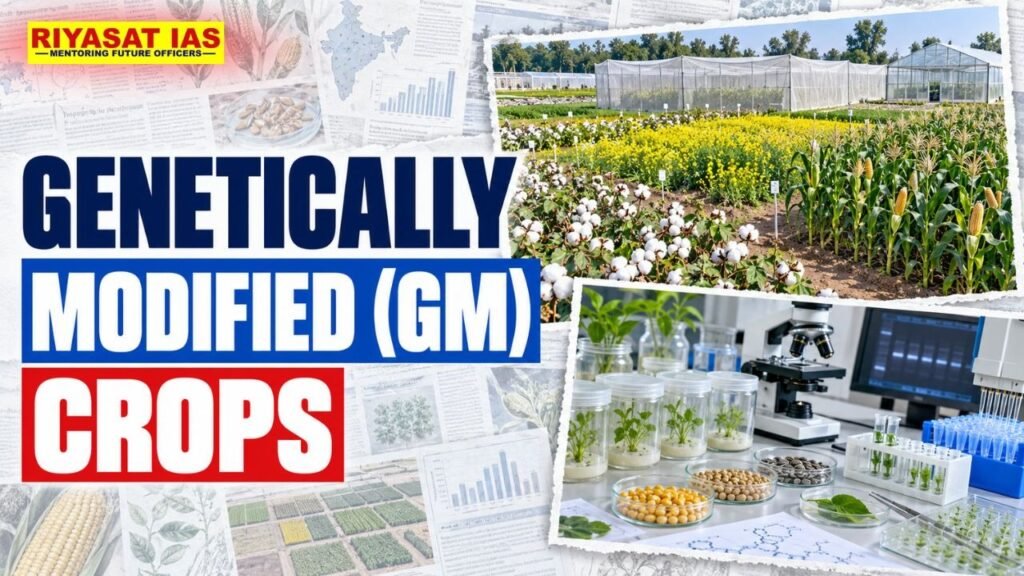
Genetically Modified (GM) Crops are plants whose genetic material has been altered using genetic engineering techniques to introduce or modify specific traits. These may include pest resistance, herbicide tolerance, increased nutritional value, etc.
Unlike traditional selective breeding that works with naturally occurring sexually compatible plants, modern biotechnology enables scientists to engineer specific desirable traits by introducing or modifying individual genes, including genes from unrelated organisms. The most prominent example in India is Bt cotton, which expresses a gene from the soil bacterium Bacillus thuringiensis.
Status of GM Crops in India
Bt Cotton – The Only GM Crop Approved for Commercial Cultivation
Bt cotton is the only genetically modified crop approved for commercial cultivation in India, with approval granted in 2002 under the regulatory framework involving the Genetic Engineering Appraisal Committee (GEAC). By expressing genes derived from Bacillus thuringiensis, it provides protection against certain destructive bollworm pests. Its adoption rate became widespread across the country, and initial government assessments noted reductions in bollworm damage and insecticide use.
However, it must be noted that Bt cotton is far from a silver bullet. Secondary pests as well as developing resistance – particularly in pink bollworm – have emerged as problems that can affect yields. Additionally, natural calamities and less-than-optimal soil and crop management can also contribute to variations in the nation’s cotton productivity:
| Crop Year | Productivity (kg/ha) |
| 2020–21 | 451 |
| 2021–22 | 428 |
| 2022–23 | 443 |
| 2023–24 | 436 |
| 2024–25 | 440 |
| 2025–26 (Prov.) | 431 |
GM Mustard – DMH-11
Dhara Mustard Hybrid-11 (DMH-11) is a transgenic mustard hybrid developed by the Centre for Genetic Manipulation of Crop Plants (CGMCP), University of Delhi. Due to mustard’s predominantly self-pollinating nature, creating a hybrid variety with higher yield than conventional counterparts proved challenging. This was achieved by utilising a three-gene system:
- barnase – switches off the male function of the plant’s flower, rendering it male sterile.
- barstar – restores the plant’s fertility, necessary for the production of hybrid seeds.
- bar – a gene that provides tolerance to glufosinate herbicide and serves as an important selection marker.
In October 2022, GEAC recommended the environmental release of DMH-11 and its parental lines for seed production and testing prior to commercial release, subject to specified conditions. The decision was subsequently challenged in court. This did not amount to approval for commercial cultivation.
Supreme Court Verdict on GM Mustard
A two-judge bench of the Supreme Court delivered a split verdict in July 2024 concerning the 2022 decision relating to the environmental release of GM mustard:
- Justice B.V. Nagarathna – held that the approvals were not sustainable and struck them down.
- Justice Sanjay Karol – upheld the GEAC decision, subject to the conditions laid down for the relevant field trials and activities.
The bench was evenly split and the matter was referred to a larger bench. The Court also directed the Central Government to formulate a National Policy on GM Crops after consultations with states, farmers, and independent experts/scientists.
Due to the ongoing judicial proceedings, it would be incorrect to describe DMH-11 as commercially approved or as merely “awaiting Ministry approval.”
Other GM Crops Under Research and Evaluation
Indian research institutions have explored various transgenic crops under confined conditions:
- GM brinjal
- GM mustard
- GM maize
- GM potato
- GM rice
- GM tomato
- GM chickpea
- GM rubber
- GM banana
- GM groundnut
It should be noted that these crops have been subject to laboratory, greenhouse, confined field or other research and evaluation activities. They are not approved for commercial cultivation merely because they have undergone such trials. Bt cotton continues to be the only GM crop permitted for large-scale commercial cultivation in India.
GM Crops Elsewhere
Elsewhere, transgenic crops are cultivated across North and South America and parts of Asia and Africa. Examples include:
GM Soybean
Herbicide-tolerant soybeans are widely cultivated in countries such as the United States, Brazil, and Argentina. They allow greater weed-control flexibility with certain broad-spectrum herbicides without harming the tolerant crop.



Bt Maize
Bt maize is widely cultivated in several countries, particularly in the Americas and South Africa. By producing insecticidal proteins derived from Bacillus thuringiensis, it provides protection from pests such as the European corn borer and armyworm, potentially reducing the need for insecticide spraying.
Golden Rice
Golden Rice is enriched with beta-carotene and was developed as a biofortified crop intended to help address vitamin A deficiency.
Because each nation evaluates the risks and benefits of transgenic crops differently, approvals are not uniform across countries.
Regulation of GM Crops in India
India’s transgenic crop research and commercialisation fall under the Environment (Protection) Act, 1986, as well as the 1989 Rules for the manufacture, use, import, export and storage of hazardous microorganisms and genetically engineered organisms or cells.
There are multiple regulatory and scientific bodies involved:
- Genetic Engineering Appraisal Committee (GEAC): The GEAC, under the Ministry of Environment, Forest and Climate Change (MoEFCC), is the key regulatory body concerned with the environmental release of genetically engineered organisms and products under the 1989 Rules. It evaluates proposals relating to environmental release and takes decisions/recommendations within the regulatory framework.
- Institutional Biosafety Committee (IBSC): Every university, laboratory, or company working with genetic engineering is required to have an Institutional Biosafety Committee (IBSC). It oversees the biosafety aspects of research involving genetically engineered organisms at the institutional level, including containment, handling, and supervision.
- Review Committee on Genetic Manipulation (RCGM):The RCGM, under the Department of Biotechnology (DBT), monitors the safety-related aspects of ongoing research and activities involving genetically engineered organisms and hazardous microorganisms. It also oversees relevant contained research and field-evaluation activities within its regulatory mandate.
- Indian Council of Agricultural Research (ICAR):The ICAR undertakes agricultural research and evaluation, including the assessment of agronomic performance of crops and varieties through appropriate field research and trials. Its role is primarily scientific and agricultural rather than serving as the environmental regulatory authority for GM crop approval.
Biosafety and Risk Assessment
Before commercial cultivation can begin – even on a limited scale – transgenic crop proposals undergo a rigorous case-by-case assessment looking at:
- Toxicological and allergenic effects – On humans, animals, the environment, and non-target organisms such as pollinators.
- Ecological impact – On soil, plants, biodiversity, and the food chain in general.
- Gene flow – The risk of pollen transfer to related plants and the possible introduction of modified genes into the gene pool of related plants or wild flora.
- Stability – The stability of the introduced genetic characteristics and their potential effects on agricultural ecosystems at local, regional, and wider levels.
Arguments in favour of GM Crops
- Increased Food Security: By virtue of potentially higher yields, reduced crop losses, or improved nutritional characteristics, GM crops can contribute to food supply and combat hunger, especially when staple crops are fortified with essential micronutrients.
- Targeted Pest Resistance: They can be engineered to resist specific insect pests by expressing proteins toxic to target insects, reducing crop damage.
- Resilience to Climate Shocks: Scientists can utilise genetic engineering to develop crop varieties with improved tolerance to environmental stresses such as drought, heat, and salinity.
- Nutritional Enhancement: Micronutrient-deficient populations may benefit from transgenic crops that are developed to synthesise or accumulate specific vitamins or other nutrients.
- Reduced Chemical Use: Certain GM traits, particularly insect-resistant traits, can reduce the need for some insecticide applications. However, the effect on chemical use depends on the crop, trait, pest pressure, and farming practices.
- Increased Farmer Profits: GM crops may improve farmer profitability where higher yields, reduced crop losses, or lower input costs outweigh the costs of seeds and other inputs. However, profitability varies according to local agricultural and market conditions.
Concerns and Disadvantages of GM Crops
- Health and Food-Safety Concerns: There are concerns about the long-term effects of consuming GM food, including the possibility of new allergens or other unintended effects. Such concerns are addressed through safety and risk assessments before regulatory approval.
- Biodiversity and Ecology: The introduction of genetically modified traits can raise concerns about gene flow, effects on non-target organisms, biodiversity, and ecological interactions.
- Herbicide Resistance: “Superweeds” and persistent broad-leaf weeds can become difficult to control, particularly where repeated use of the same herbicide contributes to the evolution of herbicide resistance.
- Pest Resistance: Similar to the above, target pests can develop resistance to the biochemical controls expressed by transgenic crops, reducing their effectiveness over time.
- Socio-Economics:There are concerns that patented seeds can be expensive and that hybrid seed saved by farmers may not retain the same combination of traits and performance, potentially increasing dependence on fresh seed purchases and affecting the economics of smallholder farming.
- Ethics:There are ethical concerns and questions about naturalness and the “unnatural” act of interfering with nature.
Bt Cotton – An Indian Lesson on GM Crops
India’s experience with Bt cotton demonstrates the importance of context-specific research, where biotechnology is only one part of the solution. While it helped in curbing losses due to susceptible bollworm pests, its effectiveness has also been affected by several factors, including:
- The development of pest resistance over time
- Variability in seed quality
- Differences in irrigation and water availability
- Local knowledge and training on refuge planting
- Appropriate technology application
Technology alone will not solve all problems – it has to be viewed in the larger context of local conditions and agricultural management. Transgenic technology should be seen as a part of a wider strategy to increase productivity and not as an end in itself.
Way Forward for GM Crops in India
- Scientific Research: There is a need for increased research, particularly in the area of indigenous biotechnology, that can provide appropriate solutions for local agro-climatic conditions and reduce excessive dependence on external technologies.
- Case-by-Case Assessment: GM crops should be evaluated on their individual merits and risks rather than being banned or allowed outright. Independent research should determine the risk-benefit profile for individual crops as well as their potential impact on the wider environment.
- Regulatory Oversight: State testing laboratories should be made more robust in their capacity to test and evaluate GM crops. The regulatory process should remain transparent, scientifically based, and adequately resourced to perform its functions efficiently.
- Transparency and Consultation: The results of biosafety testing should be made public. There should be a consultative process with farmers, states, and independent scientists/ecologists, as directed by the Supreme Court.
- Farmer Interests: Farmers should have a level playing field when it comes to purchasing GM and non-GM seeds. The economics of proprietary hybrid seeds should be evaluated to ensure that smallholder farmers are not unduly burdened.
- Post-Release Monitoring: Regulatory authorities should not rest on their laurels after a GM crop has been cleared for commercial cultivation. Independent monitoring of gene flow, secondary pests, resistance development, and economic outcomes is required to understand the long-term impacts.
- Integrated Agriculture: GM crops should be used as part of a wider strategy, including Integrated Pest Management (IPM), to manage insect pests rather than relying on single solutions.
Conclusion
Genetically modified crops offer potential benefits in terms of agricultural productivity, pest management, and nutritional enhancement, but they also raise environmental, health, and economic concerns that require case-by-case assessment. In India, Bt cotton is the only GM crop approved for commercial cultivation, while the issue of GM mustard highlights the legal, regulatory, scientific, and policy challenges associated with such technologies.
A balanced approach is required that weighs the potential benefits against the risks to the economy, the environment, agricultural systems, and food security.
FAQs on GM Crops in India
What are GM crops?
They are genetically modified plants with specific desired characteristics introduced or modified through genetic engineering techniques.
Which is the only GM crop approved for commercial cultivation in India?
Bt cotton received approval for commercial cultivation in India in 2002.
Is GM mustard approved for commercial cultivation in India?
GM mustard has not been approved for commercial cultivation in India. In October 2022, GEAC recommended the environmental release of DMH-11 and its parental lines for seed production and testing prior to commercial release, subject to specified conditions. The decision was challenged in court, and the Supreme Court delivered a split verdict in July 2024. The matter was referred to a larger bench.
What is DMH-11?
It is a transgenic mustard hybrid developed by Delhi University researchers using a three-gene system (barnase-barstar-bar) to facilitate hybrid seed production.
What is GEAC?
It stands for Genetic Engineering Appraisal Committee and is the key regulatory body under MoEFCC for assessing proposals relating to the environmental release of genetically engineered organisms under the applicable regulatory framework.
What are the 1989 Rules for GM crops?
They are the legal framework governing the manufacture, use, import, export and storage of hazardous microorganisms and genetically engineered organisms or cells, under the Environment (Protection) Act, 1986.
What are the benefits of GM crops?
They can confer resistance to specific pests, potentially reduce the need for certain chemical insecticides, provide tolerance to stresses such as drought or salinity, and offer enhanced nutritional properties.
What are the concerns with GM crops?
Gene flow, resistance development in target pests, potential effects on non-target organisms and ecosystems, economic concerns such as seed prices, and broader environmental and socio-economic effects are among the key issues.
Why is GM mustard important for India?
India imports a substantial quantity of edible oil every year, while mustard is an important indigenous oilseed crop. Developing efficient hybrid varieties may help increase domestic oilseed productivity and reduce dependence on imports.





 Ravi Raaz
 Hassan Khan
 Shadab Ali