
GS – II : Health | Governance | Public Policy
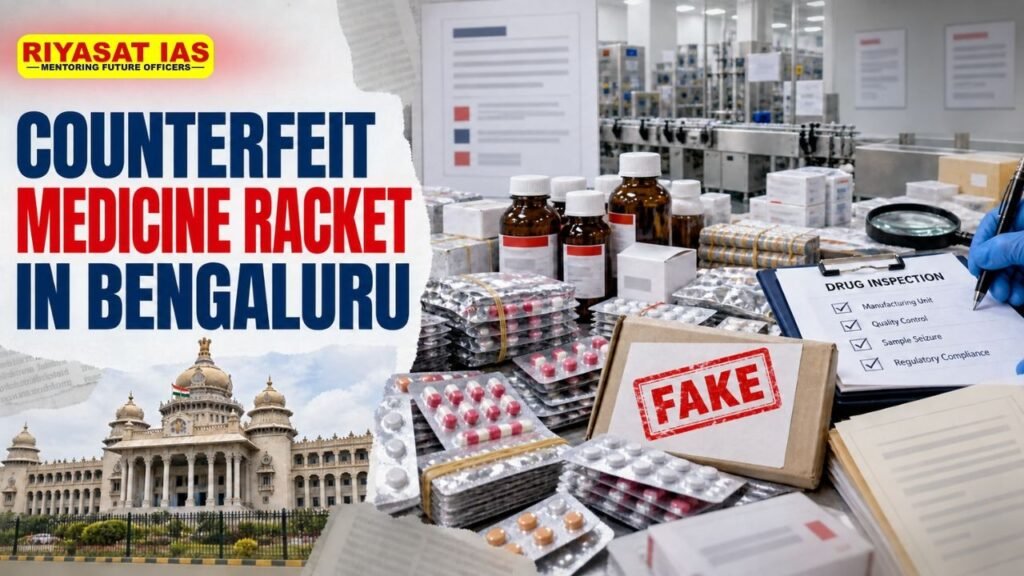
Counterfeit Medicine Racket
- Counterfeit Medicines: More than 90 hospitals and clinics in Karnataka were supplied with fake drugs, including relabelled or counterfeit medicines such as cancer drugs and ICU injections.
- Bidadi Raid : Raids on August 18 at an unlicensed farmhouse returned not only fake and expired drugs, valued in the labels ₹5 crore.
- Operation against counterfeiting: Fake and expired drugs were packaged and sold as fresh or expensive imported branded drugs at huge discounts, by manipulating the expiry dates.
- Investigation: Special Investigation Team set up to track larger racket, see inter-State links
- Hospital Network : Narcotic drugs sourced from a pharmacy in Bengaluru; probes on the role of private hospitals
- Patient Safety: Adverse reactions have been known to occur due to fake drugs, leading to serious disabilities and death especially when the administration is time sensitive.
Drug Quality Concerns
- Weak monitoring: India has struggled to provide effective as well as strong monitoring and quality control systems matching its ‘pharmacy of the world’ ambitions.
- Contaminated Medicines: Deaths due to cough syrup in India and abroad showed that systems are malfunctioning, involving a dent to the “Make in India” campaign.
- Quality Standards: Drugs and medical supply manufactured in India must satisfy the highest quality standards required.
Reasons for Poor Drug Safety Standards:
Inadequate Regulation and Enforcement
- The regulation of drugs and the cosmetics is based on Drugs and Cosmetics Act, 1940 which have become antiquated in terms of its ability to address the socio-economic complexities of modern pharma markets.
- Many aspects related to clinical trials, bioequivalence studies, good manufacturing practices etc., which are vital in assuring quality and safety of drugs, are not covered by the Act.
- The implementation of the Act is poor and disintegrated, as it involves many authorities at both central and state levels with overlapping jurisdictions and responsibilities



Inadequate Resources:
- Shortage of manpower, infrastructure, funds and technology affects effective inspections, testing, monitoring and surveillance of drug manufacturing units and products.
Lack of Transparency and Accountability:
- Central Drugs Standard Control Organization (CDSCO), India’s drug regulator, does not reveal much information regarding its activities, processes and outcomes to the publicand the media.
- There is paucity of any system to measure its effectiveness or impact on reduction in the number of sub-standard or spurious drugs.
- One more lacunae is lack of independent mechanism to ensure that the regulator works with independence and impartiality free from external influences (i.e. pressures) either from the government or the industry as is always on check for evey regulation attempted to be brought forth.
- You may also like Corruption, collusion and conflict of interest by officials: Pharmas unhappy with CDSCO’s arbitrary policy shift
- There have been allegations of corruption, collusion and conflict of interest among some officials of the CDSCO and some pharma companies.
Lack of awareness and compliance for all pharma companies
- Some pharma companies in India follow the drug manufacturing, testing, labelling, packaging and reading norms.
- A few pharma companies also engage in unethical or unlawful conduct, such as using non-compliant or fake active pharmaceutical ingredients, adulterating or dilution of drugs, falsification of data or documents and so on to reduce costs or increase profits.
- They often do not have any awareness or knowledge of what restrictions, regulations or guidelines are associated with different markets/countries.
- It means that they might be lacking in quality control systems or strategies capable of identifying, detecting or preventing errors or defects within its products.
Way Forward
- Regulate: Enhance drug regulation, inspection regime and strengthen quality control systems
- Boosting Resources: Provide manpower,infrastructure,funding and technology.
- Enhance Accountability: Increase the transparency, independence and accountability of regulators
- Trace Supply Chains : Build testing, monitoring and surveillance capacity in the drug supply chain.
- Make Sure: Adhere to prescribed parameters for production, testing, labelling, packing and storing.
Conclusion
Robust regulation and stringent quality control, backed by effective enforcement is paramount to ensure patient safety and keep India as the ‘pharmacy of the world’.
UPSC Mains Practice Question
Q: Lack of regulation, ineffective enforcement and lax compliance are part of the problem on substandard and spurious drugs in India. Identify reasons and recommend ways to enhance standards of drug safety.




 Ravi Raaz
 Hassan Khan
 Shadab Ali