
GS-II – International Relations | India–U.S. Relations | GS-III – Indian Economy | External Trade
Why in News?
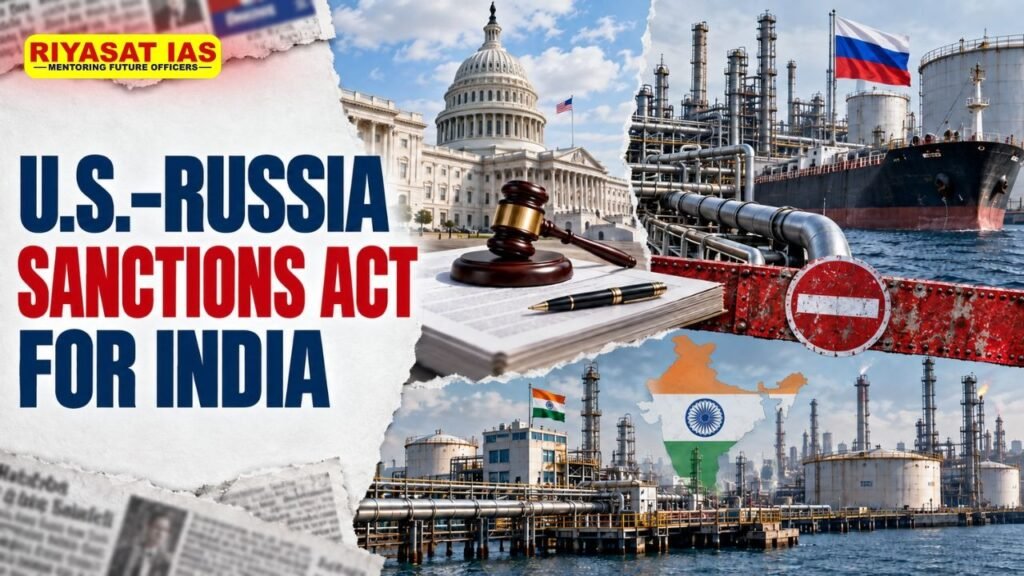
- U.S. Russia Sanctions Act: Signed into law by President Donald Trump, it allows tariffs of up to 100% on countries like India importing high levels of Russian oil and gas.
- Legal Permanence : the U.S. Congress passed this taking and it became law, unlike previously imposed tariffs based solely on executive order. Presidential exemptions have to be justified in writing to Congress.
- Dire Consequences: The tariffs can render Indian exports uncompetitive, harm MSME exporters.
Key Concerns for India
- Increased cost of Tariff: The new 100% tariffs would be additional to the already-in-place 10% ‘forced labour’ tariffs and steel and aluminium Section 232 tariffs (50%).
- MSME Impact: Sharing the earlier 50% levy burden with US customers proved to be financially unsustainable. Competing a 100% tariff would be quite impossible for many if not all of the MSME exporters.
- Lose Your Export Competitiveness- If imposed, the proposed tariffs would make Indian exports to U.S. un-competitive
- Trade Dependence: The U.S. is India’s largest export partner, consisting of approximately 20% of total goods exports in the trade relation to both countries.
- What history shows: India have a habit for submitting to U.S. pressure to cut oil imports from target countries including Russia, even if its protestations of strategic autonomy
India’s Options
- Slashing Russian Petrol Purchases: The suggested fee should help cut imports.
- Keep Imports and Bear Tariffs: If you still want imports coming in from Russia, accept the adverse externalities that will hit MESEs and exports.
- Lower Tariff: Get the U.S. to agree to less than 100% tariff (law says up to 100%)



Challenges in Diversifying Oil Imports
- Dependence on Russia : As of July 2026, more than 51% of India oil imports were from Russia.
- Alternative Supply Constraints: Supplies through the Strait of Hormuz remain constrained.
- Higher Oil Prices: Oil prices having held north of $100 per barrel, it continues to be increasingly complicated negotiating favorable agreements with new suppliers.
- Alternative Infrastructure: India needs to expedite new ports in nations like Oman.
Way Forward
- Multi-pronged Approach : Negotiate a lower tariff at G-20: Commerce Minister Piyush Goyal has planned an upcoming visit to the U.S. to attend the G-20 Trade Ministerial.
- Tariff Negotiations: Source for lower rate with 30 days remaining before tariffs by the U.S.
- Diversification of Oil Supply: Participate in identifying new alternative suppliers and to expand the existing alternative ports.
- Safeguarding Exporters: Assess the negative impact of increased tariffs on Indian exporters; focus should be given to micro, small and medium-sized enterprises (MSMEs).
Conclusion
- During this time, from October 2023): The U.S. Russia Sanctions Act is an extremely serious increase in India–U. S. trade tensions.
- India is faced with the dilemma of achieving energy security and its aspiration for high-value exports without compromising on strategic autonomy.
- Securing a lower tariff through negotiations will be an important test of India–U.S. relations.
UPSC Mains Practice Question
Q. In the words of U.S. Secretary of Energy Rick Perry, the U.S. Russia Sanctions Act poses an existential threat to India’s energy security and export aspirations. How should one understand its implications for India and how to respond




 Ravi Raaz
 Hassan Khan
 Shadab Ali