
GS-II Health | Governance | Public Policy
Why in News?
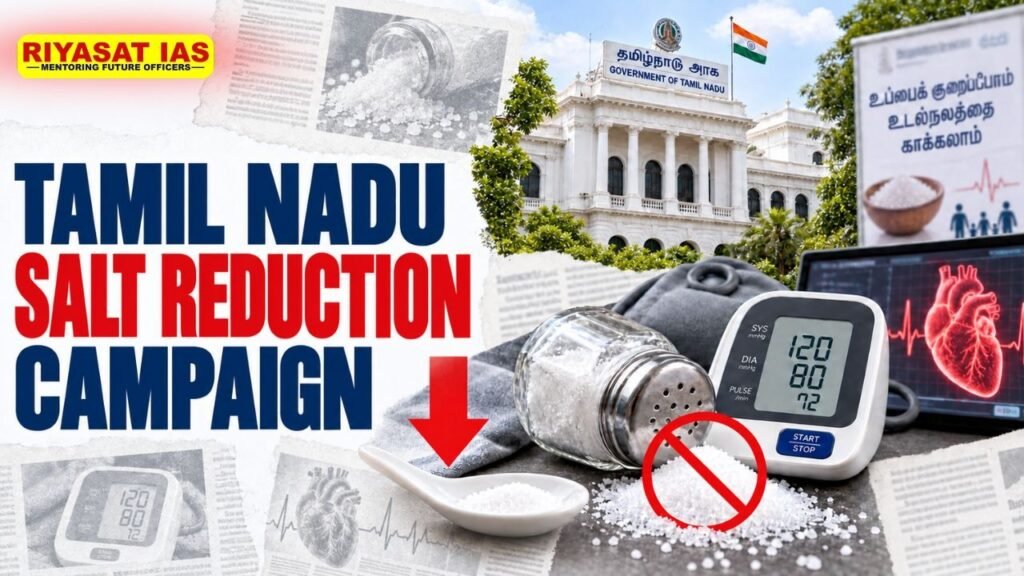
- Salt Reduction Mission: Tamil Nadu Health Minister K.G. Arunraj on Sunday announced a set of multi-pronged plan to reduce the intake of salt
- Public Health Approach: Focuses on the correct amounts and types of salt consumption while also recalibrating the perception of well-being
Salt and Human Health
- Salt plays an essential role in hydrating, nerve signalling, muscle contraction, digestion and stress physiology.
- Health Risks: Harmful excess of salt (you get this with ultra-processed foods) increases risks of stroke and heart disease, as well as kidney strain.
- Salt intake in India: Surveys show average daily consumption as 8.9 gms and 7.1 gms by men and women – September 8, 2023
- The WHO issued new suggestions in January 2025 for usage of low-sodium salt alternatives, with a recommendation to limit salt consumption to less than 5 gms per day .
- Prevalence of hypertension among adults in Tamil Nadu: A cross-sectional study by Selvavinayagam T.S. et al from October 2024 estimated that nearly one-third (33.9%) of adults were hypertensive, exceeding the national prevalence of 28·5%.
- Hypertensive Link: When you take a lot of salt, your physique retains more water to discount the surplus sodium in order that blood quantity and strain on artery walls will increase generating scientific hypertension.
Action Plan
- Statewide survey: A pioneering statewide study using urine samples will objectively quantify salt intake.
- Government kitchens — decreasing gradually in the Nutritious Meal Programme, ICDS centres and also government hospitals & hostels
- Low Sodium Alternative: Analysis of the plausibility of introducing low sodium salts alternatives will be provided.
- Eat Smart: Read food labels, taste before salt and eat natural flavour enhancers — Awareness Campaign
- Control of hypertensive: Makkalai Thedi Maruthuvam and other public health care institutions must step up activities.
- Patient Support: People diagnosed with hypertension will get systematic counseling and anti-hypertension medication.



Evidence and Expert Views
- Clinical Trial: A 2021 randomised, double-blind, controlled trial reported in the American Journal of Clinical Nutrition found that replacing salt with a reduced-sodium, added-potassium substitute was an acceptable and effective intervention for lowering systolic blood pressure in people with hypertension in rural India.
- Global Impact: A U.K. campaign launched by Graham MacGregor in 2005 led to approximately a 30 percent reduction of salt in bread.
- Preventable risk G. Sengottuvelu, senior interventional cardiologist, Apollo Hospitals, has listed excess salt among the top five important and preventable causes of rise in blood pressure leading to heart attack and stroke
- Dietary Habits: The preference for salty food among Indians is a largely-acquired taste, usually established in childhood, and can be trained away when salt is reduced gradually (Read Full Story)
Way Forward
- Scientific Approach: Execute the program with scientific rigor and cultural awareness.
- Gradual Reduction: Support gradual salt reduction so that individuals can adjust their palate.
- Scale up Hypertension: Expand screening, counselling and management for hypertension in public health institutions.
- Inter-State Learning: The Tamil Nadu programme can be emulated by other States.
Conclusion
Mr Harris said that consuming less salt was a cheap, easy and effective dietary step that can significantly enhance heart health and help prevent hypertension (high blood pressure), myocardial infarction (heart attack), stroke and kidney disorders.
UPSC Mains Practice Question
Q. Excess salt consumption is an important preventable risk factor for the development of hypertension and cardiovascular diseases. Despite all this, the great salt reduction initiative in Tamil Nadu has been presented as a success story for healthier dietary practices across India.




 Ravi Raaz
 Hassan Khan
 Shadab Ali