

Tolerance involves recognizing and respecting the beliefs, practices, and identities of others, even when they differ from one’s own. In a world characterized by diversity and complexity, tolerance is essential for fostering mutual respect, understanding, and cooperation among individuals and communities.
Significance of Tolerance
- Promotes Social Harmony: Tolerance allows people from different backgrounds and beliefs to coexist peacefully, which significantly reduces the likelihood of conflicts. For example, festivals like Diwali, Eid, Christmas, and Gurpurab are celebrated across the country, reflecting the cultural acceptance of multiple religions.
- Encourages Open-mindedness: It encourages individuals to be open-minded, broadening their perspectives and enhancing their capacity to understand and appreciate differences.
- Supports Democratic Values: Tolerance is a fundamental democratic value that enables free expression, dialogue, and public participation. It ensures that all voices are heard and respected, promoting a vibrant and inclusive democracy.
- Reduces Discrimination and Prejudice: By promoting acceptance and understanding, tolerance directly helps reduce discrimination and prejudice, fostering equality and justice.
- Enhances Social and Economic Development: Tolerance contributes to a stable and peaceful society, which creates an environment where innovation and collaboration can flourish. For example, the historical economic success of Mumbai highlights how tolerance and inclusivity drive macroscopic growth and development.
Challenges to Tolerance
- Historical Conflicts and Prejudices: Historical animosities and deeply ingrained prejudices can severely hinder efforts to promote tolerance. For example, the lingering generational effects of the partition of India and Pakistan in 1947 continue to influence communal relations in some parts of the country.
- Socio-economic Inequality: Economic disparities and social inequalities fuel resentment and intolerance, as marginalized groups feel structurally excluded and discriminated against.
- Political Polarization: Political ideologies and agendas can exacerbate divisions and promote intolerance, particularly when leaders use divisive rhetoric to gain support. For example, instances of localized communal violence, such as the Delhi or Nuh riots, highlight how political polarization leads directly to intolerance and conflict.
- Lack of Education and Awareness: Ignorance and a lack of awareness about different cultures, religions, and lifestyles lead to systemic misunderstandings and intolerance.
- Media Influence: Media can either promote tolerance by showcasing diversity and inclusive narratives or fuel intolerance through biased reporting and sensationalism.
Tolerance vs. Acceptance
The structural boundaries between tolerance and acceptance can be evaluated across multiple psychological dimensions:
| Aspect | Tolerance | Acceptance |
| Attitude | Open-minded towards diverse perspectives. | Fully embracing diverse perspectives. |
| Beliefs | Allowing others to hold different beliefs. | Embracing and celebrating different beliefs. |
| Coexistence | Coexisting peacefully despite differences. | Fully integrating differences. |
| Discomfort | Can involve internal discomfort or disagreement. | Embracing without judgment or discomfort. |
| Respect | Fosters mutual respect. | Fosters inclusivity and belonging. |
| Biases | Can still maintain personal biases. | Embracing others without biases. |
Strategies to Promote Tolerance
- Education and Awareness Programs: Integrating comprehensive lessons on cultural diversity, empathy, and respect for differences into educational curricula fosters tolerance from a young age.
- Community Engagement and Dialogue: Encouraging interaction among different community groups breaks down stereotypes and builds mutual understanding. For example, initiatives like the “Sadbhavana Mission” (Goodwill Mission) aim to promote tolerance directly through public dialogue.
- Inclusive Policies and Legislation: Governments can enact responsive public policies and laws that guarantee equality and legally protect against discrimination.
- Media Responsibility: Media outlets should strive to present balanced, unbiased reporting, actively highlighting positive stories of cross-community cooperation and understanding. For example, campaigns like “Aman ki Asha” (a joint initiative by the Times of India and Pakistan’s Jang Group) aimed to foster peace between India and Pakistan through cultural exchange.
- Leadership and Role Models: Leaders and public figures play a crucial role in promoting tolerance by setting a visible personal example and advocating for inclusive values. For example, Mahatma Gandhi’s core principles of non-violence and tolerance continue to inspire movements for peace and justice globally.



Dedication to Public Service
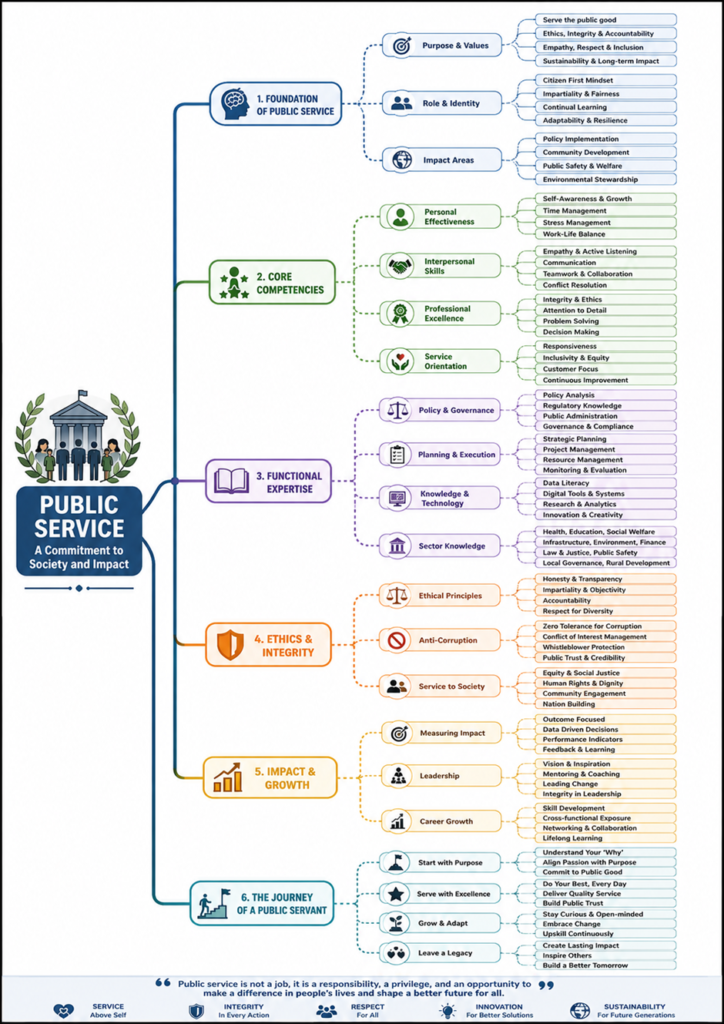
As Mahatma Gandhi poignantly remarked, “The best way to find yourself is to lose yourself in the service of others.” Dedication to public service is the cornerstone of an effective, responsive, and accountable government. It entails a strict commitment to the welfare of the public, integrity in action, and an intrinsic drive to serve with efficiency and empathy.
Importance of Dedication to Public Service
- Ensures Efficient Service Delivery: Commitment to public service ensures that government welfare targets are delivered efficiently and effectively, meeting the needs of the public in a timely manner. For example, the execution of the Aadhaar project showcases dedication to streamlining public services and improving access to welfare programs.
- Builds Public Trust: When public servants are dedicated to their roles, it builds deep trust and confidence among the citizens in their government. For example, E. Sreedharan, known as the “Metro Man,” earned immense public trust through his dedication and efficient execution of the Delhi Metro project.
- Promotes Accountability and Transparency: Dedicated public servants are significantly more likely to uphold high standards of accountability and transparency, ensuring that public resources are used appropriately. For example, T.N. Seshan demonstrated unparalleled dedication by implementing strict electoral reforms to ensure free and fair elections.
- Encourages Innovation and Problem-Solving: Dedication drives public servants to find innovative solutions to complex, systemic problems, improving public administration and addressing societal challenges effectively.
- Enhances Social Equity: A genuine dedication ensures that the needs of all segments of society, especially the marginalized and vulnerable, are addressed equitably. For example, K.R. Venugopal, an IAS officer, showed a deep commitment to improving the lives of the rural poor through various targeted poverty alleviation programs.
Factors Determining Dedication
- Salary and Perks: Act as sources of essential external motivation, encouraging employees to stay dedicated to their organizational tasks.
- Working Hours: An optimal level of working hours ensures employee commitment and a stable work-life balance.
- Work Environment and Conditions: A highly competitive and professional environment motivates individuals to work hard, while a lethargic work culture leads directly to administrative inefficiency and a lack of dedication.
- Workload Management: An evidence-based approach to workload limits unnecessary burdens on public servants, which enhances their functional efficiency and dedication.
- Internal Motivation: Higher-order psychological factors like self-actualization, self-realization, and human values such as selflessness and perseverance are critical drivers of long-term dedication.
Qualities Exemplifying Dedication to Public Service
- Integrity: Acting with honesty and strong moral principles is fundamental, ensuring that public servants remain unbiased and focused solely on the public good.
- Empathy: Understanding and addressing the needs and concerns of the public with deep compassion is vital for effective public service. For example, Armstrong Pame (IAS) built a 100-km road in a remote part of Manipur using funds raised through social media, demonstrating deep empathy for the local community’s infrastructure needs.
- Commitment: A strong sense of responsibility to one’s duties ensures that public servants work tirelessly towards achieving public welfare.
- Accountability: Taking explicit responsibility for one’s actions and decisions ensures transparency and trust in public service. For example, Santha Sheela Nair took accountability seriously in her nationwide implementation of rainwater harvesting projects in Tamil Nadu.
- Resilience: The ability to persevere through intense bureaucratic challenges and adversities is crucial for public servants facing complex and demanding situations.
Inspiring Examples from Indian Administration
- Aruna Roy: She left the elite Indian Administrative Service (IAS) to work at the grassroots level and was instrumental in leading the historic Right to Information (RTI) movement in India.
- Smita Sabharwal: Known as the “People’s Officer,” she implemented several citizen-centric initiatives in Telangana, including her “Fund Your City” project, reflecting her commitment to public service.
- R. S. Praveen Kumar: As an IPS officer, he was instrumental in transforming the educational landscape for marginalized communities in Telangana through his work with the Telangana Social Welfare Residential Educational Institutions Society (TSWREIS).
- Ajit Doval: As the National Security Advisor, he has demonstrated dedication to national security through his strategic and decisive actions in counter-terrorism and national defense, reflecting an unwavering commitment to public service.
Case Study Analysis
Context & Dilemma
A notorious criminal, Vijay Sharma, dies in police custody at a high-security facility, with the official medical report citing a sudden cardiac arrest. However, family members and human rights groups allege custodial torture, sparking massive outrage on social media and polarizing news media cycles. As the Superintendent of Police (SP), you face a severe dilemma: you must ensure a completely transparent, fair investigation into potential police misconduct while simultaneously managing the internal morale of your officers, who feel unfairly accused in the court of public opinion.
Ethical Issues Involved
- Upholding the Rule of Law: Protecting the fundamental right to life and due legal process, ensuring that even a notorious criminal is treated strictly within statutory boundaries.
- Institutional Integrity vs. Esprit de Corps: Balancing the duty to expose internal police wrongdoing with the administrative need to safeguard organizational morale.
- Public Accountability and Trust: Managing public suspicion and media pressure by adhering to absolute objectivity and institutional transparency.
Evaluation of Strategies
- Strategy 1: Conduct an Internal Inquiry by Local Station Officers
o Pros: Fast execution, allows the department to review facts quickly before public release.
o Cons: Severe deficit of public trust; carries a high risk of being perceived as an administrative cover-up or institutional bias.
- Strategy 2: Mandate an Immediate Independent Judicial Probe
o Pros: Aligns strictly with statutory requirements (Section 176 CrPC/BNSS); maximizes institutional transparency and restores public credibility.
o Cons: May temporarily lower internal police morale if the force perceives the administration as yielding instantly to media narratives.
Action Plan & Measures to Restore Trust
- Immediate Statutory Compliance: Instantly hand over the investigation to an independent Judicial Magistrate for a mandatory inquiry, and transfer the immediate handling staff to ensure an un-influenced, objective probe.
- Transparent Post-Mortem Audit: Ensure the video-recorded autopsy is reviewed by an independent forensic board of doctors outside the local jurisdiction, sharing verified scientific data openly to counter viral misinformation.
- Internal Counseling and Accountability: Hold open communication rounds with the police force to reinforce that an objective investigation protects upright officers, while simultaneously installing automated CCTV monitoring setups across all custody cells to institutionalize absolute future accountability.
Practice Questions
Question 1 “Altruism and a sense of duty are fundamental to dedication in public service.” Discuss how these values influence the performance and decision-making of public servants. (10 marks, 150 words)
Question 2 “Tolerance towards differing opinions and practices is crucial for maintaining democracy.” Discuss with examples from various democratic societies. (10 marks, 150 words)
Question 3 “The modern civil servant must operate in an increasingly polarized socio-political environment, where demonstrating passive tolerance is insufficient, and active, empathetic acceptance of diversity is required.” Critically analyze the relevance of this statement for maintaining secular governance in India. (10 marks, 150 words)



 Ravi Raaz
 Hassan Khan
 Shadab Ali