
Values are crucial elements of civil service, playing a pivotal role in shaping, guiding, and informing behavior. Adherence to robust public service values can foster significant public trust and confidence, enhancing the effectiveness of governance. Conversely, the weak application of these values, or the promotion of inappropriate ones, can erode key aspects of democratic governance and lead to ethical dilemmas and decision-making challenges.
Despite the enactment of laws, rules, and regulations aimed at ensuring impartiality, honesty, and dedication among civil servants, there remains a significant scope for administrative discretion that cannot be fully regulated by formal legal frameworks. As Otto Kirchheimer articulates, “No supervision from above can be as effective as an automatic control within the minds of those who possess it,” which can be achieved by establishing and adhering to specific value standards that civil servants must follow.
Foundational Values for Civil Service
- Devotion to Work: Emphasizes the intrinsic value of public service, inspired by selfless service traditions like Nishkama Karma. Public servants should draw long-lasting inspiration from figures like Dr. A.P.J. Abdul Kalam.
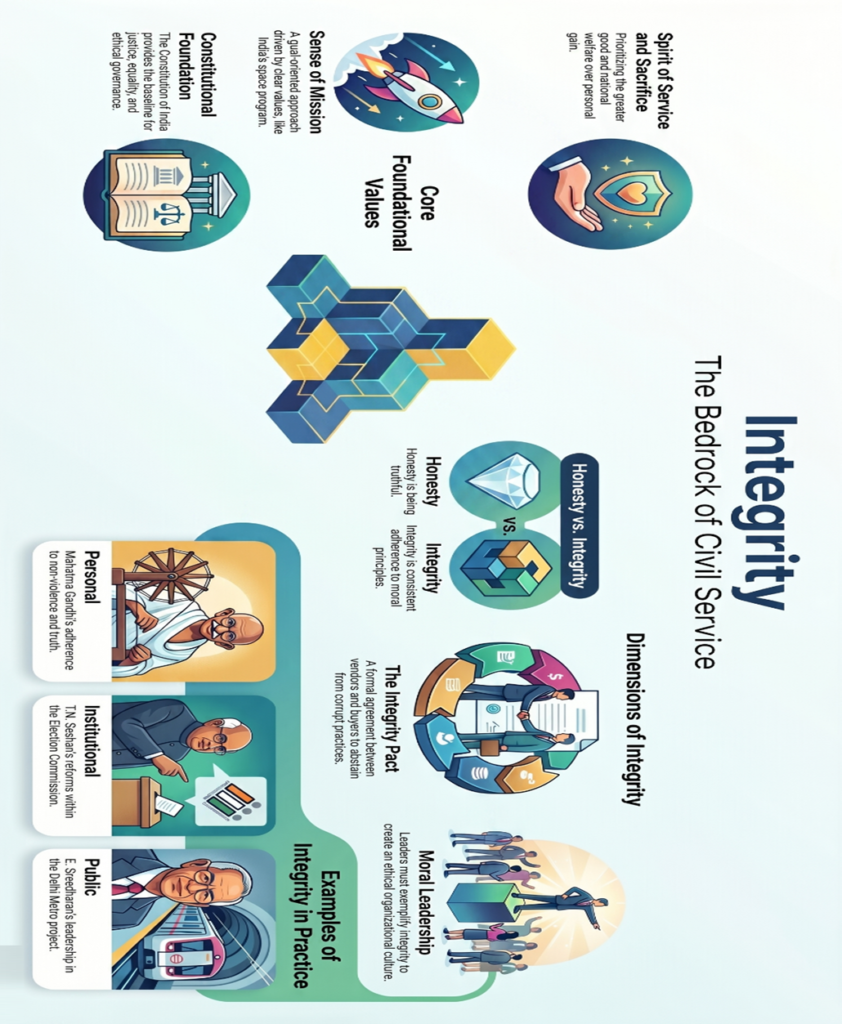
- Honesty and Integrity: Maintaining strict ethical standards, actively avoiding personal gain, and resolving potential conflicts of interest. Integrity involves consistent adherence to moral principles, even under severe external pressure.
- Fearlessness and Courage: Upholding principles and demonstrating moral courage, especially in challenging or high-pressure situations. Figures like J. F. Ribeiro illustrate the positive impact of courageous public service.
- Sense of Mission: Public servants should be driven by a mission-focused approach, guided by clear operational goals and constitutional values, as seen in India’s space program and ‘Operation Flood’.
- Spirit of Service and Sacrifice: Inspired by classical philosophical traditions, public service must always prioritize the greater good over narrow personal gain, reflecting a deep commitment to national welfare and community development.
Example:
Mission-Driven Public Overhauls: The massive administrative deployment of Mission Amrit Sarovar across Indian districts to rejuvenate thousands of water bodies, or the automated tech integration under Mission Karmayogi. These represent structured frameworks transforming regular bureaucratic routines into high-impact, value-driven missions.
Sources of Foundational Values
- Statutory Codes: The Central Services (Conduct) Rules, 1964 and All India Services (Conduct) Rules, 1968 define the expected behavior and ethics for civil servants, explicitly emphasizing integrity, devotion to duty, and avoiding conduct unbecoming of a public servant. They mandate strict adherence to ethical standards and absolute professionalism in service delivery.
- Patriotism and National Interest: Civil servants are expected to prioritize the national interest, maintain confidentiality, and protect sensitive data that could impact national security. This is exemplified by the constitutional requirement for public ministers and sensitive officials to take a sovereign oath of secrecy.
- The Constitution of India: The Constitution serves as the ultimate supreme source of values for civil servants, outlining the core principles they must uphold, such as justice, equality, fraternity, and respect for fundamental rights. These constitutional values provide a permanent baseline for ethical governance and public service.
Importance of Foundational Values
- Efficient and Effective Civil Service: Foundational values ensure civil servants operate with integrity and commitment, leading to efficient public service and enhanced quality of governance.
- Upholding Public Trust: Civil servants act as an active bridge between the government and citizens. By maintaining high ethical standards, they ensure public trust in governance is strongly upheld.
- Essential for Ethical Governance: The embodiment of values such as objectivity, fairness, and transparency is crucial for running an equitable administration.
- Regulating Conduct and Behavior: Foundational values are essential in reforming the attitudes of civil servants, particularly toward historically marginalized communities, preventing exploitation and neglect.
- Preventing Misuse of Discretionary Powers: With significant discretionary powers, civil servants must avoid cognitive dissonance and systemic abuses of power. Foundational values serve as a psychological safeguard against these risks.
- Upholding Laws and Regulations: The execution of legal policies requires civil servants to internalize key values. Their commitment to upholding the constitution and the law is fundamental to maintaining public order and distributive justice.
- Serving the Public Interest: As highlighted in landmark judicial precedents like the Vineet Narain judgment, public officials must exercise their powers solely in the public interest. Upholding foundational values through structured incentives and exemplary behavior helps align civil service actions with the public good.
Integrity



“Integrity without knowledge is weak and useless, but knowledge without integrity is dangerous and dreadful.” — Samuel Johnson
“Integrity is doing the right thing, even when no one is watching.” — C.S. Lewis
“Real integrity is doing the right thing, knowing that nobody’s going to know whether you did it or not.” — Oprah Winfrey
Stephen L. Carter, in his book Integrity, defines it as: “discerning what is right and what is wrong; acting on what you have discerned, even at personal cost; and saying openly that you are acting on your understanding of right and wrong.” Simply put, integrity refers to the quality of being honest and possessing unyielding moral principles. It is about demonstrating absolute consistency in actions, values, methods, measures, and principles across all situations.
Types of Integrity
Personal Integrity
Refers to an individual’s adherence to their own moral and ethical principles, maintaining honesty and consistency between internal beliefs and outward actions. Individuals with high personal integrity are trusted because they do not compromise their values for personal gain. For example, Mahatma Gandhi exemplified personal integrity by adhering to non-violence and truth even in the face of severe adversity.
Professional Integrity
Involves upholding the specific ethical standards, responsibilities, and codes of conduct prescribed for one’s profession, ensuring fairness and honesty in professional duties. It is crucial for maintaining public confidence in institutions. For example, Kiran Bedi demonstrated a strong commitment to justice and fought systemic corruption within the police force throughout her career, reflecting professional integrity.
Institutional Integrity
Pertains to the adherence to ethical standards by an entire organization or administrative body, ensuring transparency, structural accountability, and consistency in its daily operations. It is vital for public institutions to ensure they serve the public interest effectively and fairly. For example, under the leadership of T.N. Seshan, the Election Commission implemented strict electoral reforms, significantly enhancing its institutional credibility and public trust.
Public Integrity
Refers to the strict adherence to ethical standards in all dealings with the general public and in the execution of public duties, ensuring complete fairness, accessibility, and impartiality. Public integrity fosters trust between citizens and public institutions. For example, E. Sreedharan, known as the “Metro Man” of India, exemplified public integrity through his transparent and non-partisan leadership in the Delhi Metro project.
Intellectual Integrity
Involves maintaining absolute honesty, rigor, and openness in academic, cognitive, and intellectual pursuits, ensuring that one’s work, reports, and arguments are based on sound empirical evidence and logical reasoning, rather than personal bias. For example, Amartya Sen’s rigorous and honest approach to welfare economic research and his willingness to engage constructively with opposing viewpoints reflects intellectual integrity.
Moral Integrity
Involves consistently adhering to universal ethical and moral principles, making decisions and taking actions that align with these principles even when it is difficult, inconvenient, or professionally risky. It involves being truthful, just, and fair. For example, Justice V.R. Krishna Iyer’s lifelong commitment to human rights and victim-centric jurisprudence throughout his career serves as a reflection of moral integrity.
Honesty vs. Integrity
- Honesty is primarily about being truthful, telling the facts, and standing by one’s spoken words. It involves straightforward communication and the objective acknowledgment of facts, even when they may not be favorable.
- Integrity, on the other hand, is a much broader psychological and moral concept. It encompasses honesty but goes further by demanding a continuous, active, and holistic adherence to moral and ethical principles. It requires that one not only tells the truth but also acts in perfect alignment with core values and standards across all domains.
- Honesty without Integrity: A person can be technically honest by admitting they lied, cheated, or made a deliberate mistake, but this does not mean they possess integrity if they continue to frequently engage in dishonest or corrupt behaviors.
- Integrity without Honesty: This is philosophically impossible because integrity inherently requires truthfulness as a non-negotiable core component. Without honesty, one cannot truly embody integrity.
Importance of Integrity in Civil Services
- Public Trust: Integrity builds the initial trust between the public and the civil service. When civil servants act with integrity, they earn the confidence and respect of ordinary citizens. For example, T.N. Seshan is revered for his unwavering integrity in ensuring free and fair elections, significantly boosting public trust in the electoral process.
- Ethical Governance: Integrity ensures that administrative decisions and policy actions are based on ethical considerations, actively promoting fairness, justice, and equality. For example, Ashok Khemka’s commitment to ethical governance gets reflected in his fight against corruption.
- Consistency and Reliability: Integrity fosters predictability, stability, and reliability in public administration, ensuring that citizens are treated uniformly without favoritism.
- Moral Leadership: Integrity in leadership sets an unyielding benchmark for others within the organization to emulate, cultivating an ethical organizational culture. For example, E. Sreedharan led the Delhi Metro project with exemplary integrity, ensuring timely completion and setting high standards for transparency and accountability.
Challenges to Integrity in Civil Services
- Systemic Corruption: The presence of organized corruption syndicates can severely undermine administrative integrity, leading to public exploitation and institutional decay. For example, D.K. Ravi, who took a strong stand against the land mafia in Karnataka, faced severe threats and pressures that challenged his integrity.
- Political Pressure: Civil servants frequently face immense pressure from political executives to act in ways that directly compromise their integrity or favor partisan interests. For example, Ashok Khemka’s frequent transfers are a testament to the political pressures that civil servants face when they uphold integrity over political expediency.
Example: Upholding Rule of Law Against Pressure: Upright regulatory officers refusing to clear non-compliant, ecologically hazardous industrial projects or commercial land deals despite facing immediate threats of punitive transfers, demotions, or false disciplinary litigations. This highlights the real-world friction between professional integrity and political expediency.
- Lack of Ethical Training: Without proper ethical training and awareness, civil servants may struggle to maintain integrity. The introduction of mandatory ethics training in civil services aims to address this gap and reinforce the importance of integrity.
Best Practices
- Honesty Shops Initiative: Originated in Kerala schools, this best practice targets the early inculcation of values. These shops operate entirely without a salesperson; students select the items they wish to purchase from a displayed price list and voluntarily drop the exact payment into a collection box, fostering a culture of trust and unsupervised integrity.
- Integrity Pact: A highly effective vigilance tool designed to ensure absolute transparency and ethical behavior in large public procurement and infrastructure processes. It involves a formal binding agreement between prospective private vendors and the public buyer, where both parties commit to completely abstaining from any corrupt practices throughout the contracting process.
- Second ARC Recommendations on Integrity: * Prohibited Actions: Public officials must not misuse their official positions by leveraging insider information acquired during their duties for personal or familial gain. They must avoid accepting gifts, hospitality, or post-retirement corporate favors that could compromise their impartiality or judgment. They must not disclose confidential information without proper legal authorization.
o Required Conduct: Public officials are expected to maintain a professional demeanor that inspires and retains public confidence , ensure the efficient use of public funds and resources , engage in open and transparent dealings, and comply with all principles of administrative justice.
Way Ahead: Fostering Integrity in Civil Services
- Ethical Training and Education: Providing regular, case-study-driven training on ethics, conflict resolution, and values to civil servants throughout their careers.
- Robust Legal Framework: Enforcing anti-corruption laws through institutional bodies like the Lokpal and Lokayuktas to penalize malpractice and protect honest officials.
- Promoting a Culture of Integrity: Introducing institutional rewards and public recognition, such as the Prime Minister’s Award for Excellence in Public Administration, to motivate upright conduct.
- Leadership by Example: Senior administrators must explicitly exemplify integrity in their daily actions and decisions to set the correct moral template for their subordinates.
- Transparency Frameworks: Implementing automated tech systems, open data dashboards, and rigorous audit mechanisms to hold public servants directly accountable for their actions.
Previous Year Questions
Q. “Integrity without knowledge is weak and useless, but knowledge without integrity is dangerous and dreadful.” What do you understand by this statement? Explain your stand with illustrations from the modern context. (10 Marks, 150 Words)
Q. One of the tests of integrity is complete refusal to be compromised. Explain with reference to a real-life example. (10 Marks, 150 Words)
Q. “Integrity is a value that empowers human beings.” Justify with suitable illustration. (10 Marks, 150 Words)
Practice Questions
| Question 1 Examine the relevance of the following pairs in the context of civil service:Moral Integrity vs Professional EthicsInstitutional Integrity vs Public Trust (10 marks, 5 x 2) |
| Question 2 “A strong moral compass is essential for effective leadership.” Discuss how integrity influences leadership in public service, citing examples of leaders known for their ethical conduct. (10 marks, 150 words) |
| Question 3 “The modern administrative state uses automated algorithms and legal frameworks to enforce formal honesty, yet it lacks the mechanisms to cultivate deep internal integrity within its civil servants.” Critically analyze this statement in light of the Second ARC recommendations on public ethics. (10 marks, 150 words) |



 Ravi Raaz
 Hassan Khan
 Shadab Ali