
“If you don’t like something, change it. If you can’t change it, change your attitude.” — Maya Angelou
“The only disability in life is a bad attitude.” — Scott Hamilton
“Our attitude towards life determines life’s attitude towards us.” — John Mitchell
Attitude: Definition
In their seminal work The Psychology of Attitudes, Eagly and Chaiken defined attitude as “a psychological tendency expressed by evaluating a particular entity with some degree of favor or disfavor.”
Attributes of Attitude
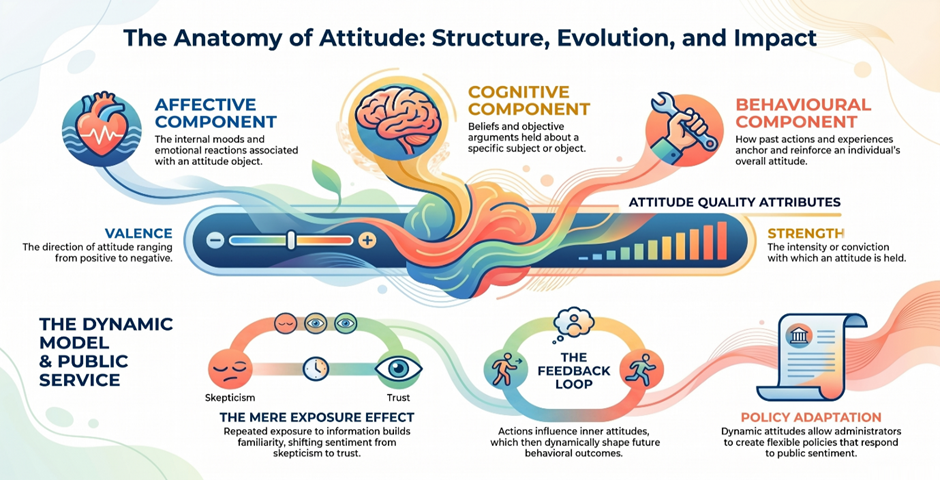
- Valence or Direction: People’s attitudes range widely in terms of positivity, negativity, or neutrality. For example, one might hold a positive attitude towards renewable energy, a negative attitude towards deforestation, and a neutral attitude towards a random genre of music.
- Strength: The intensity with which attitudes are held varies significantly. For instance, dedicated environmental activists feel very strongly about issues of pollution and climate change compared to the general public.
Content of Attitude
Multicomponent Model (ABC Model)
The structural composition of an attitude is traditionally evaluated through three tightly integrated components:
- Affective Component: Refers to the feelings, internal moods, or emotions associated with an attitude object. A primary way in which feelings affect attitudes is due to the arousal of affective reactions in response to exposure to an object. For instance, many individuals indicate that spiders make them feel intensely scared. These strong negative affective responses produce a negative attitude towards spiders.
- Cognitive Component: Refers to the beliefs, thoughts, attributes, and structural arguments associated with a particular object. For example, while buying a car, an individual devotes considerable attention to objective factors such as the vehicle’s safety records, fuel mileage, and resale value.
- Behavioural Component: Refers to an individual’s past behaviors, actions, or experiences with respect to an attitude object.
Example: Behavioral Anchoring of Attitudes: Citizens developing a strong pro-environmental attitude because they have consistently participated in local waste segregation drives, community lake cleanups, or public transport utilization campaigns. Prior active participation anchors their behavioral component, reinforcing their overall moral commitment to sustainability.



Mere Exposure Effect
The Mere Exposure Effect is the psychological tendency to develop more positive feelings and favorable evaluations towards objects, symbols, or individuals simply the more we are exposed to them.
Example: Public Awareness Campaigns: The repeated broadcast of government saturation messages regarding water conservation or digital payment safety. Constant exposure to these messages makes citizens progressively more familiar with the concepts, shifting public sentiment from skepticism to trust and positive acceptance.
Dynamic Model of Attitude
While the traditional ABC Model focuses on the static components of an attitude, the Dynamic Model emphasizes the changing, adaptable, and evolving nature of attitudes over time. Dr. Carol Dweck supports this perspective, stating, “Attitudes are not static. They are shaped by our experiences, our environment, and the people we interact with.”
Key Components
· Continuous Change: Attitudes are not fixed or permanent blocks; they are continuously evolving in response to incoming information, personal experiences, and wider social dynamics.
· Feedback Mechanism: Attitudes operate within an active feedback loop. An individual’s behavior can actively influence and realign their inner attitudes, which in turn dynamically shapes future behavioral outcomes.
· Contextual Influence: Attitudes are heavily molded by the surrounding ecosystem. Social, cultural, and environmental factors make attitudes context-dependent and highly adaptable to external changes.
· Emotional Responses: Positive or negative emotional experiences associated with an attitude object can alter both the directional valence and the absolute strength of the attitude.
· Social Interaction: Interaction with diverse groups leads to an exchange of ideas and perspectives, contributing to the gradual evolution of personal attitudes. Peer influence, social norms, and group dynamics are crucial factors in this adjustment.
Implications of the Dynamic Model in Civil Services
· Policy Adaptation: Recognizing that public attitudes are dynamic allows civil servants to design public policies that are flexible, iterative, and adaptive to changing public sentiments. Regular feedback mechanisms and public consultations ensure that policies remain relevant and retain social legitimacy.
· Training and Development: Continuous administrative training and sensitization programs help align the internal attitudes of civil servants with the evolving needs, rights, and ethical expectations of the public.
· Conflict Resolution: The Dynamic Model aids in dispute resolution by recognizing that stakeholder attitudes are not rigid or permanent. Facilitating continuous dialogue and respectful interaction among conflicting parties can systematically alter their attitudes, leading to harmonious relationships.
· Public Engagement: Active public engagement through surveys, town hall meetings, and digital media interactions provides administrators with real-time insights into the evolving attitudes of citizens, allowing for better policy implementation.
· Ethical Decision-Making: Public servants must continuously evaluate their own subconscious attitudes toward ethical dilemmas, ensuring that their administrative decisions remain strictly aligned with constitutional values and evolving societal norms.
Previous Year Questions
Q. Attitude is an important component that goes as input in the development of human being. How to build a suitable attitude needed for public servant? (10 marks, 150 words)
Q. A positive attitude is considered to be an essential characteristic of a civil servant who is often required to function under extreme stress. What contributes to a positive attitude in a person? (10 marks, 150 words)
Practice Questions
| Question 1 “Attitudes are not static; they evolve with experiences and social interactions.” Discuss this statement in the context of the Dynamic Model of Attitude. How can this understanding help civil servants in policy formulation? (10 marks, 150 words) |
| Question 2 “An administrator’s resistance to technology or inclusive reforms is often not a problem of functional capacity, but a structural rigidity of the Affective and Cognitive components of their attitude.” Critically analyze how the feedback mechanism of the Dynamic Model can be used to re-engineer administrative behavioral compliance. (10 marks, 150 words) |



 Ravi Raaz
 Hassan Khan
 Shadab Ali