

Categories of Attitude
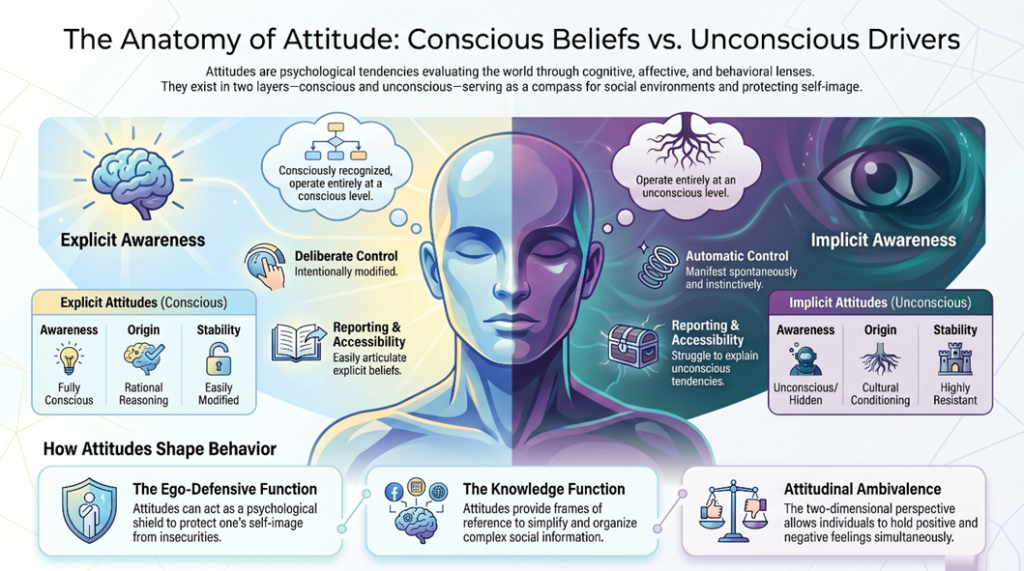
Attitudes are generally categorized into two distinct structural layers based on our conscious awareness of them:
Explicit Attitude
Explicit attitudes are those that we consciously recognize, deliberately form, and can express openly. They reflect our self-reported beliefs and values.
- Conscious Awareness: Individuals are fully aware of these underlying tendencies and can articulate them clearly. For example, a person who explicitly supports environmental conservation can openly state they do so because they believe in protecting the planet.
- Deliberate and Controllable: These attitudes can be intentionally developed, modified, or suppressed based on reasoning. For example, someone can consciously decide to adopt a positive attitude toward fitness and actively participate in regular exercise.
- Easy to Access and Report: They can be easily communicated when asked during social interactions or surveys. For example, when questioned about political views, an individual easily expresses support for a party that advocates for social equality.
- Representation of Personal Values: They align tightly with the values and beliefs that a person consciously endorses. For example, an individual who values honesty expresses a strong explicit attitude against lying.
Implicit Attitude
Implicit attitudes operate entirely at an unconscious level. They are formed through automatic psychological processes, long-term cultural conditioning, and past experiences, often manifesting without our explicit awareness.
- Unconscious Influence: Individuals are generally unaware of these attitudes and cannot easily explain or validate them through rational thought. For example, an administrator may unconsciously prefer job candidates from their own cultural background during hiring, despite genuinely believing in diversity.
- Automatic and Less Controllable: These attitudes manifest spontaneously and are significantly harder to control or suppress. For example, someone might feel an instinctive uneasiness in certain neighborhoods without a conscious reason, quietly driven by implicit social biases.
- Difficult to Access and Express: Because they reside outside of conscious awareness, they are not easily articulated. For example, a person may be unable to explain why they experience a subtle discomfort when introduced to unfamiliar foods.
Structural Perspectives of Attitude
Psychologists analyze the internal organization of positive and negative evaluations across our cognitive, affective, and behavioral components from two main perspectives:
One-dimensional Perspective
This approach views positive and negative elements as existing on a single, continuous spectrum. Favorable and unfavorable components are stored at opposite ends of this continuum, meaning that the presence of strong positive feelings automatically inhibits negative ones. For example, if an administrator holds a strong positive attitude toward absolute transparency, they are structurally unlikely to support practices that encourage administrative secrecy.
Two-dimensional Perspective
This perspective suggests that positive and negative components are stored on entirely separate dimensions within our psychology. One dimension independently tracks the presence of positive elements, while the other tracks the presence of negative elements.
This model explains attitudinal ambivalence, where an individual can experience both positive and negative feelings toward the same object simultaneously. For example, an official might highly appreciate social media for its swift public connectivity benefits (high positive dimension) while simultaneously criticizing it for facilitating the viral spread of misinformation (high negative dimension).



Characteristics of Attitude
Attitudes possess several distinct features that govern how they are formed, expressed, and modified:
- Evaluative Nature: Attitudes inherently involve making value judgments, automatically categorizing aspects of life as positive or negative. This evaluative component allows individuals to quickly assess and respond to environmental stimuli. For example, developing a positive evaluation of renewable energy sources can directly guide a homeowner’s decision to install solar panels.
- Learned Over Time: Attitudes are not innate biological traits; they are developed through personal experiences and active socialization within the family and school. Growing up in an environment that prioritizes academic success fosters a strong, enduring positive attitude toward higher education.
- Stability and Endurance: Once established, attitudes tend to be relatively stable and resistant to change. While significant life events or highly disruptive information can alter them, they generally persist over time. For example, a long-standing passion for animal rights remains deeply resistant to counter-arguments.
- Influence on Behavior: Attitudes act as internal psychological drivers that guide choices and actions. A strong positive attitude toward physical fitness naturally translates into consistent corresponding actions like running, yoga, or gym workouts.
- Consistency: Attitudes typically maintain internal harmony among their three core components: cognitive (beliefs), affective (emotions), and behavioral (actions). This consistency maintains a coherent perspective. For example, an individual concerned about sustainability will believe waste reduction is crucial (cognitive), feel passionate about conservation (affective), and actively recycle (behavioral).
- Intensity: This refers to the emotional strength associated with the attitude. Mildly held attitudes drive weak reactions, whereas intensely felt attitudes drive vigorous, passionate actions and advocacy.
- Specificity: Attitudes can range from broad, general categories to narrow, highly focused ideas. A broad attitude might manifest as a general preference for healthy living, while a specific attitude focuses on a particular interest in plant-based diets.
Functions of Attitude
Attitudes serve vital psychological functions, helping individuals adapt to, interpret, and navigate their social environments:
- Utilitarian Function: We naturally develop positive attitudes toward objects or people that reward us, and negative attitudes toward those that penalize or threaten us. For example, during the U.S. civil rights movement, marginalized communities developed highly positive attitudes toward Martin Luther King Jr. because he championed their rights, while status-quo beneficiaries often developed negative attitudes toward him.
- Knowledge Function: Attitudes provide efficient frames of reference that help individuals organize, simplify, and understand the chaotic world around them. For instance, during the Cold War, the general American public viewed geopolitical events through the simplifying lens of anti-communism, helping them easily interpret and support complex foreign policy decisions.
- Ego-Defensive Function: Attitudes can be formed as a psychological defense mechanism to protect one’s self-image or ego from internal insecurities and external threats. These attitudes often project an outward stance that masks internal vulnerabilities. For example, historical figures aggressively defending their administrative records during political scandals often do so to preserve their fragile self-image against contrary evidence.
- Value-Expressive Function: This function allows individuals to project their authentic self-image to the outer world, demonstrating what they stand for and translating core moral values into an external identity. For example, Mahatma Gandhi’s unyielding commitment to non-violence served as a direct expression of his core values of peace and justice.
- Social Identity Function: This helps individuals align with the values, beliefs, and expectations of their primary social groups, directly enhancing group cohesion and solidarity. For example, sports fans develop positive attitudes toward their favorite teams and wear merchandise to reinforce their collective identity and secure a sense of community belonging.
- Behavioral Guidance Function: Act as reliable internal compasses, providing consistent guidance for daily decision-making and automated actions. An individual holding a positive attitude toward healthy living will naturally prefer regular exercise and balanced nutrition while automatically avoiding harmful habits.
- Self-Awareness Function: Helps individuals continuously monitor, assess, and understand what is personally beneficial or harmful to them, boosting overall self-awareness. For example, someone with a positive attitude toward mental health awareness will actively practice self-care and seek professional help when needed.
- Social Adjustment Function: Facilitates smooth social interactions by helping individuals rapidly adapt their outward behavior to fit different social settings, norms, and cultural expectations. For example, an open-minded, flexible attitude makes it significantly easier for an administrator to engage constructively with people from diverse cultural backgrounds.
Applied Analytical Examples
Example: Institutional Anti-Bias Training Public service delivery organs utilizing unconscious-bias diagnostics and blind recruitment scripts to prevent implicit biases during mass selection rounds or welfare allocation. This target blocks an individual’s implicit attitude from manifesting as discriminatory behavior, forcing systemic impartiality.
Example: Behavioral Interventions for Civic Compliance Municipal boards utilizing the behavioral guidance function by gamifying local recycling or urban green spaces. When citizens physically separate waste to win localized awards, their actions feed back into the feedback loop of the dynamic model, aligning their internal cognitive and affective components over time to form a long-standing pro-environmental attitude.
Previous Year Questions
Q. Our attitude towards life, work, other people and society are generally shaped unconsciously by the family and the social surroundings in which we grow up. Some of these unconsciously acquired attitudes and values are often undesirable in the citizens of a modern democratic and egalitarian society. Discuss such undesirable values prevalent in today’s educated Indians. How can such undesirable attitudes be changed and socio-ethical values considered necessary in public services be cultivated in the aspiring and serving civil servants? (20 Marks)
Q. Two different kinds of attitudes exhibited by public servants towards their work have been identified as the bureaucratic attitude and the democratic attitude. Distinguish between these two terms and write their merits and demerits. Is it possible to balance the two to create a better administration for the faster development of our country? (20 Marks)
Q. What factors affect the formation of a person’s attitude towards social problems? In our society, contrasting attitudes are prevalent about many social problems. What contrasting attitudes do you notice about the caste system in our society? How do you explain the existence of these contrasting attitudes? (20 Marks)
Practice Questions
Question 1 In what ways do implicit attitudes contribute to the reinforcement of social norms and stereotypes? Discuss how these unconscious attitudes can perpetuate biases in a modern democratic society, and suggest strategies to address and mitigate their negative effects. (10 Marks, 150 Words)
Question 2 Stability and endurance are key characteristics of attitudes. However, certain situations can lead to attitude change. Discuss the factors that contribute to the stability of attitudes and provide examples of circumstances that might lead to a significant shift in an individual’s attitude. (10 Marks, 150 Words)
Question 3 “An administrator can easily state an explicit attitude favoring equity and inclusion, yet their implicit attitudes, shaped by historical social conditioning, can still result in systemic discrimination during public service delivery.” Critically evaluate how public services can bridge this gap between explicit compliance and implicit bias. (10 Marks, 150 Words)



 Ravi Raaz
 Hassan Khan
 Shadab Ali