
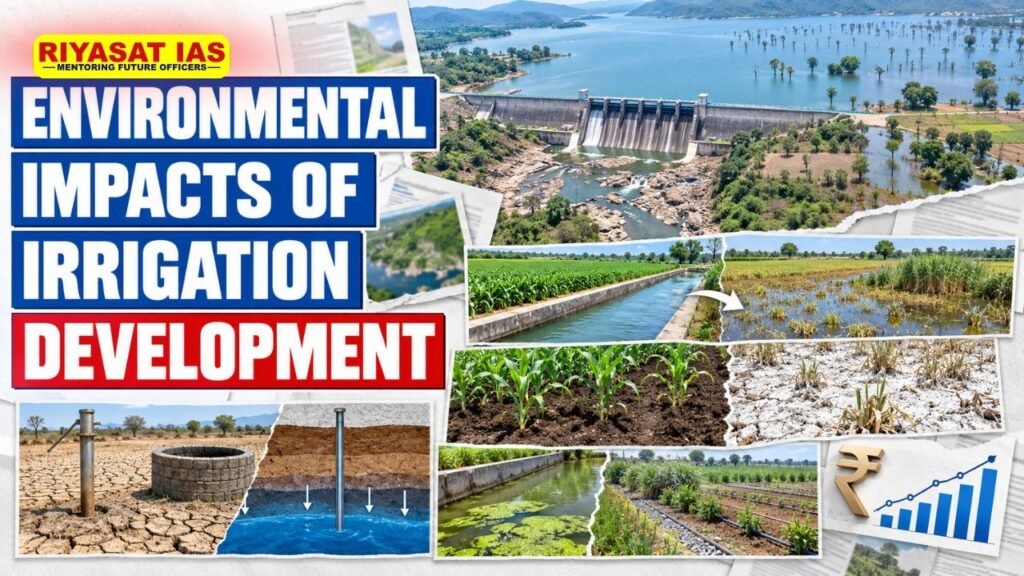
While irrigation development plays a critical role in the enhancement of food production and agricultural output, poorly planned and managed projects can lead to undesirable ecological and social outcomes. For instance, the failure to factor in the intricate basin hydrology when implementing water control structures may result in water-logging, public health hazard, river ecology degradation, and community fragmentation. This paper discusses the environmental costs of extensive irrigation schemes and water harvesting projects.
Waterlogging and Salinization
- Unregulated surface irrigation and deficient subsurface drainage systems can lead to several environmental impacts on the productive topsoil.
- Waterlogging develops when too much water is applied beyond the field’s infiltration capacity or when canal seepage enriches the shallow aquifer that would later rise to meet the roots’ level. Waterlogged soil decreases root oxygenation, hindering food production and transforming farmland into unproductive wetlands.
- Meanwhile, water from shallow aquifers carries dissolved salts that are drawn back into the wick above the water table. Hence, if left unattended, salt accumulates on top of the soil, depleting moisture and rendering the land useless.
- Moreover, irrigation can also cause land to turn to a hard, impermeable layer of sodium-rich clay known as alkalization.
- Alkalization occurs when the exchangeable sodium percentage exceeds the magnesium and calcium ions found in the cation-exchange capacity.
- As a result, clay-sized particles are displaced, destroying the soil structure and adhesion, a phenomenon that renders most farmland unusable for a prolonged period.
Water-Borne and Water-Related Diseases
- Changes in moisture patterns affect vector ecology and water quality throughout rural communities and irrigated croplands.
- Ditches along shallow canal edges, poorly maintained distributary banks, tail-end water pools, and stagnant margins offer breeding grounds for vectors, causing disease outbreaks. Water-borne diseases are also frequent in such conditions, especially when there is contamination by water-carried pathogens.
- Most irrigation schemes require intensive application of agrochemical to increase production, resulting in significant nitrate leaching into the underlying shallow aquifers and wetlands. Contamination of ground and surface water with synthetic nitrogen compounds in the form of fertilizers and pesticides can cause severe health risks to residents relying on the affected water bodies.
- Similarly, stagnant reservoir margins and unsecured drainage canals may be contaminated with water-borne pathogens that may lead to water-contact infections and diarrheal diseases.
- Lastly, the breeding of disease-carrying organisms is facilitated in the margins of tail-end pools, which may cause an increase in incidences of malaria, dengue fever, and lymphatic filariasis.



Environmental Impacts of Dams and Reservoirs
Command areas and large-scale irrigation schemes have enormous environmental footprints brought about by the construction of water impounding structures. The impacts range from altering river flow regimes to submerging extensive natural landscapes.
| Impact Dimension | Description |
| Impact on River Flow Regime | By storing the overflow river discharge and controlled release of the stored water, the natural flow regime of the river is disrupted. |
| Ecology of Running Water | The dam converts a lotic (running water) river into a lentic (still water) reservoir, fragmenting the river and disrupting the aquatic migration corridor. |
| Sediment Ingestion | Reservoirs trap sediments that would have enriched the downstream floodplains and deltas. |
| Submersion of Landscape | The dam walls submerge extensive valley forests as well as the vegetative cover within its reach. |
| Downstream Estuarine Ecology | The decreased outflow from the dam alters the delicate salt balance of the estuaries, threatening the breeding grounds of economically important food chains. |
| Construction Footprint | Excavated borrow pits, quarries, and roads excavated during the dam construction cause air pollution, noise pollution, and accelerated sheet erosion. This impacts the visual landscape of the dam reservoir. |
Socio-Economic Impacts of Irrigation Projects
- Large-scale irrigation schemes have far-reaching social implications, including the displacement of localities and the creation of alternate livelihoods for the affected population.
- Construction of mega-structures such as reservoirs and levees often displaces vulnerable communities that have lived in the line of the project.
- Such individuals and households are denied access to forest products and arable land they previously accessed. Worse still, many such communities are inadequately compensated for their loss, creating long-term poverty traps.
- In addition, large-scale irrigation projects have far-reaching social impacts, including the destruction of community solidarity, especially with the resettlement of family members. Community structure and support systems are significantly weakened, raising the likelihood of distress as a result of losing one’s primary livelihood.
- As such, there is an increased need for supplementary livelihood options for sustenance and to avoid the associated malnutrition and urban drift.
Conclusion
- Irrigation development has always been the bedrock of agricultural production and food security in many countries. However, in attempts to increase production, mankind often forgets its responsibility to ensure sustainability in its application of agricultural practices.
- As discussed, irrigation development has several environmental costs, including waterlogging, salinization, increased occurrence of vector-borne diseases, and community displacement.
- To enhance food security while mitigating the effects of irrigation development, mankind must embrace micro-irrigation structures, conjunctive use of surface canals and groundwater, and community relocations coupled with rehabilitation schemes.
FAQs on Environmental Impacts of Irrigation
What are the main environmental impacts of irrigation?
The primary environmental impacts of irrigation include rising water tables, waterlogging, salinization, expansion of vector breeding grounds, degradation of riverine ecology, and community displacement as a result of large-scale irrigation projects.
How is irrigation a cause of waterlogging?
In irrigation, waterlogging occurs when farmers apply too much water beyond the field’s infiltrability or when the canal system experiences seepage that adds water to the shallow aquifer. Once the water table rises to the root zone of crops, it impedes root oxygenation, thereby halting food production.
What is salinization?
Salinization is a process by which water-soluble salts penetrate the soil and are deposited on the ground surface. The salts are drawn to the soil from the shallow aquifer through capillary suction. Once on the ground surface, salt concentration increases, inhibiting plant growth.
What is alkalization of the soil?
Alkalization (also known as sodification) occurs when sodium ions infiltrate and accumulate in the clay’s exchangeable capacity over magnesium and calcium. It causes dispersion of fine particles, detachment, and swelling of the soil, resulting in a hard surface layer.
How is irrigation a cause of water-related diseases?
Since standing water is a significant breeding ground for disease-carrying organisms, irrigation provides the ecosystem for vectors such as the Anopheles mosquito. In addition, irrigation promotes agrochemical use, whose leachates can contaminate drinking water sources, increasing incidents of disease outbreaks among communities.
How do dams and reservoirs affect the environment?
Dams and reservoirs alter the river flow regime, fragment river ecosystems, ingest sediments, submerge large landscapes, and impact downstream estuarine ecology.
What are the social impacts of large irrigation schemes?
The primary social impact of large irrigation projects is community displacement due to the construction of such infrastructure. Such projects cause permanent loss of use of forest products and arable land to the displaced communities. Also, such communities do not receive adequate compensation, leading to adverse social effects such as poverty and community fragmentation.
Why is rehabilitation important in irrigation projects?
Rehabilitation of affected families ensures that community members are able to resume normal activities without the burden of losing their properties, forest products, and homesteads to the irrigation project.
How can the negative impacts of irrigation be reduced?
Some of the ways that can help reduce the negative impacts of irrigation include embracing drip irrigation systems, conjunctive use of surface and groundwater, constructing environmental flows in dammed rivers, conducting ecological impact assessments, and ensuring community rehabilitation.



 Ravi Raaz
 Hassan Khan
 Shadab Ali