
Kautilya:
“A person should not be too honest. Straight trees are cut first and honest people are screwed first.” — Kautilya “As soon as the fear approaches near, attack and destroy it.” — Kautilya
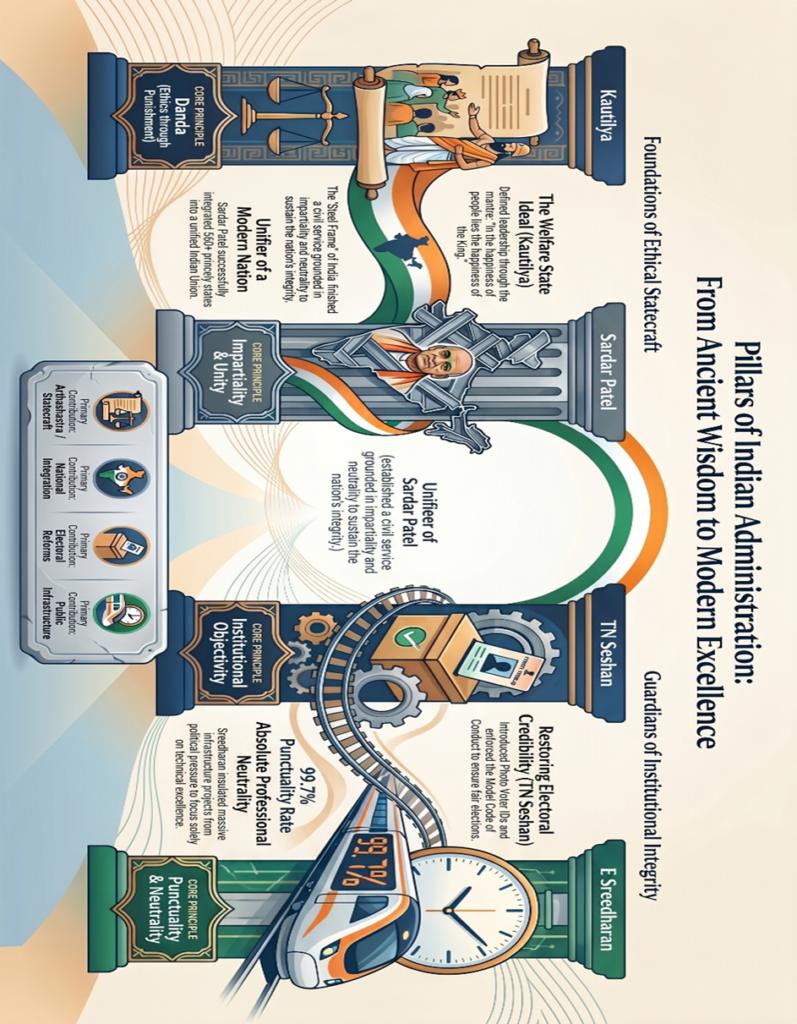
- Dharma and Justice: Kautilya emphasized the vital importance of danda (punishment) as a structural tool to uphold dharma (virtues and ethics). This is especially critical in preventing Matsya Nyaya (law of the jungle), a state where “might is right” and the strong indiscriminately prey upon the weak.
- Economic Management (Kosh): He stressed that the state’s treasury must be filled strictly with lawfully acquired funds. He suggested that the government should always take the public into confidence when implementing structural taxes.
- Welfare State: Kautilya’s Arthashastra highlighted the visionary concept of a welfare state, famously asserting: “In the happiness of people lies the happiness of the King (leader), their welfare is his welfare.”
- Civil Vigilance: Acknowledging the inherent vulnerabilities and tendencies toward dishonesty in human nature, Kautilya recommended strict, continuous vigilance in government administration to prevent the siphoning of public goods.
- On Virtue and Influence: Kautilya noted: “The fragrance of flowers spreads in the direction of the wind, but the goodness of a person spreads in all directions.” This underscores how moral character universally inspires others beyond structural barriers.
- Realpolitik and Pragmatism: He is credited with pioneering realpolitik—a highly pragmatic approach to statecraft that balances practical and material factors alongside ethical considerations to secure the realm.
- Influence on Modern Governance: Kautilya’s systemic emphasis on the ethical use of institutional power and resource distribution remains fundamentally relevant to modern discourses on good governance and public administration.
Sardar Vallabhbhai Patel:
- Fighter Against Injustice: Patel fought resolutely against regressive social evils like the practice of veth (forced labor) and personally led extensive, empathetic relief efforts during periods of plague and famine in Kheda. He also took an unyielding stance against substance abuse, stating: “A drunkard can never become a man of character… Therefore, give up drinking forever,” which reflected his belief in absolute moral integrity.
- Commitment to Social Equality: Patel strongly believed that artificial societal divisions like caste and community would eventually fade, passionately advocating for a united, egalitarian, and progressive society.
- Advocacy for Women’s Rights: During the historic Bardoli Satyagraha, Patel deliberately organized and consulted with a massive number of women, recognizing their crucial agency in political mobilization and social reform.
- Organizational Prowess: Famed for his exceptional organizational skills, Patel traveled extensively to document grass-roots grievances and rally non-violent resistance. He famously stated: “Unite and you will not have to fight.”
- Non-Violence in Action: Patel practiced and preached non-violence, maintaining that it should be thoroughly adhered to in thought, word, and deed.
- Unifier of India: Patel executed a monumental role in the political integration of 560+ princely states into the Indian Union post-independence, earning the title “Iron Man of India” and drawing comparisons to Otto von Bismarck for his unmatched nation-building efforts.
- Efforts for Peace: During the partition crisis, Patel worked tirelessly to secure the safe passage of refugees fleeing violence. His ethical appeal: “No laws of humanity or war among honorable men permit the murder of people who have sought shelter and protection,” served to de-escalate violence significantly.
- Influence on Indian Governance: His vision for a robust, independent administrative framework created the modern Indian civil services. He championed the civil services as the “Steel Frame of India,” embedding the foundational principles of impartiality and neutrality to guide the bureaucracy safely through political transitions.



TN Seshan:
- Redefining the Election Commission: TN Seshan transformed the Election Commission of India (ECI) from a passive body into an aggressive guardian of democracy, introducing major structural reforms that restored the credibility and authority of the institution. He strictly enforced the Model Code of Conduct (MCC), compelling all political parties to adhere to uniform ethical standards during campaigns.
- Enhancing Transparency: Seshan pioneered the introduction of Photo Voter ID cards, a monumental move that systematically eliminated cases of bogus voting and duplicate registration, ensuring the integrity of the ballot.
- Ensuring Equality in Campaigning: He enforced strict statutory limits on campaign expenditure, neutralizing the distorting power of money in politics and ensuring a level playing field for independent and resource-constrained candidates.
- Maintaining Impartiality: To eliminate local biases and institutional capture, Seshan strategically deployed election officials and central observers to states other than their own, securing absolute objectivity in the electoral process.
E Sreedharan
- Transforming Public Infrastructure: Widely known as the “Metro Man,” E Sreedharan revolutionized India’s public transport infrastructure by successfully executing massive engineering marvels like the Delhi Metro, Kolkata Metro, and Konkan Railway. Under his leadership, the Delhi Metro phase was completed ahead of schedule, establishing global benchmarks for institutional efficiency with a 99.7% punctuality rate.
- Visionary Leadership: His foresight transformed urban commuting by delivering world-class, mass rapid transit networks to Delhi, Kochi, Lucknow, and beyond.
- Punctuality and Discipline: Sreedharan modeled a legendary work ethic, consistently arriving 15 minutes before his staff to instill a culture of strict discipline and organizational respect, which directly enabled timely project execution.
- Empathy and Employee Empowerment: He fostered a highly supportive, empowering work culture where professionals were insulated from the fear of unwarranted disciplinary actions, creating a deeply motivated, high-performing workforce.
- Innovation in Funding: When faced with critical financial constraints during the Konkan Railway project, Sreedharan bypassed traditional bottlenecks by ingeniously raising funds through public bonds, ensuring seamless execution despite economic challenges.
- Maintaining Political Neutrality: Sreedharan fiercely insulated his engineering projects from political pressures and populist interferences, maintaining absolute political neutrality to focus solely on technical excellence and objective execution.
Previous Year Questions
Q. Corruption causes misuse of government treasury, administrative inefficiency, and obstruction in the path of national development. Discuss Kautilya’s views. (10 Marks, 150 Words)
Practice Questions
Question 1-Examine the administrative reforms introduced by Sardar Vallabhbhai Patel and their lasting impact on Indian governance. How can his approach to administration guide contemporary public policy and institutional reforms? (10 Marks, 150 Words)
Question 2-“Insulating public infrastructure execution from populist political cycles requires an administrator to possess absolute professional neutrality and unyielding functional integrity.” Evaluate this statement using the leadership model of E Sreedharan. (10 Marks, 150 Words)


 Ravi Raaz
 Hassan Khan
 Shadab Ali