
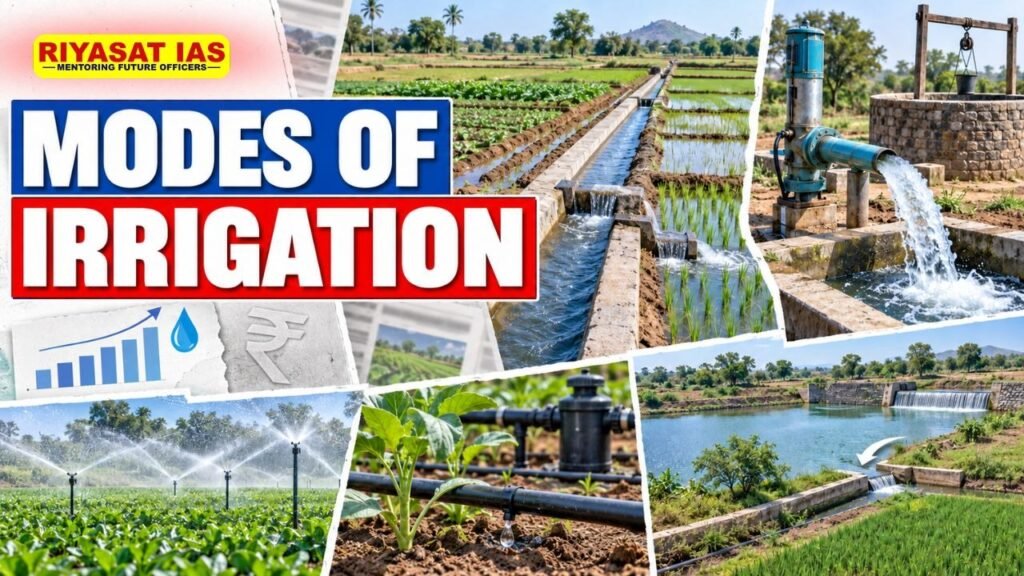
How a farmer irrigates his land is a continuous balancing act that takes into account the terrain, the soil, the local water availability, the type of crop and the initial capital expenditure. The analysis below explores the different primary irrigation modes found sustaining Indian agriculture, their practical advantages and limitations.
Well and Tube Well Irrigation
Wells are the backbone of Indian irrigation, dominating the agricultural regions of Uttar Pradesh, Bihar, Punjab, Haryana and Tamil Nadu.
- Open and Dug Wells: traditionally excavated to tap shallow aquifers, these systems are cost-effective and simple to build but highly vulnerable to seasonal variation, often running dry during peak summer.
- Tube Wells: deeper boreholes that use casing pipes driven into lower aquifers and powered by electric or diesel pump sets to irrigate significantly larger command areas than open surface wells.
Merits
- An independent water source, allows to irrigate without being beholden to canal schedules.
- Drought resistant; when water in reservoirs and canals runs dry during extended dry spells, deeper ground-water is sometimes a viable base.
- Naturally occurring minerals dissolved in ground water can add useful micronutrients to native soil.
Demerits
- Unregulated borehole pumping; the abundance of subsidized electricity has caused serious dips in the water tables of northwestern India, farmers have been forced to take out significant debt to bore further.
- Command area limitation, standard open dug wells can only irrigate limited connected land parcels.
Canal Irrigation
Canal are best suited across extensive alluvial plains where perennial rivers have high discharge, this spans Punjab, Haryana, western Uttar Pradesh, the coastal deltas of Andhra Pradesh and Tamil Nadu.
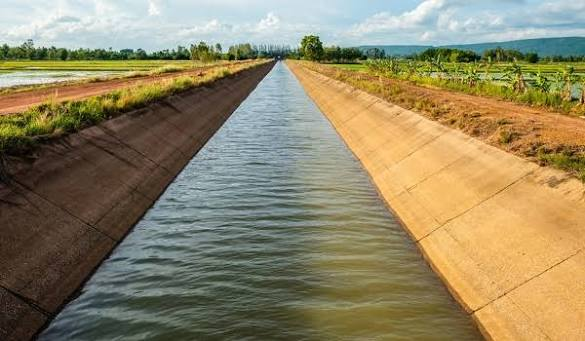
- Inundation Canals: drawn directly from rivers without any dam or barrage, these canals only operate during high-water periods, such as the summer monsoon.
- Perennial Canals: connected to barrages or storage dams that maintains steady flow all year around, the majority of India’s modern canal systems are of this type.
Merits
- Perennial networks carry a heavy flow which can service extensive agricultural districts, allowing for multi-cropping.
- Gravity-fed networks eliminates costly direct pumping costs for the cultivating household.
Merits and Operational Limitations
- Topographical limitations; constructing gravity fed canal systems through undulating hard-rock terrain (such as the peninsular plateau) proves to be both technically difficult and capital intensive.
- Tail-end deficits; excess use by upstream farmers causes tail-end farms (those further along the canal) to receive insufficient water.
- Waterlogging and salinization; seepage from canals into the subsoil raises the local water table and concentrates salts on the surface, rendering the subsoil arable.
Tank Irrigation
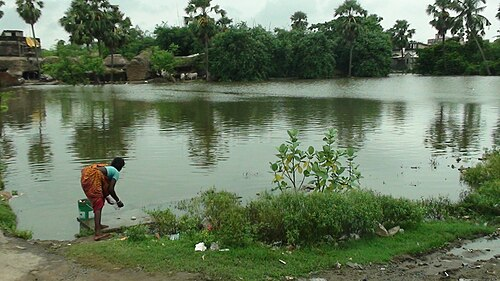
A tank is an earthen or masonry formed reservoir created by erecting a bund (a dam) across a natural depression or seasonal drainage stream. Tank irrigation holds special importance in the hard-rock terrains of the Karnataka, Telangana, Madhya Pradesh, Maharashtra, Bundelkhand, parts of Rajasthan and Gujarat where digging deep wells is difficult.
Merits
- Lower capital and ecological costs compared to large dams because tanks take advantage of natural depressions to hold water.
- Multipurpose uses for the stored water; these water bodies can provide for domestic livestock, recharge village level shallow aquifers, freshwater inland aquaculture can also be a source of secondary rural income.



Demerits
- High evaporative losses and seasonal limitations; shallow and broad tanks suffer from high evaporation during hot months, reducing the amount of water available when most crops are in need.
- Pumping overheads; as the tanks occupy natural low grounds, supplementing the water stored on the tank to higher field bunds often requires additional lifting equipment and labor.
Drip Irrigation
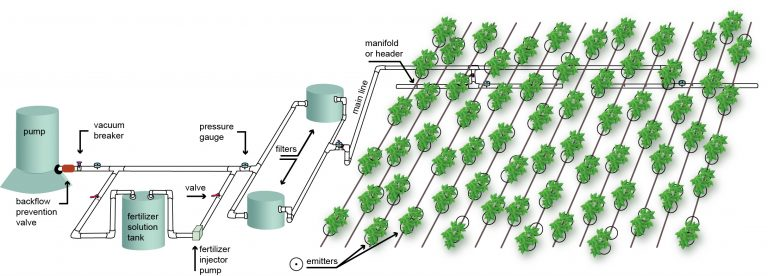
Drip irrigation delivers water directly to the plant root zone through low-pressure pipes, lateral tubes and calibrated emitters, this method is most commonly applied in horticulture, orchards, vegetables, cash crops like sugarcane and plantation crops such as tea and coffee.
Merits
- High water-use efficiency; localized water application prevents runoff and evaporative losses, a significant saving compared to flood techniques.
- Fertigation precision; soluble plant nutrients can be added to the system and delivered directly to the roots, avoiding deep leaching into the ground water.
- Weed and Erosion control; keeping the space between rows dry prevents weed seed germination and prevents surface soil erosion.
- Terrain adaptability; drip irrigation can work on uneven ground and slopes without requiring expensive land leveling.
Demerits
- High capital costs; initial setup (pumps, filtration, pressure regulation, tubing) requires meaningful investment, subsidies are needed for implementation.
- Emitter clogging; particulate matter, algae, or heavy mineral precipitates in water can clog micro-emitters, regular filtration and maintenance is required.
Sprinkler Irrigation
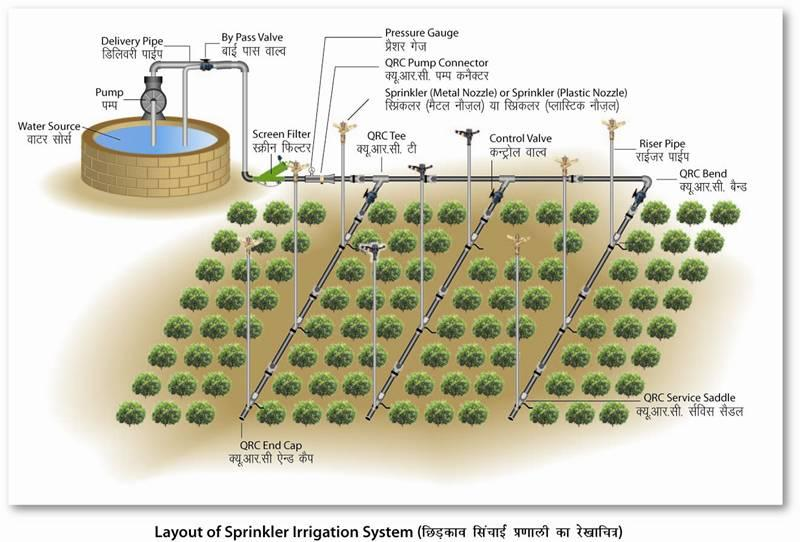
Sprinkler systems employ pressurized piping that discharges water through rotating or stationary nozzles that mimic natural precipitation over the crop canopy, they are often applied on undulating fields, sandy soils prone to rapid infiltration and plantation or field crops.
Merits
- Terrain flexibility; works well on undulating land without requiring extensive earthworks or leveling.
- Elimination of field channels; the absence of large earthen bunds and channels maximizes the net cultivable area.
- Soil structure protection; fine droplet distribution prevents the compaction and surface crusting associated with heavy furrow or flood watering.
Demerits
- Energy requirements; sprinklers require sustained water pressure, increasing energy consumption and costs.
- Environmental disruption; strong prevailing winds distort spray patterns and coverage, high ambient temperatures increase airborne evaporation losses.
Specialized Surface and Sub-Surface Methods
- Furrow Irrigation: crops are cultivated on raised ridges, water is directed down narrow channels between the rows, although effective for row crops (maize, potatoes, cotton), achieving even water absorption across the length of the furrow is a challenge.
- Surge Irrigation: A variation of furrow irrigation where water discharge is applied in controlled on-and-off cycles, the initial wetting cycle consolidate the soil surface, subsequent surges travel faster down the channel and improve water distribution.
- Ditch Irrigation: A traditional format where main field ditches distribute water into individual rows, through gravity or siphon tubes.
- Sub-Surface Irrigation: Water is supplied below the ground level, it moves up into the root zone by capillary action, this drastically suppresses evaporation and keeps the topsoil dry, installation costs are high and unmonitored systems can leach soil-borne pathogens.
Strategic Priorities and Way Forward
Sustainable irrigation management should shift from supply augmentation to demand optimization,
- Promoting Micro-Irrigation: Accelerating the transition to drip and sprinkler is critical for improving irrigation efficiency especially for water-intensive commercial crops.
- Community Groundwater Governance: Aquifer management must focus on balancing recharge-rate and decentralized village level water budgeting.
- Canal Infrastructure Modernization: Lining vulnerable canal sections, automating discharge gates and improving maintenance ensures equitable delivery to tail-end cultivators while controlling waterlogging.
- Agro-Ecological Crop Planning: Aligning irrigation techniques with local water availability entails discouraging water-intensive crops in arid zones and promoting drought resistant millets, pulses and oilseeds.
FAQs
What are the major modes of irrigation in India?
The major modes of irrigation in India are well and tube well irrigation, canal irrigation, tank irrigation, drip irrigation, sprinkler irrigation, furrow irrigation, surge irrigation, ditch irrigation and sub-surface irrigation.
What is well and tube well irrigation?
Well and tube well irrigation involves the extraction of groundwater from open and dug wells or deeper tube wells using electric or diesel pump sets to irrigate agricultural land.
What are the main advantages of well and tube well irrigation?
Well and tube well irrigation provides an independent water source, allows for irrigation without reliance on canal scheduling and can offer a viable water source during prolonged dry spells.
What are the major problems associated with tube well irrigation?
The major problems include unregulated borehole pumping, groundwater depletion and command area limitations. Subsidized electricity has led to serious drops in water tables in northwestern India.
Where is canal irrigation most suitable?
Canal irrigation is best suited across vast alluvial plains where perennial rivers have high discharge, including Punjab, Haryana, western Uttar Pradesh, and the coastal deltas of Andhra Pradesh and Tamil Nadu.
What are the major advantages of canal irrigation?
Perennial canal networks can serve extensive agricultural districts and enable multi-cropping. Gravity-fed networks also eliminate costly direct pumping costs for the cultivating household.
What are the major limitations of canal irrigation?
The major limitations include topographical limitations, tail-end deficits, waterlogging and salinization.
What is tank irrigation?
Tank irrigation involves the storage of water in an earthen or masonry reservoir created by erecting a bund (a dyke made of stone or earth) across a natural depression or seasonal drainage stream.
Where is tank irrigation important?
Tank irrigation holds special importance in the hard-rock terrains of Karnataka, Telangana, Madhya Pradesh, Maharashtra, Bundelkhand, parts of Rajasthan and Gujarat, where digging deep wells is difficult.
What is drip irrigation?
Drip irrigation delivers water directly to the plant root zone via low-pressure pipes, lateral tubes and calibrated emitters.
What are the advantages of drip irrigation?
The major advantages include high water-use efficiency, fertigation precision, weed and erosion control, and terrain adaptability.
What are the limitations of drip irrigation?
The major limitations are high capital costs and emitter clogging, which require regular filtration and maintenance.
What is sprinkler irrigation?
Sprinkler irrigation employs pressurized piping that discharges water through rotating or stationary nozzles that simulate natural precipitation over the crop canopy.
Where is sprinkler irrigation useful?
Sprinkler systems are often used on undulating fields, sandy soils prone to rapid infiltration and plantation or field crops.
What are the major limitations of sprinkler irrigation?
The major limitations include high energy requirements and environmental disruption caused by strong prevailing winds and high ambient temperatures.
What is furrow irrigation?
Furrow irrigation involves cultivating crops on raised ridges and directing water down narrow channels between the rows.
What is surge irrigation?
Surge irrigation is a variation of furrow irrigation where water discharge is applied in controlled on-and-off cycles to improve water distribution.
What is sub-surface irrigation?
Sub-surface irrigation supplies water below the ground level, allowing it to move up into the root zone through capillary action. It drastically suppresses evaporation and keeps the topsoil dry.
What is the major challenge of irrigation in India?
Major challenges include groundwater depletion, wastage of water, soil degradation, inequitable distribution of water and pollution.
What is the way forward for sustainable irrigation management?
Sustainable irrigation management should transition from supply augmentation to demand optimization via micro-irrigation, community groundwater governance, canal infrastructure modernization and agro-ecological crop planning.



 Ravi Raaz
 Hassan Khan
 Shadab Ali