
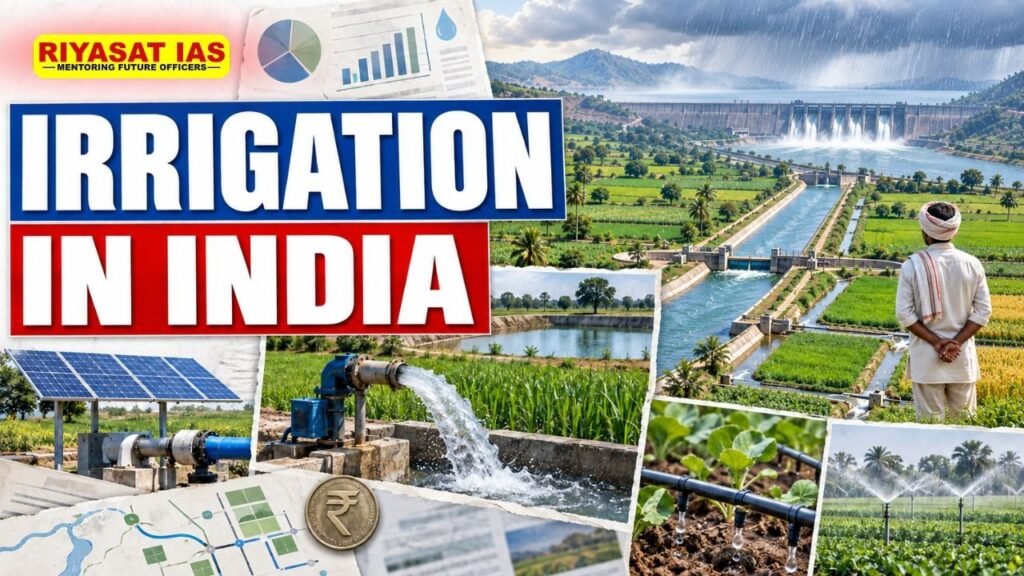
Irrigation generally refers to artificially providing water to aid in the growth of crops when natural precipitation is insufficient. In India, which is highly dependent on monsoon rainfall, irrigation ensures that dry spells do not turn a potentially bountiful harvest into a disaster.
Situation as of Today
India is among the nations with the highest extent of watered cropland. About 68 million hectares or 48% of the net sown area of the nation are watered either directly or indirectly.
It may be noted that the water availability is far from uniform across different kinds of crops as indicated below:
- Essential food and cash crops such as Wheat and Sugarcane are mostly heavily irrigated
- Rain fed cultivation dominates in the case of nutrition dense Pulses and Oilseeds
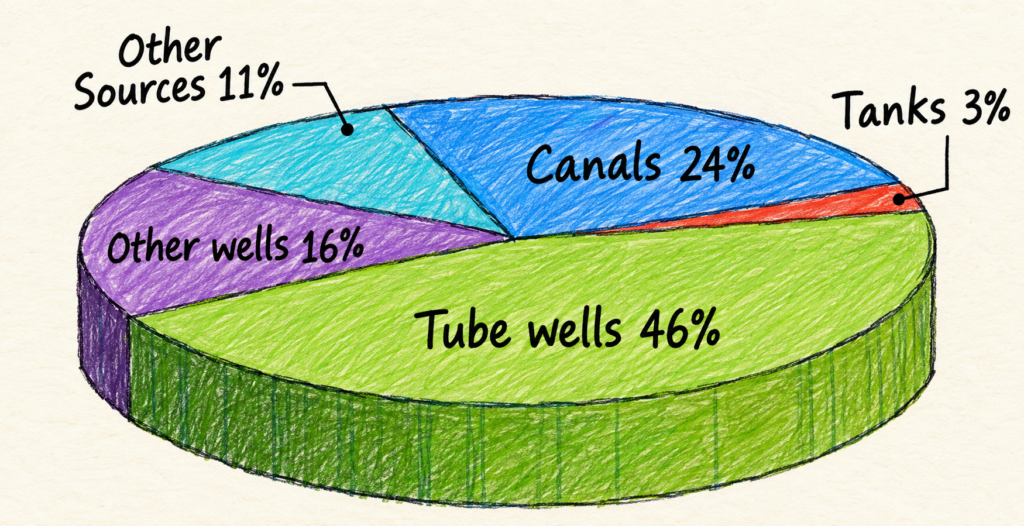
The sources of irrigation are also skewed:
- Groundwater (tube wells etc): 63%
- Canals: 24%
- Tanks, wells and water bodies managed by local authorities: 13%
Types of Irrigation
- Surface irrigation – Water is supplied to the field and allowed to stand or run-off. This irrigation method is cheap and simple but involves large wastage of water
- Sprinkler irrigation: Water is thrown into the air as a spray through a high pressure pipeline. This method prevents run-off and allows the even distribution of water even on undulating land but requires high power inputs
- Drip irrigation: Water is delivered under pressure directly to the roots of plants through narrow tubes. This method is highly effective and reduces wastage of water and negates the need for weeding
- Sub-surface irrigation: Similar to drip irrigation but the tubes are placed beneath the soil
- Centre pivot irrigation: Large rotating sprinklers are mounted on towers that move in a circular motion to water fields uniformly. Highly efficient but very expensive



Why does India Depend on Irrigation?
- Monsoon is highly variable: The rainfall pattern is extremely variable both geographically and tempororally. Meghalaya receives over 10,000 mm of rainfall while western Rajasthan receives as low as 100 mm of rainfall on an annual average. Also about 75 % of the rainfall occurs in 3-4 months
- There is a lot of wastage in terms of runoff: In regions where rainfall is discontinuous and the cloudbursts occur, a lot of water is wasted as surface run off
- Water intensive crops such as Paddy and Sugarcane demand for regular water supply which the erratic monsoon is unable to meet
- Irrigation allows multiple cropping: In the absence of natural water supply, farmers can grow crops in the dry season as well which would otherwise lie fallow
- Irrigation is a prerequisite for high yield: The high yielding varieties developed as part of the Green revolution and chemical fertilizers need consistent supply of water to give good yield
Significance of Irrigation
- Ensures consistent output: Irrigation allows for predictable output by reducing the risk of failure due to erratic monsoon
- Food security: The buffer stocks and grain reserves of the country are possible only due to the assured agricultural output that is possible because of irrigation
- Rural prosperity: The assured agricultural output leads to a predictable seasonal income for the tillers and the landlords leading to prosperity and development of the mandi or local market
- Acts as a hedge against climate vagaries: A good irrigation system insulates the farmer against risks such as prolonged dry spells or extreme heat by allowing him to plan his sowing and harvesting schedule accordingly
Challenges
- Water scarcity: Cheap or free power has led to a boom in the number of borewells and tube wells in states like Punjab, Haryana and western UP leading to depletion of groundwater.
- Wastage of water: Surface irrigation which is used extensively involves a large amount of water being lost through evaporation and seepage
- Soil degradation: Excessive irrigation without appropriate drainage leads to water logged soils which eventually become saline and infertile
- Inequitable distribution of water: The farm at the end of the canal gets relatively less water than the ones at the head of the canal. Similarly, there is a deficit irrigation in eastern and central India despite relatively high natural rainfall and groundwater levels due to the lack of canal networks and distribution infrastructure.
- Pollution: Water from irrigation can carry fertilizers and pesticides into nearby water bodies thereby polluting them
Government Initiatives
- PM Krishi Sinchai Yojana (PMKSY): This scheme addresses both the problem of water scarcity and wastage through two key principles namely “Har Khet Tak Pani” (water for all farmland) and “Per Drop More Crop” (promoting subsidy on micro irrigation equipment)
- Accelerated Irrigation Benefits Programme (AIBP): This scheme provides financial assistance to states for completion of long pending irrigation projects such as canal networks and dams
- Micro Irrigation Fund (MIF): A fund which has been allocated to NABARD to provide subsidy on micro irrigation to states which opt for it
- Atal Bhujal Yojana (ABY): This initiative targets groundwater management at the village level by promoting community participation and recharge structures
- PM-KUSUM: This scheme aims to replace conventional diesel run pumps with solar pumps so that farmers can not only save on fuel costs but also sell surplus power to the state electricity boards
Engineering Marvels
- Indira Gandhi Canal: The canal system that carries water from the melting Himalayas for hundreds of kilometers to water the Thar desert
- Sardar Sarovar Dam: One of the tallest dams in the world which is set to bring drinking water and irrigation to the drought prone Kutch and Saurashtra region of Gujarat
- Narmada Valley project: A series of dams built along the Narmada river that provides electricity as well as irrigation to the dry central India including the states of Madhya Pradesh and Maharashtra
- Krishna-Godavari basin systems: A complex network of dams and canals that have converted the coastal Andhra Pradesh region into a granary
Future Strategies
- Promote micro irrigation: Make farmers switch over from surface irrigation to micro irrigation by providing better subsidies
- Encourage groundwater conservation: Banning deep tubewell irrigation for commercial farming and promoting community participation in groundwater management schemes
- Address the canal scarcity: Line the canals with concrete to reduce seepage and prevent pilferage
- Shift to crops which require less water: Promoting millets and other nutriention dense crops by providing better procurement prices
- Promote solar irrigation pumps: Incentivize farmers to adopt solar irrigation pumps so that they are not dependent on grid electricity which is heavily subsidized
FAQ
What is the basic concept behind irrigation
Artificial application of water to aid growth of crops
What is the main source of irrigation in India
Groundwater in the form of bore wells etc account for almost two-thirds of India’s total irrigation
Which source of irrigation has the maximum wastage
Surface irrigation method has the highest wastage
What is the biggest threat to irrigation in India
The biggest threat to irrigation in India is groundwater depletion
Which government scheme promotes micro-irrigation
The “Per Drop More Crop” initiative under the PMKSY promotes micro-irrigation



 Ravi Raaz
 Hassan Khan
 Shadab Ali