
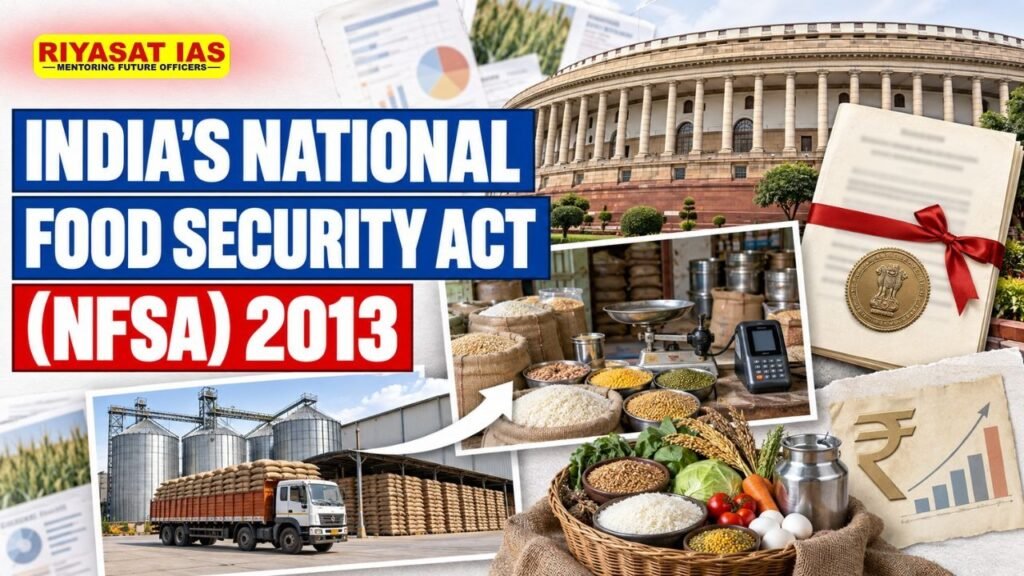
For decades, India was a country in which food subsidies to vulnerable families were considered to be acts of charity. This was significantly modified by National Food Security Act (NFSA) 2013, which provided legal status to the right of every citizen to demand entitlement to sufficient, accessible and nutritious meals.
About NFSA?
NFSA, 2013, makes it mandatory for the Central and State governments to provide subsidised food grains to eligible citizens through the Targeted Public Distribution System (TPDS).
The number of beneficiaries entitled to receive food grains under the TPDS covers:
- Upto 75% of rural and
- Upto 50% of urban households
This encompasses nearly two-thirds of the country’s population.
Key Highlights of the Act
- The Central Government is responsible for the procurement and allocation of food grains while the States identify the eligible households and manage the distribution.
- The TPDS has two categories of beneficiaries:
- The Antyodaya Anna Yojana (AAY): This covers the poorest of the poor and entitles each household to 35 kg. of food grains per month.
- Priority Households (PHH): These are eligible for 5 kg. of food grains per person per month.
- Children aged between 6 months to 14 years are entitled to free, nutritious meals through anganwadis (under the ICDS) and school feeding programs (PM-POSHAN / Mid-Day Meals). Additionally, pregnant women and lactating mothers are due a maternity benefit of at least Rs. 6,000 to aid them with healthcare expenses.
- In order to ensure food for the family is utilised for nutritional reasons, the eldest woman aged 18 or above shall be registered as the head of the household on the ration card.
- If the government fails to deliver the promised food grains or meals, beneficiaries shall be due a Food Security Allowance. The Act provides a 3-tier grievance redressal mechanism that includes the District Grievance Redressal Officers and the State Food Commissions. Further, the Act calls for the mandatory disclosure of information to the public, establishment of community vigilance committees and conduct of social audits.
- In the Draft Amendment Bill (2026), the government seeks to restructure the AAY category on a per-person basis. Under this, the number of food grains allocated to each AAY beneficiary shall be calculated on a per-person basis. Thus, a family of 5 shall receive 35 kg. as opposed to 35 kg. for the entire family regardless of the number of members. However, a cap of 35 kg. for each household shall apply. Further, the exact apportionment of the number of beneficiaries in different States was left to the Central Government.



Why it Matters
- Right to Legal Recourse: Through the National Food Security Act, if a beneficiary does not receive the entitled food grains/meal, he/she may legally demand redressal.
- Reduced Family Expenditure: Having cheaper food items under the TPDS enables families to allocate the money saved to other essentials such as personal care, education and healthcare.
- Backup during Disasters: It is the extensive procurement and storage of food grains under the NFSA that enabled India to provide relief during the COVID-19 pandemic.
- Towards a Digital India: The NFSA ushered in the era of digitised ration cards and e-PoS terminals. Additionally, the One Nation, One Ration Card (ONORC) scheme allows migrant workers to access their entitled food grains in any State.
- Meets International Standards: NFSA is India’s commitment to the United Nations Sustainable Development Goal (SDG) of Zero Hunger.
Flaws and Fault Lines
Despite the benefits, the NFSA has numerous loopholes and weaknesses.
- Outdated Databases: Since the TPDS allocates benefits on the basis of the number of households as of the 2011 Census, the exclusion of eligible poor families who have been added to the system since then continues to be a problem.
- Grain trap (Hidden Hunger): Since the TPDS makes rice and wheat the mainstay of the Indian diet, though it prevents famine, it does little to address malnutrition.
- Technology Challenges: Internet connectivity and Point of Sale (PoS) scanning errors may wrongly deny a family his entitled food grains.
- Ecological Footprint: The emphasis on wheat and rice under the TPDS has resulted in ecological damage through overexploitation of groundwater and degradation of soils.
- Weak Grievance Redressal Mechanisms: Many State Food Commissions and local level grievance officers have limited capacity.
- High Fiscal Cost: The fiscal burden of storing and transporting food grains is substantial in addition to the wastage that occurs during this process.
Way Forward
To create a food-secure country, the future of food grain distribution rests on:
- Ensuring that those who need the benefit are on the database. This requires moving away from the 2011 Census and adopting a dynamic approach in adding and deleting beneficiaries.
- Moving towards a diverse diet of coarse cereals, millets, pulses and edible oil while providing more fortified food items to address nutritional needs.
- Buying locally from Self-Help Groups (SHGs) and Farmer Producer Organisations (FPOs) to ensure a wider variety of food items.
- Building in safeguards so that a family is not denied the food grains due to technology (internet/PoS scanner) failure.
- Giving due consideration to expert recommendations such as those of the 2015 Shanta Kumar Committee on Food Security which recommended targeting the really poor, increasing the individual allocation to PHH and introducing direct electronic benefit transfers for urban migrants.
Frequently Asked Questions
What is the aim of the National Food Security Act?
The National Food Security Act aims to provide legal backing to make it possible for every eligible citizen to have physical and economic access to sufficient, nutritious and affordable food.
Who are eligible for benefits under the NFSA?
The Act provides food security for about two-thirds of the Indian population in the form of the TPDS. This covers about 75% of rural and 50% of urban households. These are further divided into the AAY and PHH.
How many food grains are people entitled to under the NFSA?
Under the NFSA:
- The AAY households are eligible for 35 kg. of food grains per month.
- The PHH are entitled to 5 kg. of food grains per person per month.
How does the NFSA benefit women?
The Act stipulates that the eldest woman in a household who is 18 or older be registered as the head of the household on the ration card.



 Ravi Raaz
 Hassan Khan
 Shadab Ali