
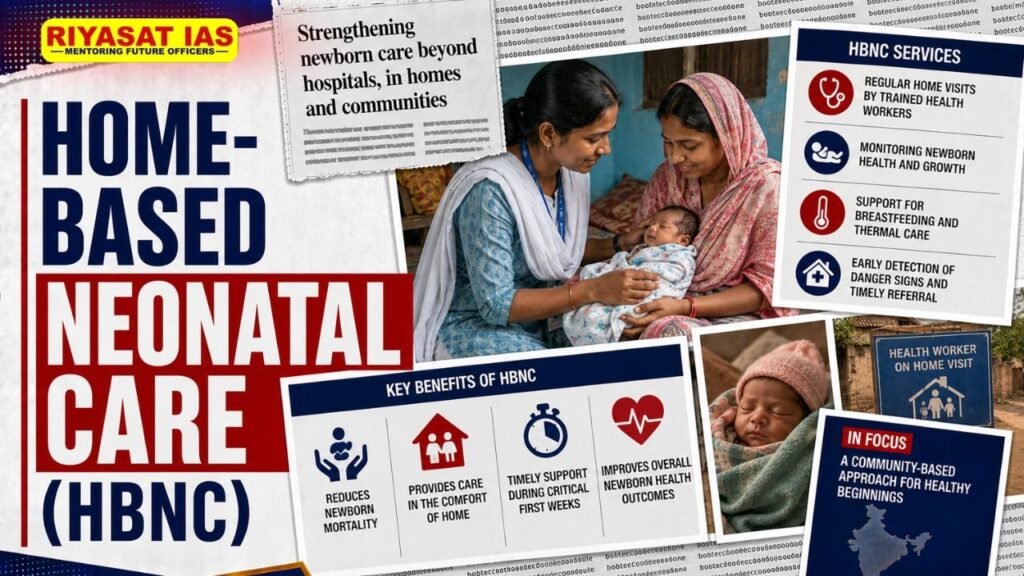
- Meaning: HBNC is a community-based approach under which newborn care is provided at the household level, particularly during the vulnerable first weeks of life.
- Implementing Workforce: HBNC relies primarily on Accredited Social Health Activists (ASHAs) for home visits and counselling of mothers and families.
- Target Group: Focuses on newborns, especially during the first 28 days of life, with attention to early identification of danger signs.
- Key Services: Essential newborn care, breastfeeding support, counselling on warmth and hygiene, identification of danger signs, referral and follow-up.
- Early Breastfeeding: ASHAs encourage early initiation and exclusive breastfeeding, supporting appropriate newborn nutrition.
- Danger-Sign Detection: HBNC helps identify signs such as poor feeding, lethargy, breathing difficulty, fever/hypothermia and other indications of illness, enabling timely referral.
- Follow-up: Regular household visits help monitor the newborn’s health, feeding and growth and reinforce maternal counselling.
- Referral Linkage: HBNC does not replace institutional/neonatal intensive care; its major role is early detection, basic care and linking sick newborns with health facilities.
Why is HBNC Important?
- Reduces Neonatal Mortality: Early identification and management/referral of newborn complications can help prevent avoidable deaths.
- Improves Continuity of Care: Extends healthcare from health facilities to households, particularly in rural and underserved areas.
- Empowers Families: Mothers and caregivers receive practical knowledge regarding breastfeeding, warmth, hygiene and danger signs.
- Strengthens Primary Healthcare: Creates a link between community-level workers and the formal health system.



Prelims MCQ
Q. With reference to Home-Based Neonatal Care (HBNC), consider the following statements:
- It focuses on providing newborn care at the household level.
- ASHAs play an important role in its implementation.
- It includes counselling on breastfeeding and identification of danger signs.
- It completely replaces facility-based neonatal intensive care.
Which of the statements given above are correct?
(a) 1, 2 and 3 only
(b) 1 and 4 only
(c) 2, 3 and 4 only
(d) 1, 2, 3 and 4
Answer: (a) 1, 2 and 3 only
Explanation: HBNC provides community/household-level newborn care and strengthens early detection and referral. It does not replace facility-based neonatal care for seriously ill newborns.





 Ravi Raaz
 Hassan Khan
 Shadab Ali