
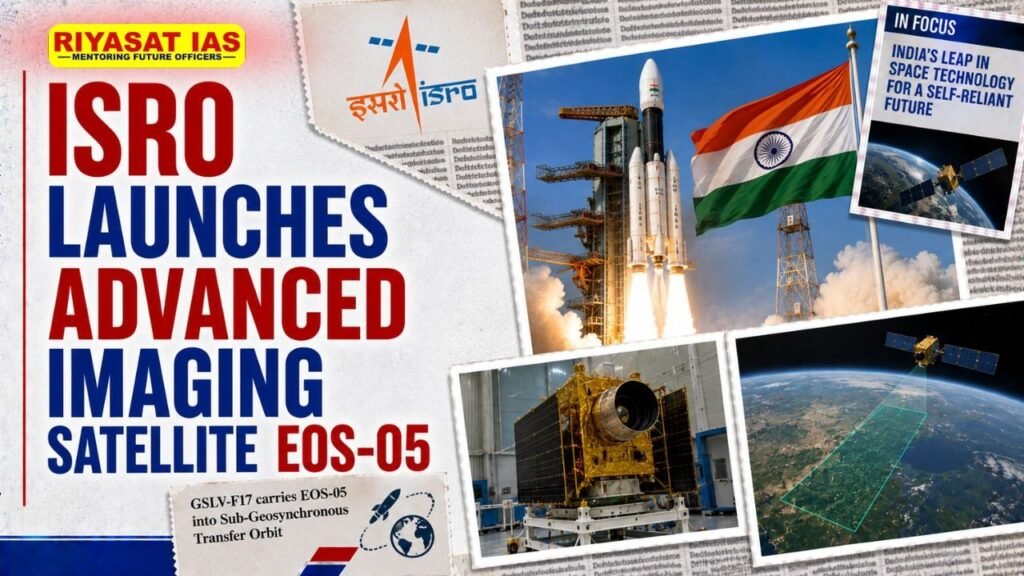
- EOS-05 is an advanced Earth Observation (EO) satellite developed by ISRO.
- It is India’s first imaging satellite designed to operate from a Geosynchronous Orbit (GEO).
- Launch Vehicle: GSLV-F17 (GSLV Mk-II).
- Launch site: Satish Dhawan Space Centre (SDSC-SHAR), Sriharikota.
- Weight: Approximately 2,367 kg, making it India’s heaviest Earth-observation satellite so far.
- The satellite was initially placed in a Sub-Geosynchronous Transfer Orbit (Sub-GTO) and will subsequently undergo orbit-raising manoeuvres.
- Operational altitude will be approximately 36,000 km above Earth.
Why is Geosynchronous Orbit Important?
- Continuous observation: A satellite in geosynchronous orbit can repeatedly observe the same broad geographical region.
- Large-area imaging: Particularly useful for monitoring large parts of the Indian subcontinent.
- Near-real-time applications: Supports frequent monitoring of rapidly changing events.
- Applications:
- Disaster management
- Agriculture
- Urban and infrastructure planning
- Weather/environmental monitoring
- National security and strategic surveillance
GSLV-F17
· GSLV: Geosynchronous Satellite Launch Vehicle.
- F17: 17th flight designation of the GSLV series.
- 19th GSLV flight: GSLV-F17 is the 19th flight of India’s GSLV.
- Uses an indigenous cryogenic upper stage, an important technology for placing heavier payloads into higher orbits.



Important Distinction for Prelims
- Geostationary orbit (GEO): A special type of geosynchronous orbit that is circular and lies over the equator, making the satellite appear stationary over one point on Earth.
- Geosynchronous orbit: Orbital period matches Earth’s rotation, but the orbit need not be exactly equatorial or circular.
- EOS-05: Designed as an imaging satellite for operation from geosynchronous orbit.
UPSC Prelims Questions
Q1. With reference to EOS-05, consider the following statements:
- It is an Earth Observation satellite developed by ISRO.
- It is India’s first imaging satellite designed to operate from geosynchronous orbit.
- It was launched using the GSLV-F17 launch vehicle.
- It was directly placed into a geostationary orbit immediately after launch.
Which of the statements given above are correct?
A. 1, 2 and 3 only
B. 1 and 4 only
C. 2, 3 and 4 only
D. 1, 2, 3 and 4
Answer: A
Explanation:
- Statement 1 — Correct: EOS-05 is an Earth Observation satellite.
- Statement 2 — Correct: It is India’s first imaging satellite designed for geosynchronous orbit.
- Statement 3 — Correct: It was launched by GSLV-F17.
- Statement 4 — Incorrect: It was first injected into a Sub-Geosynchronous Transfer Orbit (Sub-GTO) and will undergo orbit-raising manoeuvres.





 Ravi Raaz
 Hassan Khan
 Shadab Ali