
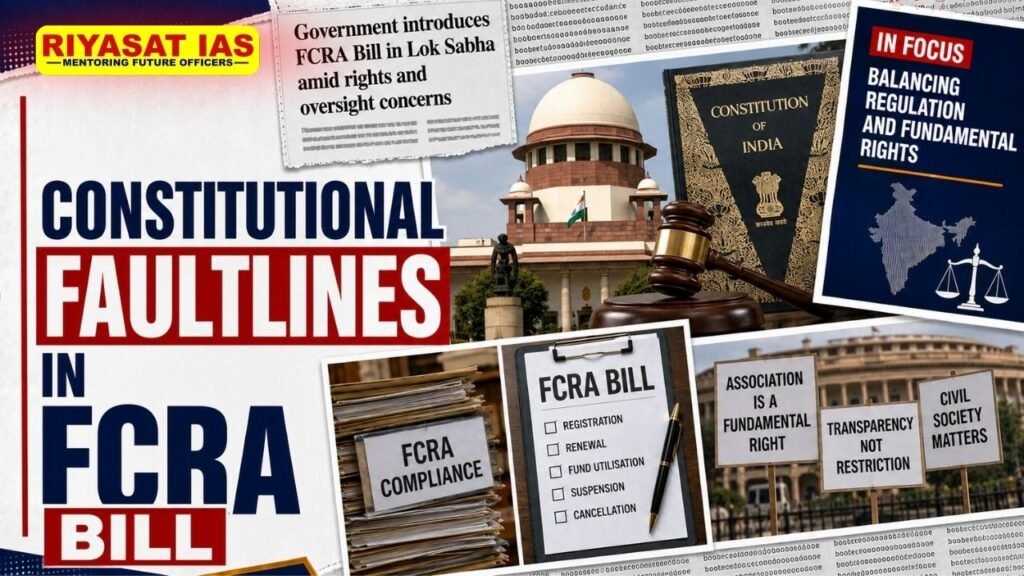
GS-II: Polity & Governance | Fundamental Rights | NGOs & Civil Society | Accountability | Constitutionalism
Context
- Legitimate State Interest: Regulation of foreign contributions is justified on grounds of national security, transparency, democratic accountability and prevention of misuse of funds.
- Core Constitutional Question: The issue is no longer merely whether foreign funding should be regulated, but how far the State can intervene in the assets and functioning of institutions receiving such funds.
Key Provision: ‘Designated Authority’
- Provisional Vesting: If an organisation’s FCRA registration is cancelled, surrendered or ceases to exist, including through non-renewal, foreign contributions and assets created from them may be provisionally vested in a Designated Authority.
- Asset Management: The Authority may take possession, supervise and manage assets created from foreign contributions.
- Institutional Management: Where considered necessary in the public interest, the government-appointed authority may also undertake management of the concerned organisation’s activities.
- Permanent Consequence: If registration is not restored within the prescribed period, the framework may lead to permanent vesting and disposal of assets.
What Changes Under the Bill?
- Existing FCRA Framework: The existing law already permits consequences such as registration cancellation, penalties and vesting of assets associated with foreign contributions.
- Expanded Statutory Framework: The Bill provides a more detailed mechanism for provisional vesting, possession, management, restoration and eventual disposal of such assets.
- Shift in Regulatory Approach: The concern is that regulation of foreign funding could potentially extend into control over institutional infrastructure and activities.
Constitutional Concern
- Ownership vs Control: Even if formal ownership of assets remains with the organisation, government control over their management and functioning can substantially affect institutional autonomy.
- Institutional Independence: Hospitals, schools and laboratories depend not merely on ownership but on independent administration and decision-making to fulfil their charitable or public purposes.
- Executive Discretion: Greater powers for a Designated Authority raise concerns regarding the extent of discretion delegated to the executive.



Doctrine of Proportionality
- Legitimate Aim: Preventing misuse of foreign contributions constitutes a legitimate governmental objective.
- Rational Connection: Any restriction must have a reasonable connection with the objective of preventing financial irregularities or diversion of funds.
- Least Restrictive Means: The State should adopt measures that achieve the objective without imposing excessive interference with institutional autonomy.
- Balancing Test: The public interest served by the measure must be balanced against the burden imposed on constitutional rights and civil-society institutions.
Need for Strong Safeguards
- Clear Standards: The circumstances in which the Designated Authority can assume possession or management must be precisely defined.
- Time-Bound Review: Restoration of assets and registration should be subject to clear and timely procedures.
- Judicial Oversight: Effective mechanisms for revision and judicial appeal are essential.
- Procedural Fairness: Organisations should receive adequate notice, opportunity to respond and reasons for adverse decisions.
- Proportional Consequences: Loss of FCRA registration should not automatically translate into disproportionate control over an institution’s entire asset base or activities.
Broader Governance Concern
- Regulatory Expansion: Over time, thousands of FCRA registrations have ceased to operate because of non-renewal or alleged statutory violations.
- Escalating Consequences: Earlier, cessation of registration primarily affected the organisation’s eligibility to receive foreign contributions; the proposed framework can potentially extend consequences to institutional management and assets.
- Civil Society Autonomy: Excessive executive control could weaken the independence and operational autonomy of legitimate civil-society organisations.
- Rule of Law: Regulatory power must remain bounded by clear legislative standards, proportionality and judicial review.
Way Forward
- Targeted Regulation: Focus regulatory intervention specifically on misuse, diversion and illegal utilisation of foreign contributions.
- Defined Executive Powers: Clearly prescribe the grounds, procedure, duration and limits of Designated Authority intervention.
- Independent Oversight: Strengthen judicial and institutional review mechanisms over possession, management and permanent vesting.
- Proportionality: Ensure that the punishment for regulatory violations remains proportionate to the nature and gravity of the violation.
- Institutional Autonomy: Preserve legitimate civil-society institutions’ ability to independently manage assets and activities consistent with lawful charitable objectives.
Conclusion
- Constitutional Balance: The State has a legitimate duty to regulate foreign contributions, but financial regulation must not become a gateway to disproportionate executive control over institutional assets and autonomy.
- Core Principle: The FCRA framework must strike a balance between national security and accountability on one side, and rule of law, proportionality and institutional independence on the other.
UPSC Mains Practice Question
“The FCRA Amendment Bill, 2026 marks a potential shift from regulation of foreign contributions to greater executive control over institutional assets and activities.” Examine the constitutional and governance concerns involved.
(250 words | 15 marks)





 Ravi Raaz
 Hassan Khan
 Shadab Ali