
GS-III: Environment & Ecology | Climate Change | International Environmental Governance | Disaster Management | Sustainable Development
Context
- 1.5°C Threshold: The UN Environment Programme (UNEP) has warned that crossing the 1.5°C warming threshold is now likely unavoidable in the coming years.
- Irreversible Ecological Losses: A sustained breach of 1.5°C could trigger ecological changes and losses that adaptation measures alone cannot fully reverse.
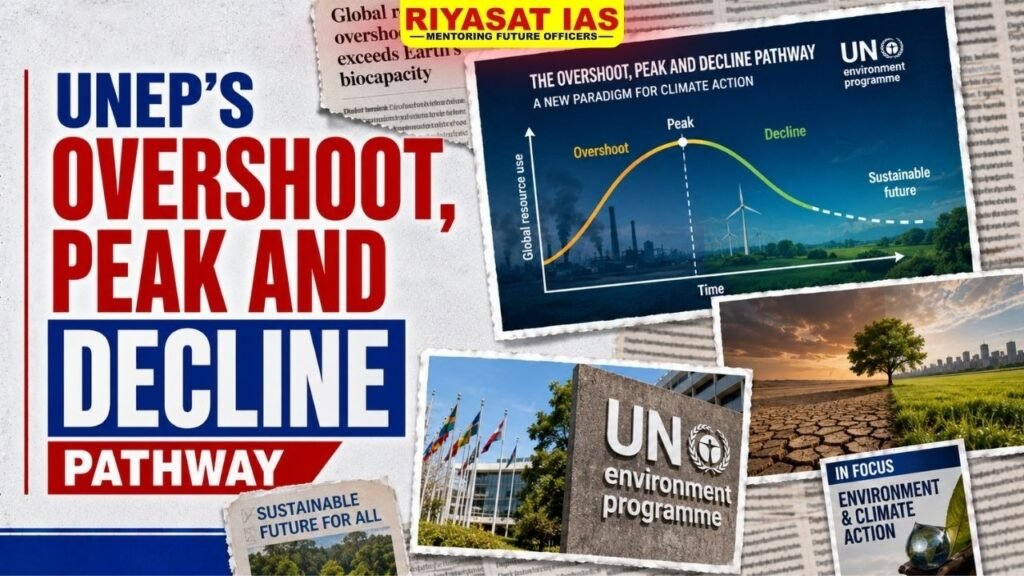
- New Pathway: UNEP has outlined an “overshoot, peak and decline” pathway for the first time, recognising the gap between climate ambitions and current emission trajectories.
- Paris Agreement: The 2015 Agreement aims to keep global temperature rise well below 2°C above pre-industrial levels while pursuing efforts to limit it to 1.5°C.
“Overshoot, Peak and Decline”
- Overshoot: Global temperatures temporarily rise above 1.5°C.
- Peak: The objective is to ensure that the temperature rise reaches the lowest possible peak and remains above 1.5°C for the shortest possible duration.
- Decline: Subsequently, warming should be brought back below 1.5°C by 2100 through deep emissions reductions and carbon removal.
- Not a Preferred Pathway: UNEP explicitly considers overshoot neither acceptable nor desirable, but the best remaining option under present circumstances.
Why 1.5°C Matters
- Climate Extremes: Higher warming increases the risks of heatwaves, floods, droughts and wildfires.
- Cryosphere: Accelerated melting of glaciers and ice sheets contributes to sea-level rise.
- Ecosystems: Coral reefs, biodiversity and climate-sensitive ecosystems face increasing irreversible damage.
- Tipping Points: Greater warming increases the possibility of crossing climate tipping points, potentially triggering self-reinforcing changes.
- Adaptation Limits: Adaptation has physical, financial and technological limits; it cannot eliminate all climate-related losses.



The Problem of Climate Overshoot
- Temporary ≠ Harmless: Even a temporary crossing of 1.5°C can cause cumulative and potentially irreversible impacts.
- Carbon Removal Dependence: Returning temperatures below 1.5°C would require significant carbon dioxide removal (CDR) alongside rapid emissions reductions.
- Technological Uncertainty: Large-scale carbon removal faces challenges relating to cost, land, water, energy requirements and ecological impacts.
- Moral Hazard: Excessive reliance on future carbon removal could weaken incentives for immediate fossil-fuel emission reductions.
Mitigation vs Adaptation
- Mitigation: Addresses the root cause by reducing greenhouse-gas emissions and increasing carbon sinks.
- Adaptation: Reduces vulnerability to the impacts of climate change.
- Loss & Damage: Deals with climate impacts that cannot be adequately prevented through mitigation or adaptation.
- Key Lesson: The possibility of overshoot reinforces the need to pursue mitigation, adaptation and loss-and-damage responses simultaneously.
Implications for India
- Climate Vulnerability: India faces significant exposure to extreme heat, floods, droughts, changing monsoon patterns and sea-level rise.
- Agriculture: Temperature and rainfall changes can affect crop yields, water availability and food security.
- Coastal Risks: Rising sea levels threaten coastal infrastructure, livelihoods and ecosystems.
- Development Challenge: India must balance poverty reduction and energy access with rapid decarbonisation.
- Climate Justice: Developed countries bear greater historical responsibility for accumulated emissions, strengthening India’s case for climate finance, technology transfer and equity.
Way Forward
- Rapid Decarbonisation: Accelerate the transition towards renewable energy, energy efficiency and low-carbon technologies.
- Strengthen NDCs: Countries must raise the ambition and implementation of their Nationally Determined Contributions.
- Protect Carbon Sinks: Strengthen forests, wetlands, mangroves and other natural carbon sinks.
- Responsible Carbon Removal: Develop scientifically credible and environmentally sustainable carbon-removal capacity for unavoidable residual emissions.
- Climate Finance: Scale up predictable finance for developing countries for mitigation and adaptation.
- Early Action: The smaller and shorter the overshoot, the lower the probability of irreversible climate damage.
Conclusion
The emerging reality of climate overshoot represents a shift from “avoiding 1.5°C at all costs” to “minimising the magnitude and duration of the breach and returning below it as rapidly as possible.”
However, an overshoot pathway must not become an excuse for delaying mitigation. The fundamental priority remains rapid emissions reduction, supported by adaptation, climate finance and responsible carbon removal.
For India and the world, the objective should be clear: make the overshoot as small, as short and as reversible as scientifically possible.
UPSC Mains Practice Question
Q. “Climate overshoot is not a substitute for mitigation but a consequence of delayed climate action.” Discuss the significance and challenges of UNEP’s “overshoot, peak and decline” pathway. (250 words, 15 marks)





 Ravi Raaz
 Hassan Khan
 Shadab Ali