
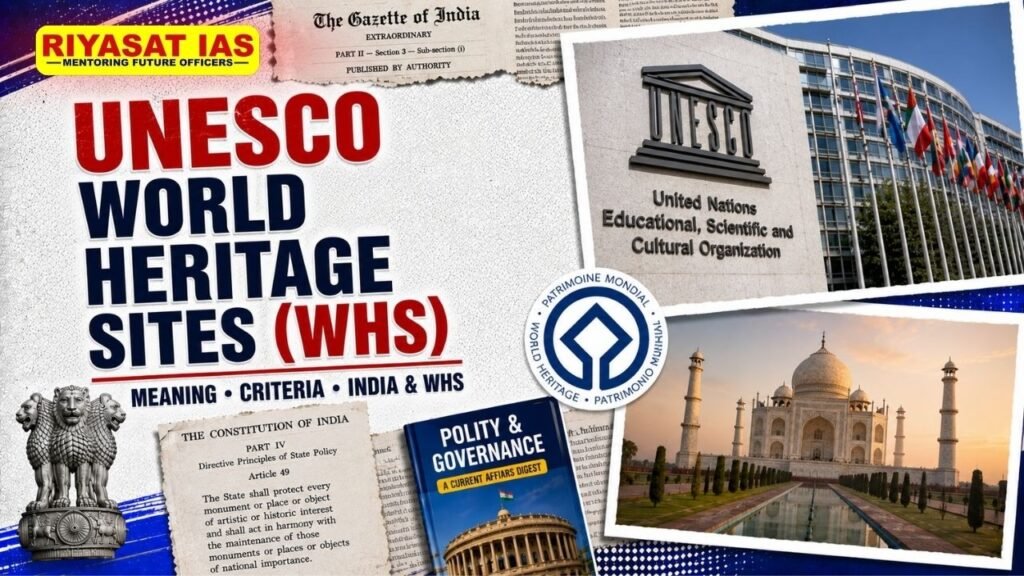
About UNESCO World Heritage Sites
· The UNESCO World Heritage List identifies cultural and natural properties considered to possess Outstanding Universal Value (OUV) and therefore deserving protection for present and future generations. The system operates under the 1972 Convention Concerning the Protection of the World Cultural and Natural Heritage, commonly known as the World Heritage Convention.
· As of 2026, the World Heritage List contains 1,273 properties across 173 States Parties, comprising 991 cultural, 240 natural and 42 mixed properties.
· India ratified the World Heritage Convention on 14 November 1977 and currently has 45 properties on the World Heritage List.
UNESCO World Heritage Convention, 1972
· The Convention Concerning the Protection of the World Cultural and Natural Heritage was adopted by the UNESCO General Conference on 16 November 1972.
· The Convention created an international framework for identifying and protecting heritage considered to have Outstanding Universal Value.
· Cultural Heritage: Under Article 1, cultural heritage includes monuments, groups of buildings and sites that possess outstanding universal value from historical, artistic, scientific, ethnological or anthropological perspectives.
· Natural Heritage: Under Article 2, natural heritage includes significant natural features, geological and physiographical formations, and natural sites or habitats having outstanding universal value from scientific, conservation or aesthetic perspectives.
· World Heritage Committee: The World Heritage Committee is responsible for implementing the Convention, deciding which properties are inscribed on the World Heritage List and examining the state of conservation of listed properties.
o The Convention also created the World Heritage Fund.
Selection Criteria
· A property must demonstrate Outstanding Universal Value and satisfy at least one of UNESCO’s ten selection criteria. In addition, UNESCO considers requirements relating to integrity, authenticity, protection and management.
· Cultural Criteria
o Criterion (i) applies to properties representing a masterpiece of human creative genius.
o Criterion (ii) covers properties demonstrating an important interchange of human values in architecture, technology, monumental arts, town planning or landscape design.
o Criterion (iii) applies to properties providing exceptional testimony to a living or disappeared cultural tradition or civilisation.
o Criterion (iv) covers outstanding examples of buildings, architectural ensembles or landscapes illustrating significant stages in human history.
o Criterion (v) applies to traditional human settlements, land-use or sea-use systems representing cultures or human interaction with the environment, particularly where they are vulnerable to irreversible change.



o Criterion (vi) covers properties directly or tangibly associated with important events, living traditions, ideas, beliefs or artistic and literary works of outstanding universal significance. UNESCO prefers this criterion to be used in combination with other criteria.
· Natural Criteria
o Criterion (vii) covers areas containing exceptional natural phenomena or areas of outstanding natural beauty and aesthetic importance.
o Criterion (viii) applies to properties representing major stages of Earth’s history, including significant geological and geomorphological processes.
o Criterion (ix) covers outstanding examples of ongoing ecological and biological processes in terrestrial, freshwater, coastal and marine ecosystems.
o Criterion (x) applies to areas containing important natural habitats for the conservation of biological diversity, particularly those supporting threatened species.
World Heritage Sites in India: 2026
India currently has 45 World Heritage properties, consisting of 37 cultural, 7 natural and 1 mixed property. The Ancient Buddhist Site of Sarnath was inscribed in 2026, becoming India’s latest World Heritage property.
| No. | World Heritage Property | State/UT | Year | Category |
| 1 | Agra Fort | Uttar Pradesh | 1983 | Cultural |
| 2 | Ajanta Caves | Maharashtra | 1983 | Cultural |
| 3 | Taj Mahal | Uttar Pradesh | 1983 | Cultural |
| 4 | Ellora Caves | Maharashtra | 1983 | Cultural |
| 5 | Group of Monuments at Mahabalipuram | Tamil Nadu | 1984 | Cultural |
| 6 | Sun Temple, Konark | Odisha | 1984 | Cultural |
| 7 | Kaziranga National Park | Assam | 1985 | Natural |
| 8 | Keoladeo National Park | Rajasthan | 1985 | Natural |
| 9 | Manas Wildlife Sanctuary | Assam | 1985 | Natural |
| 10 | Churches and Convents of Goa | Goa | 1986 | Cultural |
| 11 | Fatehpur Sikri | Uttar Pradesh | 1986 | Cultural |
| 12 | Group of Monuments at Hampi | Karnataka | 1986 | Cultural |
| 13 | Khajuraho Group of Monuments | Madhya Pradesh | 1986 | Cultural |
| 14 | Elephanta Caves | Maharashtra | 1987 | Cultural |
| 15 | Great Living Chola Temples | Tamil Nadu | 1987 | Cultural |
| 16 | Group of Monuments at Pattadakal | Karnataka | 1987 | Cultural |
| 17 | Sundarbans National Park | West Bengal | 1987 | Natural |
| 18 | Nanda Devi and Valley of Flowers National Parks | Uttarakhand | 1988 | Natural |
| 19 | Buddhist Monuments at Sanchi | Madhya Pradesh | 1989 | Cultural |
| 20 | Humayun’s Tomb, Delhi | Delhi | 1993 | Cultural |
| 21 | Qutb Minar and its Monuments, Delhi | Delhi | 1993 | Cultural |
| 22 | Mountain Railways of India | West Bengal, Tamil Nadu, Himachal Pradesh | 1999 | Cultural |
| 23 | Mahabodhi Temple Complex at Bodh Gaya | Bihar | 2002 | Cultural |
| 24 | Rock Shelters of Bhimbetka | Madhya Pradesh | 2003 | Cultural |
| 25 | Champaner-Pavagadh Archaeological Park | Gujarat | 2004 | Cultural |
| 26 | Chhatrapati Shivaji Terminus | Maharashtra | 2004 | Cultural |
| 27 | Red Fort Complex | Delhi | 2007 | Cultural |
| 28 | The Jantar Mantar, Jaipur | Rajasthan | 2010 | Cultural |
| 29 | Western Ghats | Maharashtra, Karnataka, Kerala, Tamil Nadu | 2012 | Natural |
| 30 | Hill Forts of Rajasthan | Rajasthan | 2013 | Cultural |
| 31 | Great Himalayan National Park Conservation Area | Himachal Pradesh | 2014 | Natural |
| 32 | Rani-ki-Vav at Patan | Gujarat | 2014 | Cultural |
| 33 | Archaeological Site of Nalanda Mahavihara | Bihar | 2016 | Cultural |
| 34 | Khangchendzonga National Park | Sikkim | 2016 | Mixed |
| 35 | The Architectural Work of Le Corbusier | Chandigarh | 2016 | Cultural |
| 36 | Historic City of Ahmadabad | Gujarat | 2017 | Cultural |
| 37 | Victorian Gothic and Art Deco Ensembles of Mumbai | Maharashtra | 2018 | Cultural |
| 38 | Jaipur City, Rajasthan | Rajasthan | 2019 | Cultural |
| 39 | Dholavira: a Harappan City | Gujarat | 2021 | Cultural |
| 40 | Kakatiya Rudreshwara (Ramappa) Temple | Telangana | 2021 | Cultural |
| 41 | Sacred Ensembles of the Hoysalas | Karnataka | 2023 | Cultural |
| 42 | Santiniketan | West Bengal | 2023 | Cultural |
| 43 | Moidams – the Mound-Burial System of the Ahom Dynasty | Assam | 2024 | Cultural |
| 44 | Maratha Military Landscapes of India | Maharashtra, Tamil Nadu | 2025 | Cultural |
| 45 | Ancient Buddhist Site of Sarnath | Uttar Pradesh | 2026 | Cultural |
FAQs
1. How many World Heritage properties are there globally in 2026?
As of 2026, UNESCO’s World Heritage List contains 1,273 properties: 991 cultural, 240 natural and 42 mixed.
2. How many World Heritage properties does India have?
India has 45 properties: 37 cultural, 7 natural and 1 mixed.
3. Which is India’s latest World Heritage Site?
The Ancient Buddhist Site of Sarnath in Uttar Pradesh was inscribed in 2026, becoming India’s 45th World Heritage property.
4. What is India’s only Mixed World Heritage property?
Khangchendzonga National Park in Sikkim is India’s only Mixed World Heritage property.
5. How many criteria must a site satisfy for World Heritage inscription?
A nominated property must demonstrate Outstanding Universal Value and satisfy at least one of UNESCO’s ten selection criteria, along with the relevant requirements of integrity, authenticity, protection and management.





 Ravi Raaz
 Hassan Khan
 Shadab Ali