
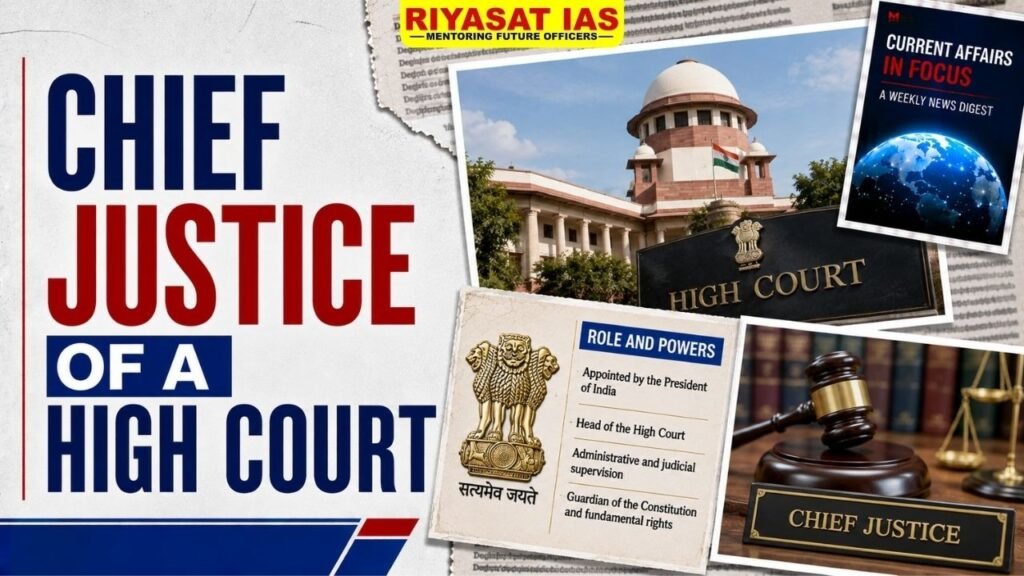
- Constitutional Provision: The office is High Court is provided under Article 216 of the Constitution.
- Appointment: The President of India appoints the Chief Justice of a High Court under Article 217.
- Consultation: The President consults the Chief Justice of India and the Governor of the concerned State; in case of appointment of a judge other than Chief Justice, the Chief Justice of the concerned High Court is also consulted.
- Eligibility: Same basic qualifications as a High Court judge:
- Citizen of India, and
- Has held a judicial office for at least 10 years in India, or
- Has been an advocate of a High Court (or two or more High Courts in succession) for at least 10 years.
- Tenure: A judge, including the Chief Justice, holds office until the age of 62 years.
- Removal: Removed by the President after an address by both Houses of Parliament, supported by the required special majority, on grounds of proved misbehaviour or incapacity.
- Oath: Administered by the Governor of the State or a person appointed by the Governor.
- Transfer: The President can transfer a judge from one High Court to another after consultation with the Chief Justice of India.



UPSC Prelims Question
Q. With reference to the Chief Justice of a High Court, consider the following statements:
- The President of India appoints the Chief Justice of a High Court.
- The Chief Justice of India is consulted in the appointment.
- The High Court holds office until the age of 65 years.
- The Chief Justice can be removed by the Governor of the concerned State.
Which of the statements given above are correct?
(a) 1 and 2 only
(b) 1, 2 and 3 only
(c) 2 and 4 only
(d) 1, 2, 3 and 4
Answer: (a) 1 and 2 only
Explanation: The President appoints the Chief Justice of a High Court after consultation with the Chief Justice of India and the Governor of the concerned State. The retirement age for a High Court judge is 62, not 65. Removal is by the President through the parliamentary removal process, not by the Governor.





 Ravi Raaz
 Hassan Khan
 Shadab Ali