
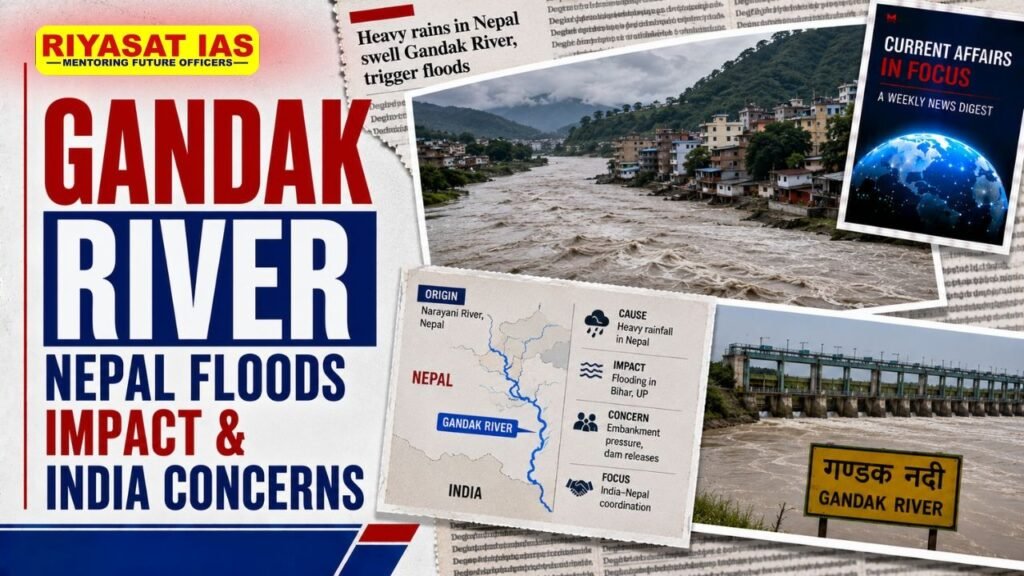
- River System: Gandak is a major Himalayan river and a left-bank tributary of the Ganga.
- Names: In Nepal, it is known as Gandaki/Narayani; in India, it is called Gandak. The upper river is associated with Kali Gandaki.
- Origin: The Gandaki system originates in the Himalayan/Tibetan Plateau region and drains central Nepal before entering India.
- Major Tributaries: Kali Gandaki, Trishuli, Budhi Gandaki, Marsyangdi, Seti, Madi and Daraudi constitute the major tributaries of the Gandaki system.
- Course in India: It enters India near Valmikinagar in West Champaran, Bihar, flows through northern Bihar and joins the Ganga near Hajipur/Sonpur.
- Gandak Barrage: The Gandak Barrage at Valmikinagar is an important India–Nepal water-management and irrigation project. The bilateral Gandak Agreement was signed in 1959 for construction of the barrage in Nepal.
- Flood Significance: Heavy rainfall in the Nepalese catchment can rapidly increase Gandak discharge, making it important for flood management in Bihar and eastern Uttar Pradesh.
- Ecological Importance: The river system is associated with the Valmiki Tiger Reserve region and important riverine ecosystems.
- Map Point: Gandak lies broadly between the Kosi system to the east and the Karnali–Ghaghara system to the west.



UPSC Prelims Question
Q. Consider the following statements regarding the Gandak River:
- It is a left-bank tributary of the Ganga.
- It is known as Narayani in Nepal.
- The Gandak Barrage is associated with an India–Nepal water agreement.
- It joins the Ganga near Patna/Hajipur.
Which of the statements given above are correct?
Answer: 1, 2, 3 and 4
Explanation: Gandak/Narayani is a transboundary Himalayan river, enters India near Valmikinagar and joins the Ganga near Hajipur/Sonpur. The 1959 Gandak Agreement provides the bilateral framework associated with the Gandak Barrage project.





 Ravi Raaz
 Hassan Khan
 Shadab Ali