
GS-II: Polity & Governance | Social Justice | Reservation | Constitutional Bodies & Judiciary
Context
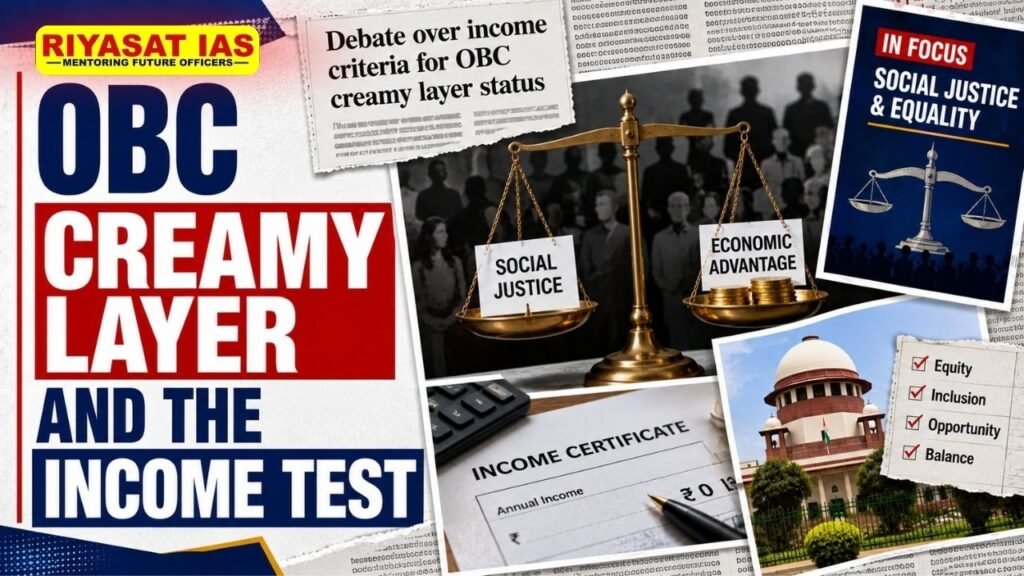
- SC to Consider Centre’s Plea: The Supreme Court has said it will consider setting up a Bench to hear the Centre’s application seeking clarification on its March 11, 2026 judgment concerning the income test for determining the OBC creamy layer.
- Centre’s Concern: The Centre has argued that retrospective implementation of the judgment would be extremely difficult and could have a cascading effect on settled services from 2012 onwards.
- Wider Impact: The Centre apprehends that the consequences could extend beyond OBC candidates to all categories, including the Unreserved category.
- Background: The cases involved at least 50 OBC candidates who appeared in Civil Services Examinations since 2015 and were excluded from OBC-reserved posts based solely on their parents’ income.
What is the OBC Creamy Layer?
- Concept: The creamy layer refers to the relatively socially and economically advanced sections among OBCs who are excluded from reservation benefits.
- Origin: The concept emerged from the Supreme Court’s 1992 Indra Sawhney judgment, which paved the way for implementation of OBC reservations.
- Purpose: The objective was to ensure that reservation benefits reach the socially and economically disadvantaged sections within OBC communities.
- 1993 OM: The DoPT issued an Office Memorandum in September 1993, prescribing criteria for exclusion from OBC reservation.
What are the Creamy Layer Exclusion Criteria?
- Constitutional & Senior Officials: Children of senior constitutional, judicial, government and armed-forces officers are among the categories subject to exclusion.
- Income/Wealth Test: A separate test applies to certain salaried professionals, persons engaged in trade, holders of plantations, vacant land/buildings in urban areas and certain PSU/private-sector categories.
- Income Threshold: The income limit was initially ₹1 lakh in 1993 and was revised several times, reaching ₹8 lakh in 2017.
- Exclusion of Salary & Agricultural Income: Under the 1993 OM, salary and agricultural income were consciously excluded while applying the income/wealth test.
- Three-Year Requirement: Under the income/wealth test, the prescribed income threshold had to be exceeded for three consecutive years.
What was the Problem with the 1993 OM and 2004 Letter?
- 1993 OM: The OM excluded salary and agricultural income while applying the income/wealth test.
- 2004 DoPT Letter: A clarification issued in October 2004 appeared to suggest that salary income should be counted for certain OBC candidates whose parents worked in Central/State PSUs where equivalence with government posts had not been established.
- Differential Treatment: This resulted in children of PSU/private-sector employees being treated differently from children of government employees.
- Core Issue: Without establishing equivalence of posts, salaries were used to exclude some OBC candidates while salaries were not similarly considered for candidates whose parents were in government service.



How Did the Supreme Court Interpret the Income Test?
- Rohith Nathan Judgment: In Union of India v. Rohith Nathan, the Supreme Court held that OBC candidates whose parents work in PSUs or the private sector cannot be treated differently merely because their parents are outside government service where post equivalence has not been established.
- Income Test as Residual Filter: The Court held that the income/wealth test must operate as a “residual filter”.
- Salary Exclusion: The Court observed that salaries and agricultural income had been consciously excluded under the 1993 OM.
- Hostile Discrimination: Applying salary income to PSU/private-sector employees while excluding it for similarly placed government employees resulted in “hostile discrimination”.
- Equality Principle: The Court held that treating similarly placed candidates differently would amount to “equals being treated unequally.”
- Supernumerary Posts: The Centre was directed to create supernumerary posts for affected OBC candidates and allot services according to their ranks in their respective CSE years.
- Implementation Timeline: The Centre was directed to implement the Court’s interpretation of the income test within six months.
Why Does the Centre Call Retrospective Implementation ‘Extremely Difficult’?
- Settled Services: Retrospective implementation could disturb settled service positions from 2012 onwards.
- Cascading Effect: Reopening past selections could trigger a cascading effect across service allocations and seniority.
- Increasing Claims: The government has reported an increasing number of claims seeking adjustment under the judgment.
- Seniority Issues: Adjusting candidates retrospectively could create complex seniority-related disputes.
- Impact on Other OBC Candidates: The Centre argues that accommodating one category of candidates could potentially be unfair to other OBC candidates.
- Impact on Unreserved Candidates: The Centre apprehends consequences extending to all categories, including the Unreserved category.
- Expansion of Litigation: Since the judgment, the DoPT stated that 22 other judgments have applied its principles and 12 new cases have been filed seeking reconsideration of OBC non-creamy-layer status.
What Steps Has the Centre Taken?
- Inter-Ministerial Consultation: The Ministry of Personnel wrote to the Ministry of Social Justice and Empowerment on June 3 seeking advice on implementation.
- Policy Jurisdiction: The Personnel Ministry referred to the Allocation of Business Rules, under which the Social Justice Ministry formulates reservation policy.
- Implementation Claim: As of August 19, the Centre told the Central Administrative Tribunal that it was in the process of implementing the March 11 judgment.
- Subsequent Application: The DoPT later approached the Supreme Court highlighting difficulties, particularly concerning retrospective implementation.
- CSE 2025 Candidates: The Centre has sought permission to continue allotting services to CSE 2025 candidates under the earlier interpretation for the time being.
- Foundation Course: The Centre stated that more than 950 CSE 2025 candidates were about to begin their Foundation Course and had been recommended under the earlier interpretation.
Centre’s Additional Argument
- Salary as Differentiator: The Centre has argued that there may be value in considering salary income because, in some cases, it could be the “sole intelligible differentia” between OBC candidates from similar social backgrounds.
- High-Income Cases: It has argued that excluding salary consideration could potentially result in OBC candidates whose parents earn up to ₹1 crore being treated as non-creamy layer.
- Clarification Sought: The Centre has therefore sought clarification on the broader implementation of the judgment.
Way Forward
- Clear Implementation Framework: The Supreme Court’s clarification should provide a clear and uniform framework for applying the income/wealth test.
- Avoid Arbitrary Classification: The implementation must prevent unequal treatment of similarly situated OBC candidates.
- Protect Settled Services: Retrospective implementation should be carefully structured to minimise disruption to existing seniority and service allocations.
- Balance Competing Claims: The interests of affected OBC candidates, other OBC candidates and Unreserved candidates need to be considered.
- Policy Clarity: The government should clearly specify how salary, wealth, parental occupation and post equivalence interact in determining creamy-layer status.
- Reduce Litigation: A transparent and consistently applied framework can prevent repeated litigation and conflicting interpretations.
- Constitutional Balance: The creamy-layer mechanism should continue to ensure that reservation benefits reach those who genuinely require them while maintaining the principle of equality.
Conclusion
The Rohith Nathan judgment raises a fundamental issue concerning the proper application of the OBC creamy-layer exclusion criteria. While the Supreme Court sought to prevent discriminatory treatment between similarly situated OBC candidates, retrospective implementation has created complex questions concerning seniority, service allocation and competing claims.
The immediate challenge is therefore to reconcile social justice and equality with administrative certainty, through a clear, uniform and constitutionally sound framework for determining OBC creamy-layer status.
UPSC Mains Practice Question
Q. “The OBC creamy-layer principle seeks to ensure that reservation benefits reach the genuinely disadvantaged, but its implementation has raised questions of equality and administrative certainty.” Discuss in the light of the Supreme Court’s Rohith Nathan judgment. (250 words, 15 marks)




 Ravi Raaz
 Hassan Khan
 Shadab Ali