
GS-II: Indian Constitution | Fundamental Rights | Social Justice | Judiciary
Context
- Haldwani Shuddhikaran Ritual: A purification ritual was performed at Haldwani’s Ramlila ground on August 10, two days after Mallikarjun Kharge addressed a rally there.
- Contested Explanation: Mr. Kharge described the ritual as reflecting the “sting of untouchability” and sought legal action. The organisation cited slogans allegedly raised during the rally and Mr. Kharge’s earlier political remarks.
- Core Legal Question: The issue is whether purification of a place after its use by a Dalit person can amount to untouchability under Indian law.
Constitutional and Legal Framework
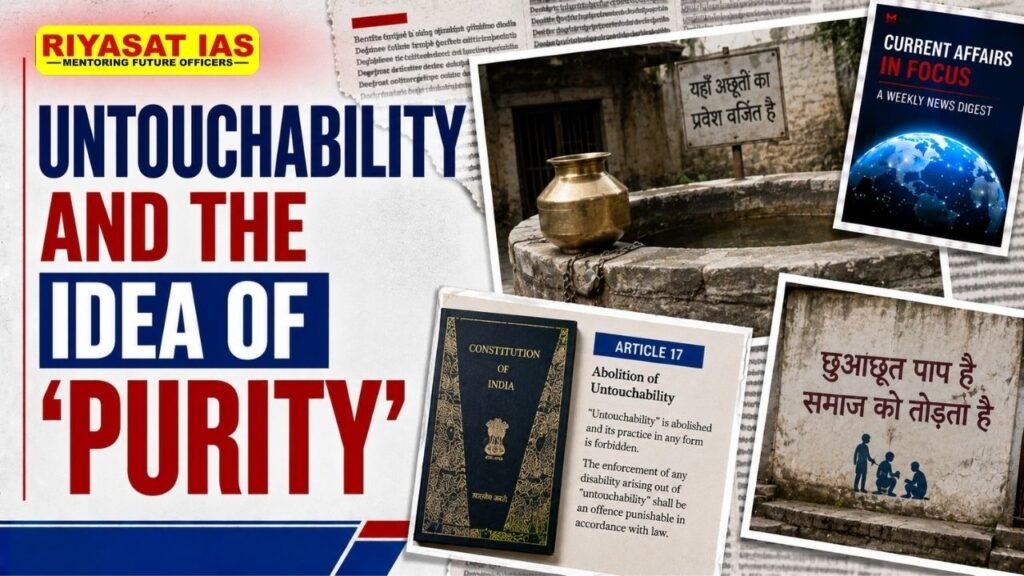
- Article 17: It abolishes “untouchability”, prohibits its practice “in any form”, and makes enforcement of disabilities arising from it an offence.
- Non-State Actors: The Supreme Court has recognised that Article 17 can also operate against non-State actors.
- Protection of Civil Rights Act, 1955: Parliament gave effect to Article 17 through the Untouchability (Offences) Act, 1955, later amended and renamed the Protection of Civil Rights Act, 1955 in 1976.
- Beyond Denial of Entry: The Act covers practices such as preventing entry into places of worship, imposing social disabilities and discrimination in access to public facilities.
- Section 7(1)(d): It also punishes insulting or attempting to insult a Scheduled Caste member “on the ground of ‘untouchability’.” Mere humiliation of an SC person is therefore not sufficient; the connection with untouchability must be established.
Supreme Court on Article 17
- Sukanya Shantha v Union of India (2024): The Supreme Court linked untouchability with the caste system and notions of “purity and pollution”, which reinforce caste hierarchy.
- Broad Scope of Article 17: Since discrimination can take different forms, the absence of a specific constitutional definition does not restrict Article 17 to traditional forms of untouchability.
- Stigma of Presence: The Court stated that “There cannot be any stigma attached to the existence, touch or presence of any person.”
- Caste-Based Pollution: The judgment therefore addresses discriminatory treatment based on a person’s touch or presence, not merely physical exclusion.



Judicial View on Purification
- Surya Narayan Choudhary v State of Rajasthan (1988): The Rajasthan High Court dealt with purification imposed on Dalit devotees at the public Shrinathji temple in Nathdwara.
- Equal Access: The Court held that Dalit devotees could not be subjected to an additional condition for temple entry that did not apply to other devotees.
- Articles 14, 15 and 17: The reported purification practice was directed to be discontinued as discriminatory and violative of these Articles.
- Difference from Haldwani: At Nathdwara, purification was imposed before temple entry. At Haldwani, it occurred after Mr. Kharge had used the venue, and its reason is disputed.
- Limited Relevance: The Nathdwara judgment does not decide the Haldwani controversy; it establishes that caste-specific purification imposed as a condition of equal access can violate Article 17.
Article 17 and SC/ST Act: Distinction
- Separate Legal Framework: Article 17 and the Protection of Civil Rights Act must be distinguished from the SC/ST (Prevention of Atrocities) Act, 1989, which contains separate offences.
- Section 3(1)(r): It concerns intentional insult or intimidation of an SC/ST member with intent to humiliate them in a place within public view, when committed by a person who is not SC/ST.
- Hitesh Verma v State of Uttarakhand (2020): The Supreme Court held that not every insult to an SC/ST person attracts the provision; the insult must be connected to their protected community status.
- Gunjan @ Girija Kumari v State (NCT of Delhi) (2026): The Supreme Court reiterated that “public view” is an essential requirement for the offence.
What Would Establish Untouchability?
- Caste-Based Pollution: If evidence shows that the venue was cleansed because caste-based notions of pollution were attached to Mr. Kharge’s touch or presence, Sukanya Shantha and Surya Narayan Choudhary become directly relevant.
- Unconnected Reasons: If the ritual was undertaken for reasons unrelated to caste, including those cited by the organisers, its timing alone would not establish untouchability.
- Central Legal Test: The word shuddhikaran itself does not determine the legal issue. What matters is the connection between the ritual and caste-based notions of pollution.
Conclusion
Article 17 is not limited to physical exclusion. Its scope also extends to caste-based notions of purity and pollution and discriminatory treatment based on a person’s touch or presence.
In the Haldwani case, the decisive question is therefore whether the purification ritual was connected to caste-based notions of pollution.
UPSC Mains Practice Question
Q. “Article 17 is not confined to physical exclusion but also addresses caste-based notions of purity and pollution.” Discuss in the light of judicial interpretation. (250 words, 15 marks)




 Ravi Raaz
 Hassan Khan
 Shadab Ali