
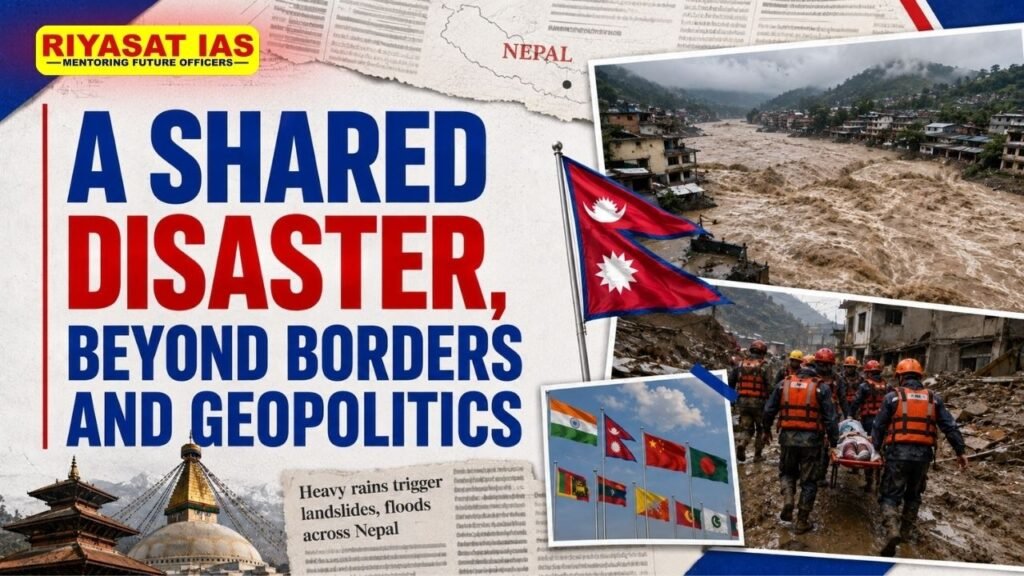
GS-II: International Relations | India’s Neighbourhood | India–Nepal–China Relations | Regional Cooperation | Disaster Diplomacy
GS-III: Environment & Ecology | Glacial Hazards | GLOFs | Disaster Management | Climate Change
Context
- Unusual Disaster: On 26 August 2026, a massive glacial slab collapse near the Nepal–China border triggered a destructive landslide and flash floods.
- Non-Tectonic Event: The initial seismic signal was subsequently attributed to the glacial collapse and landslide, rather than a conventional tectonic earthquake.
- Transboundary Impact: The disaster affected Nepal, China and India, demonstrating that natural hazards do not respect political boundaries.
- Infrastructure Loss: Roads, bridges, hydropower infrastructure and border connectivity suffered extensive damage, including disruption around Gyirong Port in Tibet.
- Humanitarian Impact: Indian nationals, including Kailash Mansarovar pilgrims, were among those reported missing/untraced.
- Downstream Risk for India: Floodwaters and rising levels in the Gandak, Kosi and Ganga systems triggered heightened preparedness in Bihar and Uttar Pradesh.
- India’s Response: India activated Humanitarian Assistance and Disaster Relief (HADR) measures and deployed relief material and personnel to Nepal.
Why the Disaster is Significant
- Transboundary Nature: Himalayan rivers, glaciers and ecosystems cut across political borders, creating shared disaster risks.
- Fragile Himalayas: Rapid environmental changes, steep terrain and intense rainfall increase vulnerability to landslides, flash floods and glacial hazards.
- Cascade Effect: A single glacial collapse can trigger a chain of events—ice/rock collapse → landslide → river blockage/overflow → flash flood → downstream destruction.
- Infrastructure Vulnerability: Roads, hydropower projects, bridges and border trade infrastructure are particularly exposed in mountain regions.
- Geopolitical Dimension: The disaster demonstrates that ecological interdependence can override geopolitical boundaries.
What is a Glacial Collapse?
- Glacial Collapse: Sudden failure or movement of a large mass of glacier/ice and associated rock and debris down a steep slope.
- It can generate enormous quantities of ice, rock, sediment and water.
- When this material enters a river valley, it can produce flash floods and debris flows.
- Unlike conventional earthquakes, such events may generate seismic signals without tectonic fault movement.
Related Hazard: Glacial Lake Outburst Flood (GLOF)
- A GLOF occurs when water stored in a glacial lake is suddenly released.
- Triggers include:
- Glacier collapse
- Landslides
- Ice avalanches
- Moraine-dam failure
- Earthquakes
- GLOFs can travel rapidly downstream and cause destruction far from the original source.



Why the Himalayas are Increasingly Vulnerable
- Climate Change: Rising temperatures accelerate glacier retreat and destabilise ice and mountain slopes.
- Glacial Lake Expansion: Glacier retreat can create or enlarge unstable glacial lakes.
- Extreme Rainfall: Intense precipitation can destabilise slopes and rapidly increase river discharge.
- Permafrost Degradation: Warming can weaken frozen mountain slopes and increase rockfall and landslide risks.
- Rapid Infrastructure Development: Roads, tunnels, hydropower projects and settlements can increase exposure in fragile terrain.
- Cumulative Risk: Climate change + geological instability + infrastructure expansion creates compound disasters.
Impact on India
1. Flood Risk
- Nepal-origin rivers such as the Gandak, Kosi and other Himalayan tributaries enter the Gangetic plains.
- Sudden increases in upstream discharge can rapidly raise water levels downstream.
- Bihar and Uttar Pradesh are particularly vulnerable because of their extensive low-lying floodplains.
2. Humanitarian Concerns
- Indian nationals travelling through the Nepal–Tibet corridor may become stranded or untraceable.
- Pilgrimage and tourism routes can be severely disrupted.
3. Infrastructure
- Floods can damage:
- Bridges
- Roads
- Railways
- Embankments
- Hydropower facilities
- Communication networks
4. Energy Security
- Damage to hydropower infrastructure can affect electricity generation and transmission.
- This is particularly important because Nepal’s energy sector is increasingly linked to cross-border electricity trade with India.
Strategic Significance for India
- Disaster Diplomacy: Humanitarian cooperation can create channels of engagement even when broader geopolitical relations are difficult.
- Neighbourhood First: Helping Nepal during disasters reinforces India’s role as a first responder in its neighbourhood.
- Himalayan Security: Ecological security is increasingly becoming part of national and regional security.
- Bay of Bengal Linkage: Himalayan floods eventually affect the wider Ganga-Brahmaputra-Meghna basin, linking mountain and downstream security.
- Strategic Autonomy: Cooperation on disasters need not imply convergence on broader geopolitical issues.
Challenges to Cooperation
- Strategic Mistrust: India-China relations remain affected by border and security concerns.
- Data Sensitivity: Sharing hydrological and geospatial information may be viewed through a strategic-security lens.
- Institutional Fragmentation: Disaster-management mechanisms remain largely national rather than genuinely transboundary.
- Unequal Capacities: The three countries possess different technological, financial and institutional capabilities.
- Infrastructure Priorities: Development projects may sometimes conflict with ecological risk reduction.
Way Forward
- Create a Trilateral Himalayan Disaster Mechanism: Establish a dedicated India–Nepal–China framework for disaster preparedness and response.
- Real-Time Data Sharing: Develop mechanisms for sharing rainfall, river-flow, glacier and glacial-lake data.
- Joint Early-Warning Systems: Build interoperable warning systems reaching vulnerable communities downstream.
- Himalayan Risk Mapping: Undertake joint mapping of glaciers, landslide zones, flood corridors and vulnerable infrastructure.
- Climate-Resilient Infrastructure: Make roads, bridges and hydropower projects more resilient to extreme events.
- Strengthen Existing Mechanisms: Improve bilateral arrangements between India–Nepal and India–China while gradually developing trilateral cooperation.
- Community-Based Disaster Management: Integrate local communities, traditional knowledge and local disaster-response networks.
- Disaster Diplomacy: Keep humanitarian and ecological cooperation insulated from broader geopolitical disputes wherever possible.
Conclusion
The Nepal disaster is a stark reminder that the Himalayas constitute a shared ecological system, not three separate geopolitical spaces. A glacial collapse in the mountains can rapidly become a humanitarian and economic crisis across national borders.
For India, Nepal and China, the practical response should be to compartmentalise geopolitical disagreements and create functional cooperation on shared natural risks. Disaster management can therefore become an important avenue for confidence-building, regional resilience and Himalayan ecological security.
Geopolitical borders may divide territories, but rivers, glaciers and natural hazards do not recognise them.
UPSC Mains Practice Question
Q. “The Himalayas are a shared ecological system, and transboundary disasters require transboundary solutions.” Discuss the need for India–Nepal–China cooperation in managing emerging Himalayan hazards. (250 words, 15 marks)





 Ravi Raaz
 Hassan Khan
 Shadab Ali