
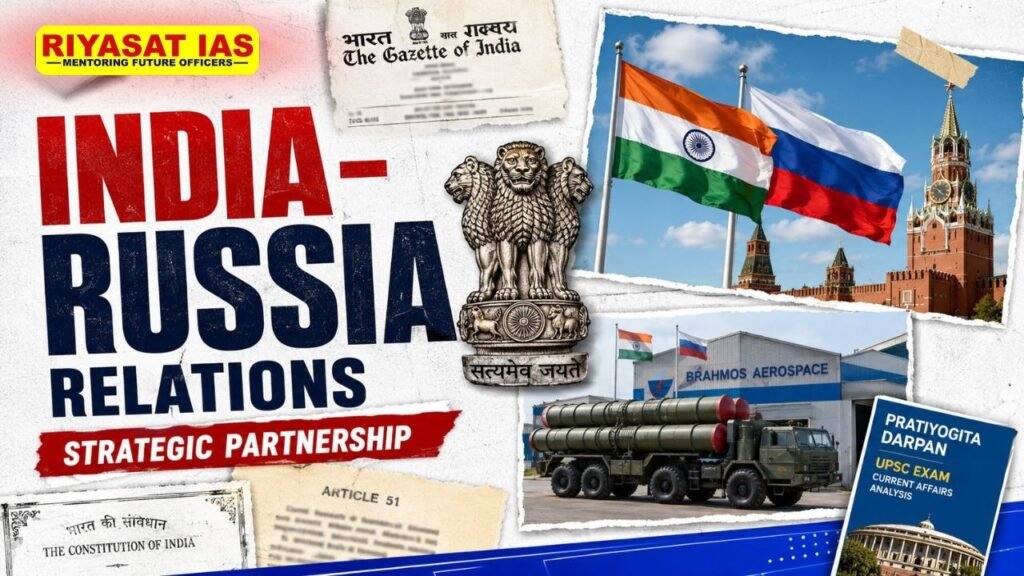
India–Russia relations constitute one of India’s most enduring strategic partnerships. The relationship has evolved from Soviet-era political, economic and defence cooperation into a broad-based Special and Privileged Strategic Partnership covering defence, energy, nuclear power, space, trade, connectivity, science and technology and multilateral cooperation. The partnership continues to be guided by mutual trust, strategic autonomy and respect for each other’s core national interests.
Historical Background
· India established diplomatic relations with the Soviet Union in April 1947, even before India’s independence. During the following decades, the Soviet Union became an important partner in India’s industrialisation, defence modernisation, science and technology and infrastructure development.
· Soviet assistance contributed to the establishment of major industrial projects such as the Bhilai Steel Plant, while cooperation also extended to power, heavy engineering, defence and space technology. The Soviet Union also supported India’s space programme, including the launch of Aryabhata in 1975 and the space mission of Rakesh Sharma in 1984.
· The relationship acquired a strong strategic dimension during the Cold War, particularly with the signing of the 1971 Treaty of Peace, Friendship and Cooperation. After the dissolution of the Soviet Union, India successfully maintained the relationship with the Russian Federation through a new institutional and treaty framework.
India–Russia Relations: Key Treaties and Agreements
Treaty of Peace, Friendship and Cooperation, 1971
o The 1971 Treaty of Peace, Friendship and Cooperation provided a formal framework for closer India–Soviet relations and strengthened political and strategic cooperation during a period of major regional tensions.
o The treaty emphasised principles such as peaceful coexistence, respect for sovereignty and territorial integrity, non-interference and cooperation in international affairs. It became particularly significant during the 1971 Bangladesh Liberation War, when India faced considerable geopolitical pressure.
Treaty of Friendship and Cooperation, 1993
o After the dissolution of the Soviet Union, India and the Russian Federation signed the Treaty of Friendship and Cooperation in January 1993.
o The treaty helped preserve the continuity of bilateral relations in the post-Cold War environment and provided a new foundation for political, economic, scientific and technological cooperation. It was also described as a continuation of the broad relationship established by the 1971 treaty.
Declaration on Strategic Partnership, 2000
o The Declaration on Strategic Partnership, signed in October 2000, gave the bilateral relationship a more institutionalised and long-term strategic character.
o It established mechanisms such as annual summit-level meetings and regular political consultations, while promoting cooperation in defence, trade, science and technology, energy and international affairs.
Special and Privileged Strategic Partnership, 2010
o By 2010, the relationship had evolved into a “Special and Privileged Strategic Partnership”, reflecting the breadth and depth of cooperation between the two countries.
o The partnership covers political, economic, defence, energy, nuclear, space, technological and cultural cooperation.
Military-Technical Cooperation Programme, 2021–2031
o India and Russia signed the Military-Technical Cooperation Programme for 2021–2031 in December 2021.
o The framework focuses on joint research, development, production and after-sales support of military equipment, reflecting India’s effort to move from a traditional buyer–seller relationship towards greater technological cooperation and joint production.
Why is Russia Important for India?
o Russia remains strategically important for India because of its contribution to defence preparedness, energy security, nuclear power, space cooperation, access to Eurasia and India’s strategic autonomy.
o Russia is also a major Eurasian power with influence in Central Asia, the Arctic, the Russian Far East and global multilateral institutions. Maintaining a strong relationship with Moscow enables India to pursue its interests across Eurasia while simultaneously developing partnerships with the United States, Europe, Japan and other countries.
o Russia has also supported reform of global governance institutions, including India’s aspiration for permanent membership of a reformed UN Security Council.
Defence Cooperation
· Defence cooperation remains one of the strongest pillars of India–Russia relations. The relationship has gradually moved beyond a conventional buyer–seller model towards joint development, licensed production, technology cooperation and co-production. Major examples of defence cooperation include:
o India operates the Su-30MKI fighter aircraft, which has been produced in India under licence with Russian cooperation.
o India has acquired and locally produced T-90 tanks.
o Russia has supplied India with the S-400 air-defence system.
o India and Russia have cooperated in the production of AK-203 assault rifles.
o Russia has supported India’s naval capabilities, including the INS Vikramaditya aircraft carrier.
o The BrahMos programme represents a major example of joint development and production of a high-technology weapon system.
· The 2021–2031 Military-Technical Cooperation Programme further emphasises joint research, development and production, thereby supporting India’s objective of increasing domestic defence manufacturing.
· The INDRA-2025 naval exercise conducted in March–April 2025 demonstrated continuing operational defence cooperation between the two countries.
Energy Cooperation
· Energy has become an increasingly important pillar of India–Russia relations because India has growing energy requirements while Russia possesses substantial reserves of oil, gas, coal and other energy resources. Cooperation extends to:
o Crude oil and petroleum products.
o Natural gas and LNG.
o Coal and coking coal.
o Oil exploration and production.
o Refining and petrochemicals.
o Civil nuclear energy.
· Russian crude oil has become particularly significant for India’s energy security in the post-2022 period. India’s engagement with Russian energy has helped diversify its sources of crude oil and contributed to managing domestic energy requirements.
· However, India continues to emphasise diversification of energy sources rather than excessive dependence on any single supplier.
Civil Nuclear Cooperation
· Civil nuclear cooperation is one of the most technologically advanced areas of India–Russia relations. (serving as a pillar for India’s net-zero goals)
· The Kudankulam Nuclear Power Project in Tamil Nadu is the flagship example of this partnership. Russia has cooperated with India in the construction and development of Russian-designed nuclear reactors at Kudankulam.
· The partnership has expanded beyond reactor construction towards nuclear fuel, life-cycle support and other peaceful applications of nuclear technology.
· At the 23rd India–Russia Annual Summit in December 2025, both sides agreed to deepen cooperation in the nuclear sector, including fuel-cycle activities and further development of Kudankulam.



Space Cooperation
· India and Russia have a long history of cooperation in space technology.
· The Soviet Union supported the launch of India’s first satellite, Aryabhata, in 1975, while Rakesh Sharma’s 1984 space mission represented another landmark in bilateral space cooperation.
· Contemporary cooperation includes human spaceflight, astronaut training, space science, research and technological cooperation.
· Russian assistance has also been relevant to the training of Indian astronauts associated with India’s Gaganyaan programme.
Trade and Economic Relations
· Economic relations have expanded rapidly in recent years, particularly because of increased Indian imports of Russian energy.
· Bilateral trade reached a record US$68.7 billion in FY 2024–25. India’s exports were approximately US$4.9 billion, while imports from Russia stood at approximately US$63.8 billion.
· India’s Major Exports to Russia
· India primarily exports pharmaceuticals, chemicals, iron and steel products and marine products to Russia.
· India primarily imports crude oil and petroleum products, fertilisers, coking coal, sunflower oil and precious stones and metals from Russia.
· The rapid growth in trade has also produced a large trade imbalance in Russia’s favour, with India’s imports substantially exceeding its exports.
India–Russia Economic Cooperation till 2030
· India and Russia have adopted a framework for developing strategic areas of economic cooperation up to 2030. The framework focuses on:
o Removing non-tariff barriers to trade.
o Increasing bilateral trade beyond US$100 billion by 2030.
o Increasing Indian exports to achieve a more balanced trade relationship.
o Promoting investment.
o Developing national-currency payment mechanisms.
o Increasing cargo movement through new connectivity routes.
o Exploring an India–Eurasian Economic Union Free Trade Agreement.
· The 26th session of the India–Russia Intergovernmental Commission for Trade, Economic, Scientific & Cultural Cooperation, held in August 2025, specifically addressed trade barriers, logistics, payment mechanisms and the India–EAEU FTA.
Connectivity Cooperation
· Russia is important for India’s efforts to strengthen connectivity with Central Asia, Eurasia and European markets.
· International North–South Transport Corridor: The International North–South Transport Corridor (INSTC) provides a multimodal connectivity route involving India, Iran, the Caspian region and Russia.
o The corridor can reduce transportation time and costs and provide India with an alternative route for accessing Central Asian, Russian and European markets.
· Chennai–Vladivostok Maritime Corridor: India and Russia are also developing the Chennai–Vladivostok maritime corridor, which can strengthen maritime connectivity between India’s eastern coast and Russia’s Far East.
· Northern Sea Route: India has also shown growing interest in the Northern Sea Route, particularly because of its implications for Arctic connectivity, energy transportation and emerging Eurasian trade routes.
· The 2025 India–Russia summit emphasised strengthening cooperation through the INSTC, Chennai–Vladivostok corridor and Northern Sea Route.
Arctic and Russian Far East Cooperation
· Russia’s control over a significant part of the Arctic makes it an important partner for India in the areas of energy, minerals, shipping, climate research and emerging maritime routes.
· India has Observer status in the Arctic Council, while Russia remains a major Arctic power.
· India and Russia are also cooperating in the Russian Far East, particularly in sectors such as energy, mining, agriculture, pharmaceuticals and maritime connectivity.
· The 2025 Annual Summit further emphasised cooperation in the Russian Far East and Arctic region.
Fertilizer and Agricultural Supply-Chain
- Russia has become an important and reliable source of fertilizers for India, helping reduce the impact of fluctuations in global fertilizer prices and supporting the stability of India’s agricultural sector and food security.
- Stable fertilizer supplies are particularly important because volatility in global natural-gas prices can increase the cost of fertilizer production, thereby putting pressure on domestic fertilizer prices and government subsidies.
- In 2024–25, Russia accounted for more than 90% of India’s mixed-fertilizer imports, highlighting its growing importance in India’s fertilizer supply chain.
- During the August 2025 meeting of the India–Russia Inter-Governmental Commission for Trade, Economic, Scientific, Technological and Cultural Cooperation (IRIGC-TEC), discussions focused on securing reliable and long-term supplies of DAP and urea to strengthen fertilizer availability and improve the predictability of India’s subsidy expenditure.
Science and Technology Cooperation
· Science and technology have traditionally formed an important component of India–Russia relations.
· Current areas of cooperation include space science, nuclear technology, advanced engineering, materials science, biotechnology and other emerging technologies.
· The relationship is increasingly shifting from conventional technology transfer towards joint research, innovation and technology development.
Multilateral Cooperation
· India and Russia cooperate closely through several multilateral platforms, including:
o BRICS.
o Shanghai Cooperation Organisation.
o G20.
o United Nations.
o Russia–India–China or RIC framework.
· Both countries broadly support a multipolar international order and reform of global governance institutions.
· Russia has consistently supported India’s position on UN Security Council reform and India’s permanent membership of an expanded Security Council.
Russia–Ukraine Conflict and India–Russia Relations
· The Russia–Ukraine conflict has created a complex diplomatic situation for India because India has maintained its strategic partnership with Russia while simultaneously deepening relations with the United States and European countries.
· India’s approach has emphasised dialogue, diplomacy, respect for sovereignty and territorial integrity, and peaceful resolution of conflicts.
· India has also avoided joining Western sanctions against Russia and has continued economic engagement, particularly in the energy sector.
· This approach reflects India’s broader principle of strategic autonomy, under which India seeks to make foreign-policy decisions according to its own national interests rather than aligning completely with any geopolitical bloc.
Why Does Russia Value India?
· Russia also derives substantial strategic benefits from maintaining strong relations with India.
· India provides Russia with access to a large and growing market, particularly in pharmaceuticals, technology, energy and defence-related sectors.
· India’s strategic autonomy also allows Russia to maintain relations with a major power that simultaneously has partnerships with the United States, Europe, Japan and other Indo-Pacific countries.
· India and Russia also cooperate in BRICS, SCO, the United Nations and other multilateral forums, giving Moscow an important partner in shaping discussions on global governance.
Major Challenges in India–Russia Relations
Growing Russia–China Strategic Partnership
o The deepening strategic and economic relationship between Russia and China is a major concern for India.
o Russia’s growing economic dependence on China following Western sanctions could increase Beijing’s influence over Moscow and potentially affect India’s interests in Central Asia, Eurasia and the Indo-Pacific.
Defence Dependence
o India has historically relied heavily on Russian-origin defence platforms and equipment.
o This dependence can create vulnerabilities related to spare parts, maintenance, supply chains, technology access and geopolitical disruptions.
Trade Imbalance
o Although bilateral trade reached US$68.7 billion in FY 2024–25, India’s exports amounted to only US$4.9 billion, compared with imports of US$63.8 billion from Russia.
o This imbalance highlights the need to substantially increase Indian exports to Russia.
Payment and Financial Challenges
o Western sanctions and restrictions on international financial systems have complicated payments between Indian and Russian businesses.
o India and Russia are therefore working towards national-currency settlement mechanisms and greater use of digital financial instruments to facilitate bilateral trade.
Connectivity Bottlenecks
o The full potential of the INSTC, Chennai–Vladivostok corridor and Northern Sea Route remains constrained by infrastructure gaps, logistics, customs procedures and payment-related challenges.
o India therefore needs to focus not only on building corridors but also on making them commercially viable and operationally efficient.
Russia’s Growing Engagement with Pakistan
o Russia has gradually expanded its engagement with Pakistan, including defence and energy-related contacts.
o Although this does not amount to an India–Russia strategic shift, India needs to ensure that growing Russian engagement with Pakistan does not undermine India’s core security interests.
Russia–West Confrontation
o Continued confrontation between Russia and Western countries can create difficulties for Indian companies dealing with Russia and can affect technology transfers, defence supplies, banking channels and global supply chains.
o India therefore needs to maintain diversified economic and technological partnerships.
23rd India–Russia Annual Summit, 2025
o Russian President Vladimir Putin visited India on 4–5 December 2025 for the 23rd India–Russia Annual Summit.
o Both leaders reaffirmed the Special and Privileged Strategic Partnership and emphasised cooperation in defence, energy, trade, nuclear power, science and technology, connectivity and multilateral affairs.
Important Outcomes
o The two countries reaffirmed their ambition to increase bilateral trade to US$100 billion by 2030.
o They also agreed to work towards greater balance in bilateral trade, expand Indian exports to Russia and address tariff and non-tariff barriers.
o Both sides supported progress towards an India–EAEU Free Trade Agreement and strengthened cooperation in the INSTC, Chennai–Vladivostok maritime corridor and Northern Sea Route.
o The summit also emphasised cooperation in the Russian Far East, Arctic, nuclear energy, defence production and emerging technologies.
Way Forward
Move from Buyer–Seller Relations to Co-Development
o India should gradually move from dependence on imported platforms towards joint development, technology transfer, localisation and co-production.
o The 2021–2031 military-technical cooperation framework provides an important opportunity for this transition.
o This approach would simultaneously strengthen India’s defence capabilities and support the objectives of Atmanirbhar Bharat (Make in India).
Reduce the Trade Imbalance
o India should expand exports of pharmaceuticals, engineering goods, agricultural products, chemicals, automobiles, electronics and services to the Russian market.
o The objective of achieving US$100 billion in bilateral trade by 2030 should therefore be accompanied by a clear strategy for increasing Indian exports.
Strengthen Energy Cooperation while Maintaining Diversification
o India should deepen cooperation with Russia in crude oil, natural gas, nuclear energy, coal, petrochemicals and emerging energy technologies.
o At the same time, India should maintain diversified energy partnerships to prevent excessive dependence on any single country.
Make the INSTC Commercially Viable
o India should work with Iran, Russia and Central Asian countries to address infrastructure, customs, logistics and payment-related bottlenecks affecting the INSTC.
o A commercially viable corridor would strengthen India’s access to Central Asia, Russia and European markets.
Expand Arctic and Russian Far East Cooperation
o India should expand cooperation with Russia in the Arctic and Russian Far East, particularly in energy, minerals, shipping, agriculture, pharmaceuticals and advanced technologies.
o This can support India’s long-term interests in energy security, critical minerals and alternative connectivity routes.
Maintain Strategic Autonomy
o India should continue maintaining constructive relations with Russia, the United States, Europe, Japan and other major powers.
o This diversified approach would enable India to protect its national interests without becoming excessively dependent on any particular geopolitical bloc.
Manage Russia–China Dynamics
o India should maintain close strategic communication with Moscow regarding China, Central Asia, Afghanistan and the Indo-Pacific, while strengthening India’s own partnerships in these regions.
o The objective should not be to force Russia to choose between India and China, but to ensure that Russia’s relationship with China does not adversely affect India’s core strategic interests.
Conclusion:
“India–Russia relations remain an important pillar of India’s strategic autonomy. The future of the partnership will depend on India’s ability to transform historical trust into contemporary cooperation through defence co-development, balanced trade, energy security, Eurasian connectivity and technological collaboration while maintaining diversified relations with other major powers.”
FAQs
1. Why is Russia important for India?
Russia remains important for India because of its role in defence security, energy security, nuclear power, space cooperation, Eurasian connectivity and India’s strategic autonomy.
2. What are the major treaties and frameworks governing India–Russia relations?
Important milestones include the 1971 Treaty of Peace, Friendship and Cooperation, 1993 Treaty of Friendship and Cooperation, 2000 Declaration on Strategic Partnership, 2010 elevation to a Special and Privileged Strategic Partnership, and the 2021–2031 Military-Technical Cooperation Programme.
3. What is the biggest economic challenge in India–Russia relations?
The major economic challenge is the large trade imbalance. In FY 2024–25, bilateral trade reached US$68.7 billion, but India’s exports were only US$4.9 billion compared with US$63.8 billion of imports from Russia.
4. How does Russia–China proximity affect India?
Russia’s growing strategic and economic dependence on China could increase Chinese influence over Moscow and create complications for India’s interests in Central Asia, Eurasia and the Indo-Pacific.
5. What should be India’s approach towards Russia?
India should preserve the Special and Privileged Strategic Partnership while moving towards greater defence co-development, balanced trade, energy cooperation, Eurasian connectivity and technological collaboration, without compromising its policy of strategic autonomy.


 Ravi Raaz
 Hassan Khan
 Shadab Ali