
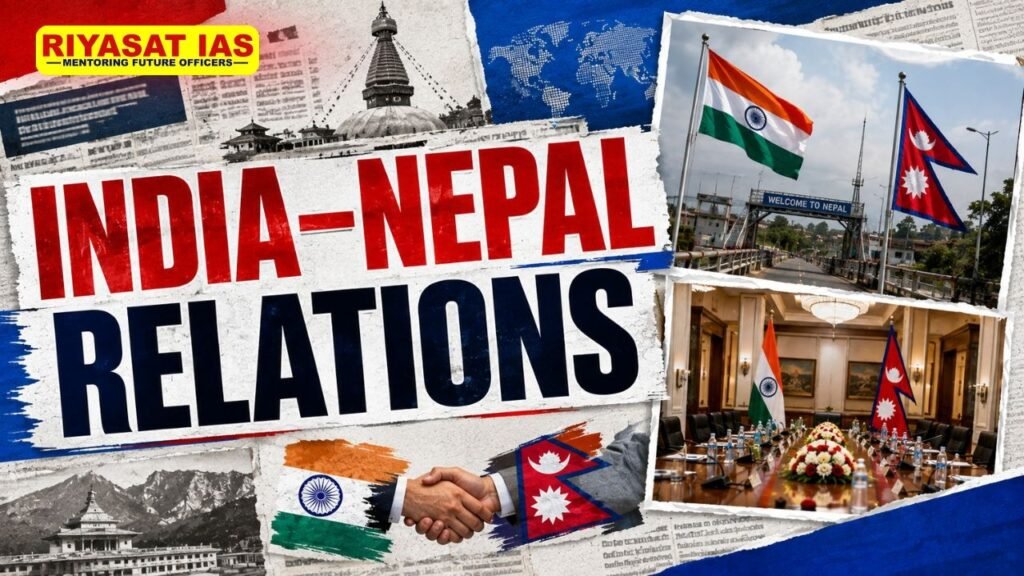
India and Nepal share a unique relationship based on geography, history, civilisation, culture, religion and extensive people-to-people contacts. Unlike a conventional bilateral relationship, the two countries have an open border and deep social and economic interdependence, making Nepal a particularly important country for India’s neighbourhood policy.
Historical Background
Civilisational and Cultural Linkages
o India and Nepal have centuries-old civilisational connections. Hinduism and Buddhism provide important cultural linkages, with places such as Pashupatinath, Janakpur and Lumbini having deep religious and historical significance for the people of both countries.
o The relationship is further strengthened by shared languages, traditions, family ties, religious pilgrimage and social interaction across the open border. The Ministry of External Affairs describes India-Nepal relations as being rooted in shared heritage, civilisation, culture and extensive people-to-people relations.
Open Border
o The India-Nepal border facilitates extensive movement of people for employment, education, trade, tourism, pilgrimage and family relations. This makes the relationship highly integrated at the societal level, but it also creates challenges related to cross-border crime, smuggling and security management.
Treaty of Peace and Friendship, 1950
· The India-Nepal Treaty of Peace and Friendship was signed on 31 July 1950 and remains one of the foundational instruments governing bilateral relations.
· The treaty begins by recognising the ancient ties between the two countries and seeks to strengthen friendship and preserve peace between them.
Key Provisions
o Sovereignty and Independence: Both countries agree to respect each other’s complete sovereignty, territorial integrity and independence.
o Security Communication: Both governments undertake to inform each other of serious friction or misunderstanding with neighbouring states that could affect their friendly relations.
o Diplomatic Relations: The treaty provides for the continuation of diplomatic relations and reciprocal diplomatic privileges and immunities.
o Reciprocal Treatment: The treaty provides for reciprocal privileges relating to residence, ownership of property, participation in trade and commerce and movement of people, subject to the relevant laws and regulations.
o These provisions have contributed significantly to the unusually close economic and social relationship between India and Nepal.
o Security Dimension: The treaty established a framework for maintaining friendly relations and addressing security concerns between the two countries.
Why is the 1950 Treaty Controversial?
o Nepal has periodically expressed the desire to review or replace the 1950 Treaty, arguing that some provisions reflect the geopolitical circumstances of the 1950s and do not adequately reflect present-day sovereignty and equality.
o India has indicated its willingness to discuss the treaty and other bilateral arrangements in order to further strengthen bilateral relations. The issue has therefore remained an important component of India-Nepal diplomatic discussions.
Major Areas of India–Nepal Cooperation
A. Trade and Economic Cooperation
o India is one of Nepal’s most important economic partners. The relationship includes extensive bilateral trade, investment, transit arrangements and cross-border economic activity.
o India’s geographical position is particularly important for Nepal because Nepal is a landlocked country and relies heavily on transit routes through India for international trade.
B. Connectivity and Infrastructure
o India has supported Nepal’s connectivity through roads, railways (for example Jayanagar-Kurtha rail line), integrated check posts and cross-border infrastructure.
o Cross-border railway links and road connectivity are particularly important because they can reduce transportation costs and strengthen Nepal’s access to Indian and international markets.
o A recent development was the November 2025 Letter of Exchange expanding rail-based freight movement between Jogbani and Biratnagar, including bulk cargo, and extending the liberalised transit arrangements to important corridors such as Kolkata–Jogbani and Visakhapatnam–Nautanwa.
Hydropower and Energy Cooperation
o Hydropower represents one of the most promising areas of India-Nepal cooperation because Nepal possesses substantial hydropower potential while India has a large and growing electricity market.
o In 2023, India and Nepal signed a long-term power trade agreement with a target of importing 10,000 MW of electricity from Nepal over the following ten years. Cooperation has also expanded through projects such as Phukot-Karnali, Lower Arun and Arun-3.
o In 2025, India and Nepal further strengthened cross-border electricity transmission cooperation, including agreements concerning the Inaruwa–New Purnea and Lamki–Bareilly 400 kV transmission systems.



o Thus, Nepal’s hydropower potential can attract Indian investment and provide access to the Indian electricity market, generating export revenues for Nepal while contributing to regional energy security.
Water Resources and Flood Management
o India and Nepal share several transboundary rivers, including the Kosi, Gandak and Mahakali.
o Cooperation in water resources is important for irrigation, hydropower generation, flood control and disaster management. At the same time, differences over water projects and benefit-sharing have periodically generated political sensitivities.
o Therefore, water cooperation requires joint basin-level planning, transparent data sharing and equitable benefit-sharing.
Defence and Security Cooperation
o India and Nepal maintain extensive defence cooperation. The two countries conduct the Surya Kiran military exercise, which focuses particularly on counter-terrorism, disaster response and interoperability.
o The long tradition of Gorkha soldiers serving in the Indian Army is another distinctive feature of bilateral defence relations.
o Security cooperation is increasingly important because the open border can also be exploited for smuggling, trafficking, illegal financial activities and other forms of transnational crime.
Humanitarian Assistance
· Disaster Relief: Following the 2015 Nepal earthquake, India launched Operation Maitri to provide immediate humanitarian assistance and support reconstruction efforts.
· Operation Vaccine Maitri: Under this initiative, India supplied approximately 9.5 million COVID-19 vaccine doses to Nepal, supporting its vaccination programme.
· Operation Ajay: During the Israel–Hamas conflict, India facilitated the evacuation of several Nepalese citizens from Israel along with Indian nationals.
· Operation Ganga: During the Russia–Ukraine conflict, India also assisted in evacuating Nepalese citizens from Ukraine and neighbouring countries along with Indian nationals.
Development Partnership
o India’s development cooperation with Nepal covers areas such as health, education, infrastructure, agriculture, power, water resources, human-resource development and disaster management.
o India’s approach increasingly emphasises demand-driven development projects that respond to Nepal’s local development priorities.
Tourism and Religious Connectivity
o Religious and cultural tourism is an important component of bilateral relations.
o The Ramayana Circuit and Buddhist tourism can strengthen connections between important religious sites in both countries.
o India and Nepal have also sought to promote connectivity between sites such as Ayodhya–Janakpur and Lumbini–Bodh Gaya, thereby using shared civilisation as an instrument of people-to-people diplomacy.
Recent Developments, 2025–26
o Power Cooperation: Energy cooperation has continued to deepen. In 2025, India and Nepal advanced major cross-border transmission projects, while Nepal’s hydropower projects such as Arun-3 continued to receive Indian participation.
o Trade and Transit: The 2025 Letter of Exchange on rail-based freight movement strengthened Nepal’s access to Indian transit corridors and international markets. This is particularly important for Nepal as a landlocked economy.
o Institutional Dialogue: The two countries continue to use mechanisms such as the India-Nepal Joint Commission to review the entire spectrum of bilateral cooperation. The latest available MEA annual reporting records the 7th Joint Commission meeting in January 2024 and continued high-level diplomatic engagement during 2024.
o 2026 Perspective: As of 2026, the relationship is increasingly centred on energy trade, connectivity, infrastructure, digital payments, development cooperation and economic integration, while traditional sensitivities surrounding border management and the 1950 Treaty remain important.
Major Issues and Challenges
Boundary Disputes
o The most sensitive territorial issue concerns areas around Kalapani, Lipulekh and Limpiyadhura.
o Nepal’s constitutional map includes these territories within Nepal, while India maintains its own position regarding the boundary.
o The issue has periodically generated political tensions and nationalist sentiment in Nepal.
1950 Treaty – Perception Gap
o A section of political opinion in Nepal considers the 1950 Treaty to be unequal or outdated, while India views the treaty as an important historical foundation of bilateral relations.
o The challenge is therefore not merely legal but also one of perception and sovereignty.
o A mutually acceptable review could help modernise the relationship without undermining its historical foundations.
India’s “Big Brother” Image
o Nepalese political discourse sometimes expresses concern about perceived Indian interference or asymmetry of power.
o Because India is much larger economically and strategically, Nepal may seek greater autonomy in its external relations.
o India therefore needs to adopt a relationship based on equality, sensitivity and mutual respect, rather than allowing the size asymmetry to translate into political asymmetry.
China Factor
o China’s growing economic and strategic engagement with Nepal has introduced a new dimension into India-Nepal relations.
o Nepal seeks to diversify its economic and connectivity options, including through Chinese initiatives. India, meanwhile, remains attentive to developments that could have implications for its security and Himalayan strategic environment.
o The challenge for India is to avoid viewing every Nepal-China engagement through a zero-sum lens while protecting legitimate Indian security interests.
Trade Imbalance and Economic Dependence
o Nepal’s significant economic dependence on India can generate perceptions of vulnerability and asymmetry.
o India should therefore encourage greater two-way investment, Nepalese exports, value-chain integration and market access, rather than allowing the relationship to remain primarily one of Nepal’s dependence on Indian markets and transit.
Open Border: Opportunity and Security Challenge
o The open border is one of the greatest strengths of India-Nepal relations because it facilitates employment, trade, tourism and family connections.
o However, it can also create challenges relating to smuggling, trafficking, counterfeit currency, illegal migration and cross-border crime.
o The solution is not necessarily to close the border but to develop smart border management, better information sharing and coordinated law enforcement.
Water and Hydropower Disputes
o Although hydropower offers enormous potential, projects involving rivers, dams, land acquisition, environmental impacts and benefit-sharing can generate political sensitivities.
o Greater transparency, local consultation and equitable sharing of benefits are therefore necessary to make water cooperation sustainable.
For Examples:
· Kosi Agreement (1954): Nepal has raised concerns regarding land ownership, compensation, water utilisation and the distribution of benefits under the Kosi project.
· Gandak Agreement (1959): Differences have emerged over water utilisation, irrigation benefits and implementation of the agreement.
· Mahakali Treaty (1996): Issues remain regarding water allocation, benefit-sharing and the implementation of the Pancheshwar Multipurpose Project.
· Pancheshwar Project: Delays have persisted due to differences over project design, cost-sharing, power benefits and water-sharing arrangements.
Way Forward
· Modernise the 1950 Treaty: India and Nepal should pursue a mutually acceptable review and modernisation of the 1950 Treaty while preserving its fundamental spirit of friendship and cooperation.
· Resolve Boundary Issues through Dialogue: Both countries should institutionalise sustained technical and diplomatic dialogue to resolve Kalapani-Lipulekh-Limpiyadhura and other boundary issues.
· Make Hydropower a Strategic Partnership: India should expand investment in Nepal’s hydropower sector while ensuring transparent benefit-sharing, environmental safeguards and predictable power-purchase arrangements.
· Strengthen Connectivity: Projects relating to railways, roads, integrated check posts, pipelines, transmission lines and digital connectivity should be completed within defined timelines.
· Promote Equal Economic Partnership: India should encourage greater Nepalese exports to India and support joint ventures, manufacturing, tourism and value-chain integration so that economic relations become more balanced.
· Adopt a Non-Zero-Sum Approach towards China: India should protect its strategic interests while recognising Nepal’s sovereign right to maintain relations with other countries. A mature India-Nepal relationship should not force Nepal to choose between India and China.
· Strengthen People-to-People Relations: India should continue to build on religious tourism, education, healthcare, cultural exchanges and cross-border community relations, which constitute the deepest foundation of the bilateral relationship.
· Improve Border Management: The open border should be preserved while strengthening joint patrolling, information sharing, digital systems and coordinated action against transnational crime.
Conclusion
“India and Nepal are bound not merely by a border but by a living civilisational and social relationship. The challenge for India is to convert this unique interdependence into a modern partnership based on mutual respect, economic integration and strategic sensitivity.”
FAQs
1. Why is India-Nepal relations considered unique?
Ans: The relationship is characterised by shared civilisation, an open border, deep people-to-people contacts, cultural ties and extensive economic interdependence.
2. What is the significance of the 1950 India-Nepal Treaty?
Ans: The treaty provides the foundational framework for peace, friendship, sovereignty, diplomatic relations and close socio-economic interaction between the two countries.
3. What are the major areas of India-Nepal cooperation?
Ans: Major areas include trade, connectivity, hydropower, electricity trade, infrastructure, defence, tourism, health, education and development cooperation.
4. What are the major issues between India and Nepal?
Ans: Key issues include boundary disputes, concerns over the 1950 Treaty, trade asymmetry, open-border security, water-resource issues and Nepal’s growing engagement with China.
5. What should be India’s approach towards Nepal?
Ans: India should pursue a sensitive, equal and development-oriented partnership based on dialogue, connectivity, economic integration, hydropower cooperation and respect for Nepal’s sovereignty.




 Ravi Raaz
 Hassan Khan
 Shadab Ali