
1. (a) Owing to paucity of time, a university professor generates a Ph.D. evaluation report using Artificial Intelligence and submits it with some modifications. Discuss this from the perspective of accountability and integrity. (Answer in 150 words)
Introduction
The case presents a conflict between technological convenience and professional responsibility. While AI can help a professor manage time, a Ph.D. evaluation involves an independent academic judgement that cannot be mechanically outsourced.
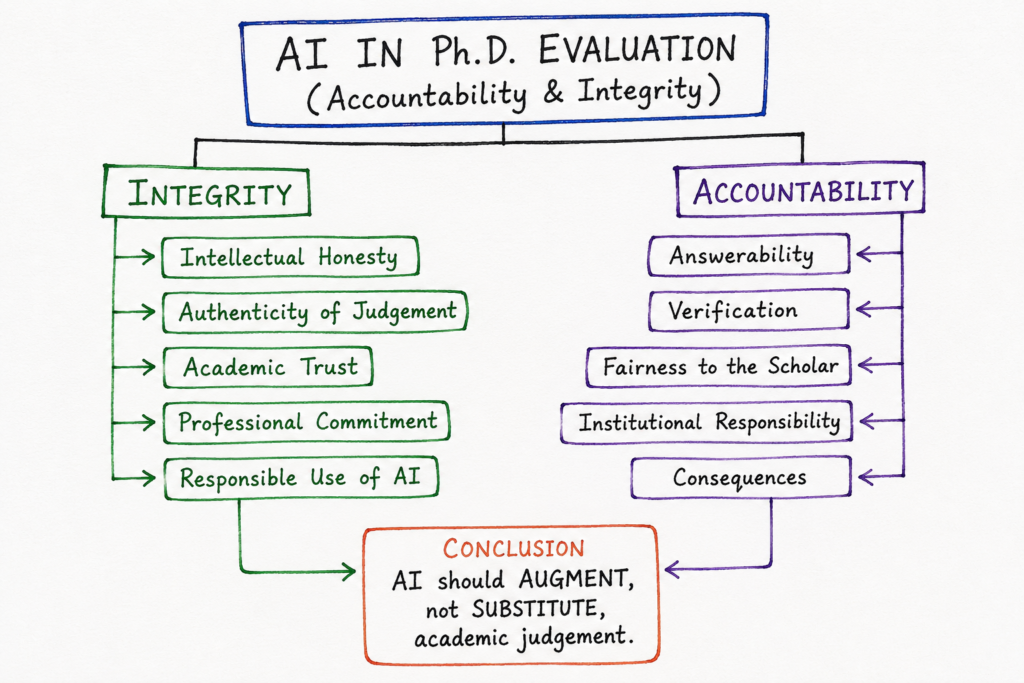
Integrity
- Intellectual honesty: A Ph.D. evaluation requires the examiner to critically assess the originality, methodology, evidence and contribution of the research.
- Authenticity of judgement: Merely modifying an AI-generated report may create a false impression that the evaluation reflects the professor’s own scholarly assessment.
- Academic trust: A research scholar places trust in the examiner for an impartial and competent evaluation.
- Professional commitment: Paucity of time may explain the action, but it cannot justify compromising the standards attached to an examiner’s responsibility.
- Responsible use of AI: AI may assist in language correction, organisation or preliminary analysis, but the substantive assessment must remain human-led.
Accountability
- Answerability: Since the professor submits the report, he/she remains responsible for its accuracy and fairness.
- Verification: AI-generated errors, fabricated references or incorrect interpretations must be identified before incorporating them.
- Fairness to the scholar: An unchecked error could adversely affect the scholar’s academic career and research future.
- Institutional responsibility: The professor has a duty to protect the credibility and academic standards of the university.
- Consequences: Responsibility cannot be shifted to the AI tool if the evaluation proves inaccurate or unfair.



Example: If AI incorrectly interprets a researcher’s methodology or labels an original finding as copied, an examiner who submits the report without independently checking it could unfairly damage the scholar’s career.
Conclusion
Thus, AI should augment, not substitute, academic judgement. Ethical use requires human oversight, independent critical thinking, verification and ownership of the final assessment.
1. (b) A business house is working on a project that could displace a forest community from their habitat. As the administrative officer of that district, what ethical challenges are you likely to face? (Answer in 150 words)
Introduction
A development project can bring jobs, infrastructure and economic opportunities, but for a forest community, displacement may mean losing much more than a house—it can affect livelihood, culture, community ties and access to common resources. As an administrator, I would therefore face the following ethical challenges.
Ethical Challenges
- Development vs. Rights: Balancing economic growth with the community’s rights to livelihood, habitat, dignity and cultural identity.
- Consent and Participation: Ensuring meaningful participation and due Gram Sabha processes under the Forest Rights Act, 2006, rather than treating consultation as a mere formality.
- Livelihood vs. Compensation: Money may compensate for land but cannot easily replace forest-based livelihoods, common resources and traditional knowledge.
- Empathy vs. Objectivity: Understanding the fears of displaced families while taking decisions fairly and within the law.
- Integrity vs. Pressure: Resisting corporate, political or other external pressure for hurried clearances or favourable decisions.
- Environment vs. Development: Assessing whether ecological damage is justified by the project’s wider benefits.
- Individual vs. Community Interest: Protecting vulnerable forest dwellers while considering employment and development needs of the wider population.
- Inter-generational Justice: Preventing irreversible ecological damage that may burden future generations.
- Dignified Rehabilitation: Ensuring that affected families receive not merely compensation, but livelihood restoration, basic services and a secure future.
- Trust in Administration: Maintaining transparency so that people do not feel that development decisions are being imposed upon them.
Example: The Narmada Valley projects illustrate the ethical complexity of development-induced displacement, where questions of infrastructure and public benefit were closely intertwined with rehabilitation, livelihood and environmental concerns.
Conclusion
The administrator should follow the spirit of Antyodaya—ensuring that the weakest do not bear a disproportionate cost of development. Meaningful consultation, lawful procedures, fair rehabilitation and environmental safeguards can make development both humane and sustainable.
“Development should improve lives, not merely relocate people.”




 Ravi Raaz
 Hassan Khan
 Shadab Ali