
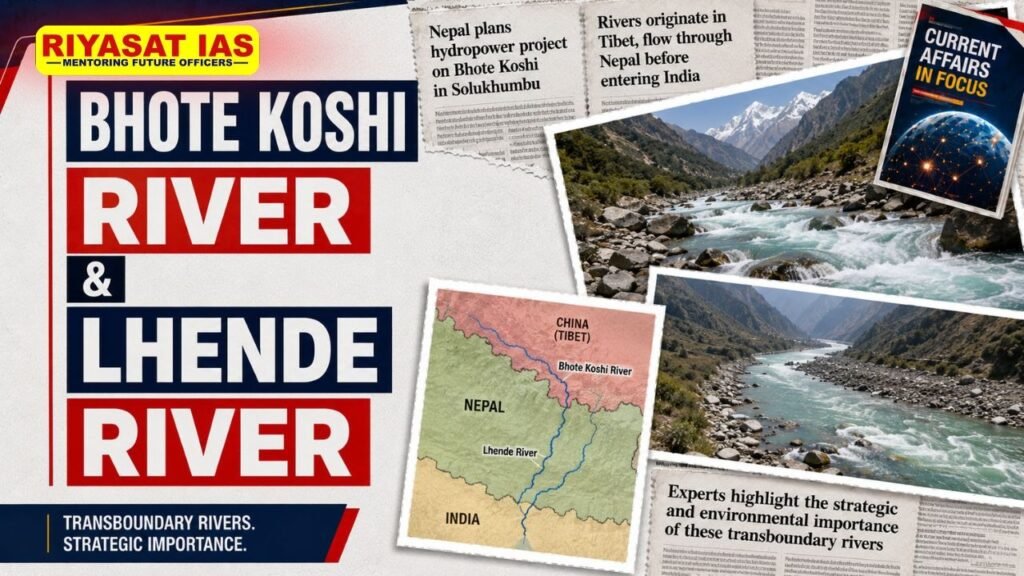
- Bhote Koshi River: A Himalayan river associated with Tibet (China) and Nepal and forms part of the Koshi river system.
- Lhende Khola: A smaller Himalayan stream/tributary in Rasuwa district of Nepal, near the Nepal–China border.
- River Relationship: Lhende Khola joins the Bhote Koshi, making it important in understanding the recent flash-flood event.
- Koshi River System: The Bhote Koshi is part of the wider Koshi drainage system, which ultimately contributes to the Ganga basin.
- Terrain: The rivers flow through the steep Himalayan landscape, making the region highly susceptible to flash floods and landslides.
- Disaster Significance: Sudden heavy rainfall, landslides or high-altitude events can rapidly increase river discharge, producing flash floods downstream.
UPSC Prelims Practice Question — English
Q. With reference to the Bhote Koshi and Lhende rivers, consider the following statements:
- Lhende Khola is a smaller stream associated with the Bhote Koshi River system in Nepal.
- The Bhote Koshi is associated with the wider Koshi river system.
- The Bhote Koshi river system ultimately forms part of the Ganga basin.



Which of the statements given above are correct?
A. 1 and 2 only
B. 2 and 3 only
C. 1 and 3 only
D. 1, 2 and 3
Answer: D
Explanation
- Statement 1 — Correct: Lhende Khola is a smaller stream in Nepal’s Himalayan region and is associated with the Bhote Koshi system.
- Statement 2 — Correct: The Bhote Koshi is an important component of the broader Koshi river system.
- Statement 3 — Correct: The Koshi system eventually joins the Ganga river system, making it part of the larger Ganga basin.





 Ravi Raaz
 Hassan Khan
 Shadab Ali