
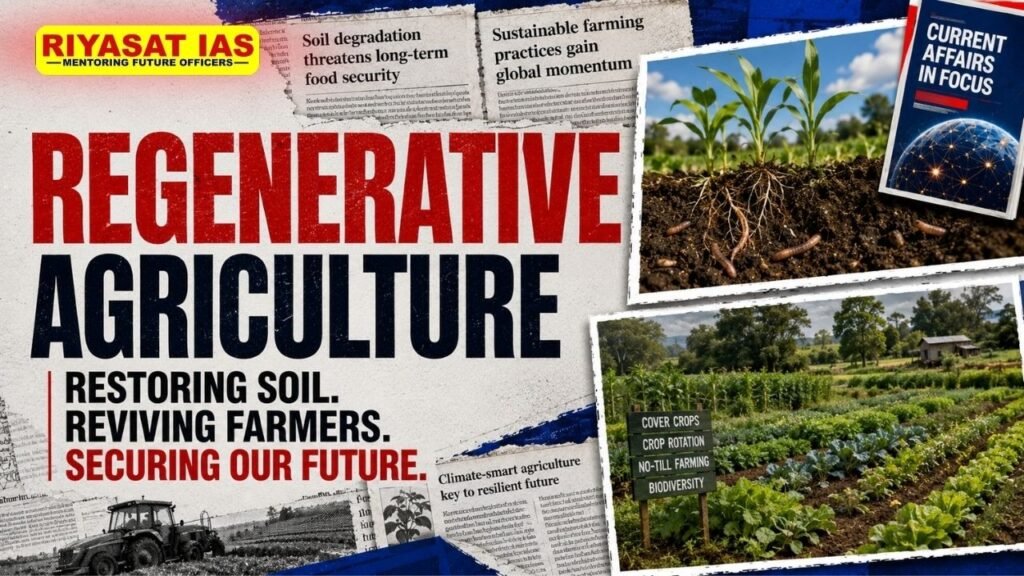
- Regenerative Agriculture is an approach to farming that aims to restore and improve soil health, biodiversity and ecosystem functions while producing food.
- Unlike conventional agriculture, which often focuses mainly on maximising short-term yields, regenerative agriculture emphasises long-term ecological health and resilience.
- It is generally associated with improving soil organic matter, water retention, nutrient cycling and carbon sequestration.
Key Practices
- Cover Cropping: Growing crops such as legumes or grasses between main crops to protect and enrich the soil.
- Crop Rotation: Rotating different crops to improve soil fertility and reduce pests and diseases.
- Reduced/No Tillage: Minimising soil disturbance to preserve soil structure and microorganisms.
- Composting & Organic Inputs: Returning organic matter to the soil.
- Integrated Livestock: Using livestock in ways that can support nutrient cycling and soil health.
- Agroforestry: Integrating trees with crops and/or livestock.
- Mulching: Covering soil to reduce evaporation, erosion and temperature fluctuations.
- Integrated Pest Management: Reducing dependence on chemical pesticides.
Major Benefits
- Soil Health: Improves soil structure, organic matter and microbial activity.
- Water Conservation: Enhances infiltration and water-holding capacity.
- Climate Mitigation: Healthy soils can store more carbon, although the actual sequestration potential varies by location and practice.
- Climate Resilience: Can improve the ability of farming systems to withstand droughts, floods and heat stress.
- Biodiversity: Supports soil organisms, pollinators and other biodiversity.
- Reduced Input Dependence: Can potentially reduce dependence on synthetic fertilisers and pesticides.



Regenerative Agriculture vs Organic Farming
| Regenerative Agriculture | Organic Farming |
| Focuses primarily on restoring ecosystem and soil health | Focuses on production according to organic standards/certification rules |
| No single universally accepted certification or definition | Has established regulatory/certification frameworks in many countries |
| May include practices such as cover crops, reduced tillage and agroforestry | Restricts/controls specified synthetic inputs according to applicable standards |
| Can be practiced with different production systems | Must meet defined organic standards to be certified organic |
UPSC Prelims Question — English
Q. With reference to Regenerative Agriculture, consider the following statements:
- It aims to improve soil health and ecosystem functions.
- Practices such as cover cropping, crop rotation and reduced tillage can form part of regenerative agriculture.
- Regenerative agriculture and organic farming are legally identical concepts.
- Regenerative agriculture can contribute to improved water retention and carbon sequestration.
Which of the statements given above is/are correct?
(a) 1, 2 and 4 only
(b) 1 and 3 only
(c) 2, 3 and 4 only
(d) 1, 2, 3 and 4
Answer: (a) 1, 2 and 4 only
Explanation: Regenerative agriculture focuses on restoring soil health, biodiversity and ecosystem functions. Cover crops, crop rotation and reduced tillage are commonly associated practices. It is not legally identical to organic farming, and its outcomes such as carbon sequestration can vary according to local conditions and practices.





 Ravi Raaz
 Hassan Khan
 Shadab Ali