
GS-III: Agriculture | Food Security | Climate Change | Environment | Sustainable Development
Context
- From Food Deficit to Food Security: India has transformed from dependence on food aid in the 1960s into a major food-producing country with substantial buffer stocks and a legal food entitlement under the NFSA, 2013.
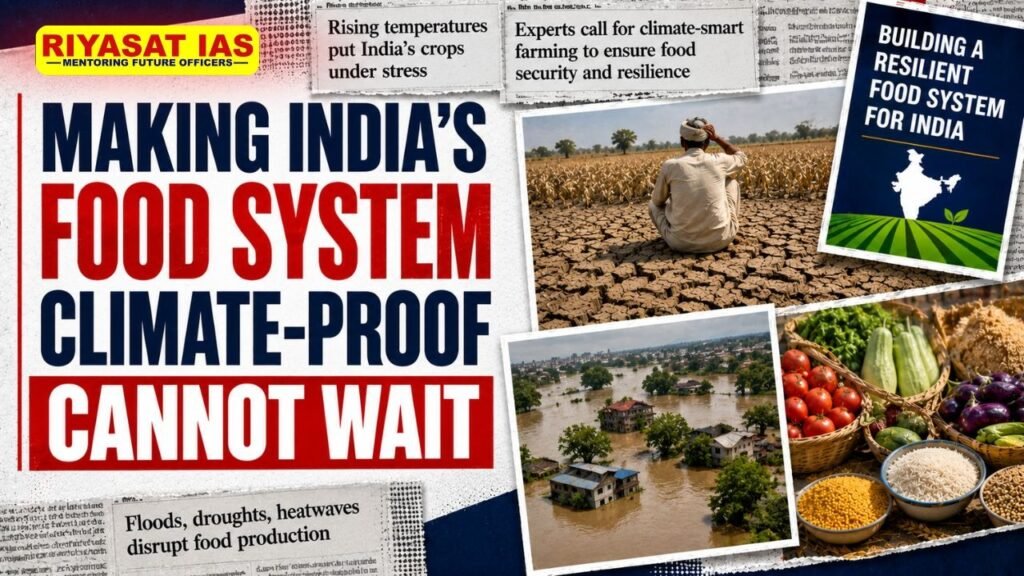
- New Challenge – Climate Resilience: The policy challenge has shifted from merely producing enough food to ensuring affordable, nutritious and sustainable food for 1.4 billion people despite rising temperatures, erratic rainfall, extreme weather and water scarcity.
- Need for a New Approach: India now needs to protect the gains of its food-security system by making the entire food chain—from production to storage, transport and consumption—climate resilient.
India’s Food Security Foundation
- Strong Production Base: Foodgrain production crossed 350 million tonnes in 2024-25, including record production of rice and wheat, providing India with a strong foundation to address future food-security challenges.
- National Food Security Act, 2013: The NFSA created a legal entitlement to subsidised foodgrains for around 800 million people, making food security a rights-based framework.
- Public Distribution System: The PDS provides the institutional mechanism through which food entitlements are delivered to vulnerable households.
- One Nation One Ration Card: ONORC has improved portability of food entitlements, particularly benefiting beneficiaries who migrate between States.
How Climate Change Threatens Food Security
- Rising Temperatures: Heat stress can reduce crop yields, particularly in temperature-sensitive crops such as wheat, thereby affecting national food availability.
- Erratic Rainfall: Changing monsoon patterns can produce floods and droughts within the same agricultural season, increasing production uncertainty.
- Groundwater Depletion: Falling groundwater levels reduce the irrigation buffer available to farmers during periods of inadequate rainfall.
- Damage to Infrastructure: Extreme weather can damage warehouses, roads, transport networks and storage facilities, disrupting food movement even when production is adequate.
- Impact on Nutrition: Supply disruptions and higher prices can reduce household access to diverse and nutritious foods, making climate change a nutrition-security issue as well.
Challenge of the Rice-Wheat System
- Historical Success: The rice-wheat system was an appropriate response to India’s earlier food-production constraints and played a major role in achieving food security.
- Geographical Concentration: Public procurement remains concentrated in a limited number of crops and regions, creating systemic risks.
- Groundwater Stress: Several major procurement regions are simultaneously experiencing serious groundwater depletion, making the existing pattern increasingly difficult to sustain.
- Need for Diversification: India should build upon the achievements of the existing system while gradually making procurement more responsive to local climate and water conditions.



Diversification of Procurement
- Millets: Greater procurement of millets can diversify the national food basket while supporting dietary diversity and climate adaptation.
- Pulses: Expanding pulse procurement can improve nutritional diversity and reduce excessive dependence on cereals.
- Oilseeds: Greater inclusion of oilseeds can diversify agricultural production and strengthen the resilience of the food system.
- Regional Diversification: Procurement can gradually expand to different regions according to their local water availability and climatic suitability.
- Balanced Food Portfolio: Rice and wheat will remain essential, but diversification can reduce the risk associated with excessive dependence on a few crops and regions.
Diversification of the PDS
- Broader Food Basket: The PDS can progressively include locally appropriate millets and pulses, rather than focusing predominantly on conventional cereals.
- Nutrition–Climate Link: A diversified PDS can simultaneously promote food security, nutrition, water conservation and climate adaptation.
- Local Suitability: Incorporating crops suited to local agro-climatic conditions can make the food-security system more sustainable.
Climate-Resilient Agriculture
- Climate-Resilient Seeds: Developing and distributing suitable seed varieties can reduce the impact of heat, drought and other climate stresses on crop production.
- Micro-Irrigation: Technologies such as micro-irrigation can improve water-use efficiency and reduce dependence on increasingly stressed groundwater resources.
- Watershed Development: Watershed-based interventions can improve water conservation and strengthen local resilience to rainfall variability.
- Precision Farming: Precision farming can help farmers use water and agricultural inputs more efficiently while adapting production to changing conditions.
- Digital Advisories: Timely digital weather and agricultural advisories can help farmers make better decisions regarding sowing, irrigation and harvesting.
- Weather-Indexed Insurance: Weather-indexed insurance can reduce farmers’ income variability caused by adverse weather events.
Climate-Resilient Food Supply Chain
- Resilient Warehouses: Flood-resilient warehouses are necessary to protect buffer stocks from extreme weather events.
- Heat-Resilient Storage: Storage infrastructure must be adapted to higher temperatures to minimise post-harvest losses.
- Cold Chains: Expanded cold-chain infrastructure can protect perishable commodities and support a more diversified food basket.
- Transport Resilience: Robust transport networks are essential to ensure that food reaches markets even during floods and other extreme events.
- Whole-Chain Approach: Climate adaptation should cover procurement, storage, logistics and market stabilisation, rather than focusing only on farm-level production.
Role of Private Sector and Public Safety Nets
- Public-Private Collaboration: Collaboration can accelerate research, certification and last-mile delivery of climate-resilient agricultural technologies.
- Protection of Smallholders: Public safety nets remain necessary because small and climate-exposed farmers may not have sufficient resources to independently absorb climate shocks.
- Balanced Approach: Private investment can improve innovation and delivery, while public policy must ensure that vulnerable farmers and regions are not excluded.
Financing Climate-Resilient Food Systems
- Green Bonds: Green bonds can mobilise capital for sustainable agricultural and food-system infrastructure.
- Adaptation Finance: Dedicated adaptation finance can support farmers and infrastructure exposed to climate risks.
- Insurance: Insurance mechanisms can distribute and reduce the financial burden of climate-related agricultural losses.
- Resilient Value Chains: Investment is required across the agricultural value chain rather than concentrating only on farm production.
- Climate Finance: Measurable targets for emission reduction, carbon sequestration and resilience can help integrate food systems with climate finance.
The Concept of a ‘Climate Buffer’
- Traditional Buffer Stock: India’s conventional grain buffer stock protects the country against the risk of poor harvests and supply disruptions.
- Broader Climate Buffer: India can develop a broader “climate buffer” combining diversified crops and procurement regions with resilient infrastructure, climate information, insurance and improved water management.
- Systemic Resilience: Such a diversified portfolio can reduce the systemic risks created by an increasingly unpredictable climate.
From Food Security to Sustainable Food Security
- Changing Objective: Food security should no longer mean only adequate foodgrain availability; it should ensure affordable, nutritious and sustainable food.
- Climate as a Design Parameter: Climate-risk management should become a first-order consideration in NFSA planning and monitoring, rather than something addressed after a crisis.
- Institutional Advantage: India already possesses the necessary institutions, production capacity and policy mechanisms to make this transition.
- Long-Term Vision: The objective should be to build food systems capable of remaining nutritious, affordable and resilient for future generations.
Way Forward
- Diversify Procurement: Align procurement and price support with local climatic and water conditions while gradually expanding the range of crops.
- Reorient the PDS: Incorporate suitable millets, pulses and other nutritious crops into the food basket.
- Integrate Climate Forecasts: Link IMD forecasts with procurement, buffer stocks and contingency planning.
- Strengthen Farm Resilience: Expand climate-resilient seeds, micro-irrigation, watershed development, precision farming and digital advisories.
- Build Resilient Infrastructure: Make warehouses, storage, cold chains and transport networks capable of withstanding extreme weather.
- Expand Risk Financing: Strengthen insurance, adaptation finance, green bonds and investment in resilient agricultural value chains.
- Institutionalise Climate Risk: Embed climate-risk indicators into NFSA monitoring and food-security planning.
- Protect Vulnerable Farmers: Ensure that smallholders and climate-exposed regions benefit from adaptation measures and public safety nets.
Conclusion
India’s food-security journey has evolved from food-aid dependence to large-scale production, buffer stocks and legally guaranteed food entitlements. The next challenge is to ensure that these achievements remain sustainable under climate change.
Therefore, India needs to move from a narrow concept of “food security” to “sustainable food security”, where production, procurement, PDS, nutrition, water management, infrastructure and climate adaptation work together. The objective should be not merely to produce more food, but to build a resilient food system capable of delivering affordable and nutritious food despite an increasingly uncertain climate.
UPSC Mains Practice Question
Q. “India’s food-security framework must evolve from ensuring adequate foodgrain availability to building sustainable and climate-resilient food systems.” Discuss the challenges and suggest measures to achieve climate-resilient food and nutrition security in India. (250 words, 15 marks)




 Ravi Raaz
 Hassan Khan
 Shadab Ali