
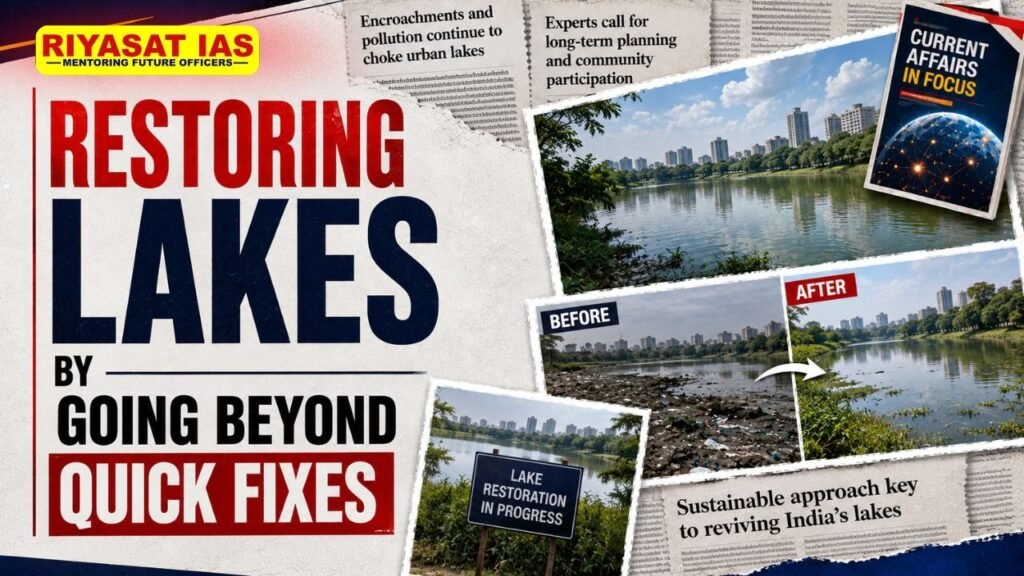
GS-III: Environment | Biodiversity | Climate Change | Urbanisation | Disaster Management
GS-II: Governance | Urban Local Bodies | Government Policies
Context
- Ecological Importance: Wetlands, including urban lakes, cover nearly 6% of the planet’s surface and are among the most productive ecosystems, contributing to carbon sequestration, biodiversity, climate regulation and human well-being.
- Rapid Degradation: Lakes are disappearing rapidly, while many remaining urban wetlands have become biologically dead or heavily eutrophic due to pollution, encroachment and altered hydrology.
- Climate Vulnerability: Their destruction weakens cities’ natural protection against urban flooding, heat stress and water scarcity.
- Core Issue: Rapid and unplanned urbanisation has increasingly treated wetlands as vacant land rather than ecological and civic infrastructure.
Why Urban Wetlands Matter
- Carbon Sequestration: Wetlands can store significant quantities of carbon, with some wetland systems storing carbon very efficiently per unit area.
- Flood Regulation: Lakes and wetlands act as natural sponges, temporarily storing excess rainwater and reducing urban flood risk.
- Groundwater Recharge: Healthy wetlands facilitate water infiltration and contribute to groundwater replenishment.
- Climate Regulation: Water bodies moderate local temperatures and can help reduce the intensity of urban heat islands.
- Biodiversity: They provide habitats for a wide range of aquatic organisms, birds and other species.
- Human Well-being: Urban water bodies contribute to the liveability and ecological quality of cities.
Drivers of Urban Lake Destruction
- Unplanned Urbanisation: Rapid expansion of cities has increased pressure on wetlands and lake catchments, making them vulnerable to conversion.
- Land-Value Pressure: Rising urban land prices have transformed lakes and their surrounding catchments into attractive real-estate opportunities.
- Encroachment: Wetlands are increasingly filled, fragmented and repurposed for housing, highways and commercial complexes.
- Pollution: Untreated sewage, industrial effluents and municipal solid waste are frequently discharged into already degraded water bodies.
- Institutional Apathy: Weak enforcement and fragmented responsibility allow degradation to continue over long periods.
- Loss of Catchments: Blocking feeder channels and altering natural drainage disrupts the hydrological functioning of lakes.
Evidence of the Crisis
- Jammu & Kashmir: Reports of the Comptroller and Auditor General (CAG) have flagged large-scale shrinkage, including the loss of over 500 lakes since 1967.
- Hyderabad: One study reported that Hyderabad lost approximately 61% of its lake area since 1979, while 268 water bodies disappeared between 2002 and 2012.
- Urban Consequences: The disappearance of lakes is occurring alongside intensifying heat islands and unpredictable urban flooding, making their restoration increasingly important.



Economic Dimension of Encroachment
- Changing Land Economics: Urban land was relatively affordable decades ago, while urban expansion was comparatively moderate, allowing lakes to retain their functional civic role.
- Real-Estate Pressure: In cities such as Hyderabad, Bengaluru and Mumbai, former agricultural areas and natural lake catchments have increasingly become valuable urban land.
- Opportunity Cost: Rising land values create an economic incentive to view wetlands as potential development sites.
- Result: Wetlands may be filled, fragmented or converted into built-up areas despite their wider ecological and climate-regulation value.
Ramsar Recognition vs Ground Reality
- Ramsar Sites: India’s expansion of its designated Ramsar sites reflects formal recognition of the importance of wetlands.
- Implementation Gap: International designation does not automatically guarantee effective conservation at the local level.
- Ground-Level Challenges: Wetlands continue to face:
- Ambiguous boundaries
- Encroachment
- Disrupted catchments
- Pollution
- Altered hydrological flows
- Key Lesson: Legal recognition must translate into effective local protection and ecological restoration.
Government Initiatives
- AMRUT: The Atal Mission for Rejuvenation and Urban Transformation provides a policy framework for improving urban infrastructure, including water-related infrastructure.
- Jal Shakti Abhiyan: Focuses on water conservation and water management.
- Mission Amrit Sarovar: Promotes the development and rejuvenation of water bodies.
- Implementation Challenge: The impact of such initiatives can be diluted by fragmented accountability, weak coordination and inadequate enforcement.
Beautification vs Ecological Restoration
- Cosmetic Approach: Municipal bodies may prioritise visible interventions such as promenades, lighting and fencing.
- Ecological Neglect: Such interventions cannot substitute for restoration of feeder channels, catchments and water quality.
- Restoration Principle: A lake should be treated as a living hydrological ecosystem, not merely as an urban landscape feature.
- Need for Shift: Urban lake policy must move from beautification-centric projects to ecosystem restoration.
HYDRAA: An Example of Enforcement
- Institutional Intervention: The Hyderabad Disaster Response and Asset Protection Agency (HYDRAA) has undertaken action against encroachments on lakebeds.
- FTL Protection: It has cleared illegal structures within Full Tank Level (FTL) zones and initiated restoration across several water bodies.
- Hydrological Restoration: Desilting blocked feeder channels and restoring natural flows can substantially improve lake capacity.
- Nalla Cheruvu: Restoration efforts reportedly increased the water spread of the severely choked Nalla Cheruvu from 16 to 30 acres, demonstrating the importance of restoring hydrological connectivity.
Role of Citizen Participation
- Lake Champions: Citizen groups in cities such as Bengaluru and Hyderabad have played an important role in reviving degraded water bodies.
- Examples: Community-driven restoration has been demonstrated at water bodies such as Puttenahalli, Jakkur and Kudikunta.
- Local Ownership: Community participation can improve monitoring and create sustained public pressure for conservation.
- Limitation: Individual successes remain isolated unless supported by legal backing, sustained funding and statutory enforcement.
Governance Challenges
- Fragmented Responsibility: Multiple departments and agencies may have overlapping responsibilities over water bodies.
- Weak Coordination: Poor inter-departmental coordination can undermine restoration efforts.
- Inadequate Enforcement: Weak or inconsistent action against encroachment allows degradation to continue.
- Planning Deficiency: Lakes and their catchments are often insufficiently integrated into master plans and urban planning.
- Accountability Gap: Without a clearly accountable institution, responsibility for protection and restoration becomes diffused.
Way Forward
- Integrate Lakes into Urban Planning: Water bodies and their catchments should be formally incorporated into city master plans and development planning.
- Legal Protection: Lake boundaries, feeder channels and catchments require clear legal demarcation and protection.
- Strict Enforcement: Encroachment should attract consistent and effective penalties, supported by regular monitoring.
- Unified Governance: Fragmented responsibilities should be streamlined under clearly accountable institutional arrangements.
- Ecological Restoration: Priority should be given to desilting, restoring feeder channels, improving water quality and reviving natural hydrological flows.
- Move Beyond Beautification: Promenades, lighting and landscaping should not substitute for genuine ecological recovery.
- Institutionalise Citizen Participation: Citizen groups should be integrated into monitoring and local lake-governance mechanisms.
- Sustained Funding: Restoration requires long-term financial support rather than short-term beautification projects.
- Climate-Resilient Planning: Lakes should be treated as urban climate buffers and sponge systems capable of reducing flood and heat risks.
Conclusion
Urban lakes are not vacant spaces awaiting development; they are critical ecological and climate infrastructure. Their destruction through encroachment, pollution and disruption of catchments weakens cities’ natural capacity to manage floods, heat stress and water scarcity.
India’s urban future therefore requires a shift from treating lakes as landscaped backdrops to recognising them as living ecosystems. Effective legal protection, integrated urban planning, accountable governance, ecological restoration and citizen participation can transform urban wetlands into durable climate buffers and sponge systems.
UPSC Mains Practice Question
Q. “Urban wetlands are not merely ecological assets but critical climate-resilience infrastructure.” Discuss the causes of their degradation in Indian cities and suggest measures for their effective conservation and restoration. (250 words, 15 marks)



 Ravi Raaz
 Hassan Khan
 Shadab Ali