
11. Explain the key challenges for India’s energy security. What measures do you suggest for ensuring energy security along with economic growth and sustainability? (Answer in 250 words)
Introduction
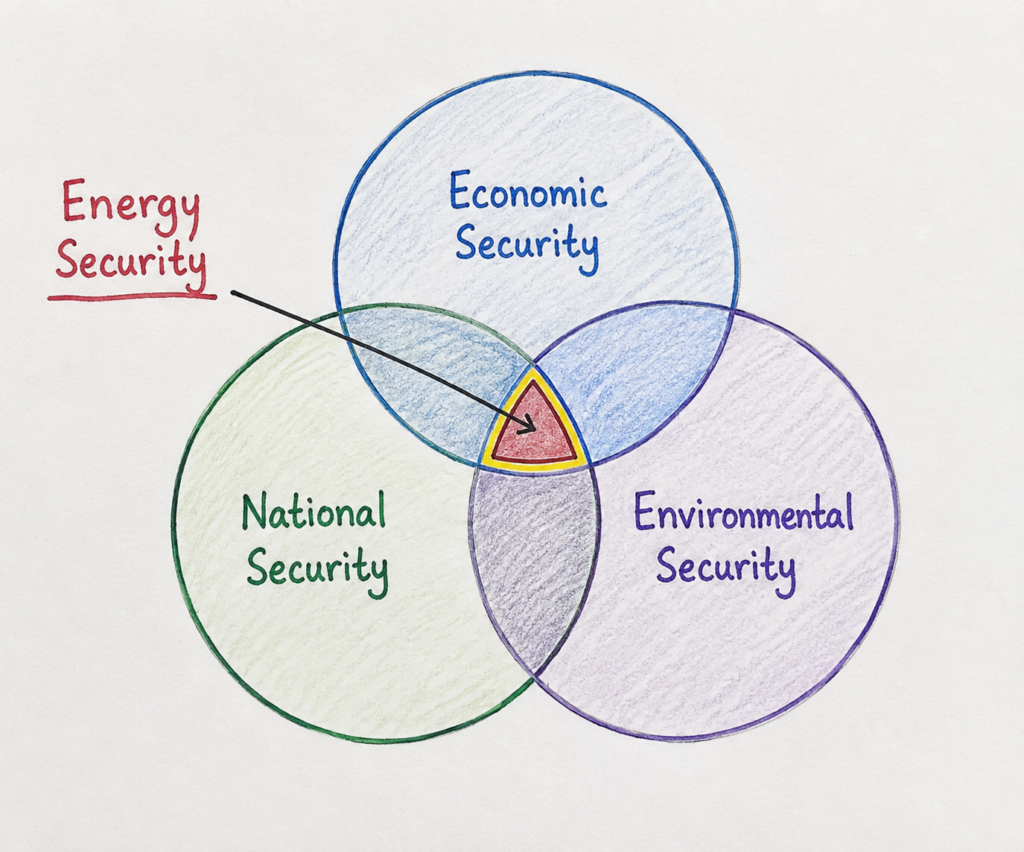
Energy security means having reliable and affordable access to energy without compromising long-term sustainability. For a rapidly growing economy like India, it is essential for industrialisation, employment and better living standards. However, India faces an “energy trilemma”—balancing energy security, economic growth and environmental sustainability.
Key Challenges
- High import dependence: India imports around 88% of its crude oil and 48% of natural gas, exposing the economy to global price fluctuations, geopolitical conflicts and chokepoints such as the Strait of Hormuz.
- Critical mineral dependence: The renewable-energy transition itself creates dependence on imported lithium, cobalt and rare earth elements, whose supply chains are concentrated in a few countries.
- Financially stressed DISCOMs: High AT&C losses, tariff cross-subsidies and delayed subsidy payments weaken the financial health of power distribution companies and discourage investment.
- Grid and storage challenges: Solar and wind power are intermittent. Therefore, India needs stronger transmission networks and greater capacity for Battery Energy Storage Systems (BESS) and Pumped Storage Projects (PSPs).
- Coal-transition dilemma: Coal remains important for reliable electricity supply, but its environmental costs make a gradual and just transition necessary.



Way Forward
- Diversify the energy mix: Expand renewables towards the 500 GW non-fossil capacity target by 2030 through initiatives such as PM-Surya Ghar and PM-KUSUM.
- Develop green alternatives: Scale up the National Green Hydrogen Mission for sectors such as steel, fertilisers and heavy transport.
- Strengthen energy reserves: Expand Strategic Petroleum Reserves and secure critical minerals through initiatives such as KABIL.
- Modernise the grid: Promote BESS, PSPs, smart grids and regional electricity connectivity to provide reliable and flexible power.
- Reduce oil dependence: Promote E20 ethanol blending, Compressed Bio-Gas (CBG), EVs and public transport.
- Improve power-sector efficiency: Strengthen RDSS, smart metering and PAT, while developing the Indian Carbon Market.
Conclusion
India’s energy security cannot come from energy self-sufficiency alone. It requires a diversified energy mix, resilient supply chains, efficient power markets and cleaner technologies. A balanced transition towards “Urja Aatmanirbharta” can support India’s economic growth while keeping the country on track towards Net Zero 2070.




 Ravi Raaz
 Hassan Khan
 Shadab Ali