
12. How are startups in India promoting entrepreneurship, innovation and employment? Discuss the global and domestic challenges in their working and suggest suitable measures to overcome these challenges. (Answer in 250 words)
Introduction
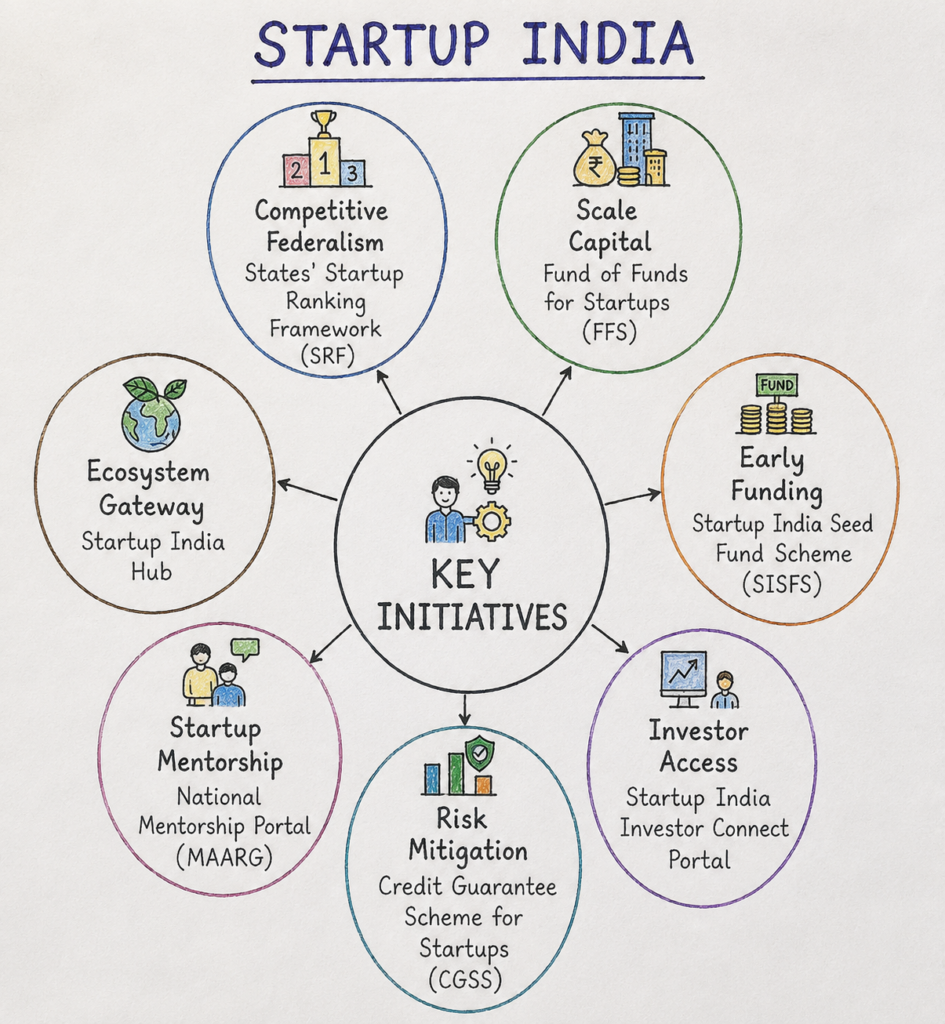
India’s startup ecosystem has grown rapidly under initiatives such as Startup India, turning entrepreneurship into an increasingly important source of innovation, investment and employment. With over 1.6 lakh DPIIT-recognised startups and more than 115 unicorns, India has emerged as one of the world’s largest startup ecosystems.
1. Role of Startups
- Promoting entrepreneurship: Startups have reduced entry barriers for young and first-generation entrepreneurs. Their spread to Tier-II and Tier-III cities has also widened the geographical base of entrepreneurship.
- Driving innovation: Startups are using India’s Digital Public Infrastructure (DPI) such as UPI, ONDC and ABDM to develop solutions in FinTech, Agritech, HealthTech, SpaceTech, EVs and DeepTech.
- Creating employment: Startups generate direct jobs as well as indirect employment through logistics, delivery services, digital platforms and supply chains.
- Solving local problems: Many startups are addressing practical challenges such as access to credit, farm marketing, healthcare and education, thereby linking innovation with social needs.



2. Challenges
Global:
- Funding uncertainty: High global interest rates and economic volatility can reduce the availability of venture capital.
- Technology dependence: Dependence on imported semiconductors, advanced GPUs and specialised technologies can increase costs and supply-chain vulnerabilities.
- Global competition: Indian startups face intense competition for capital, talent and international markets.
Domestic:
- Regulatory complexity: Multiple compliances and overlapping regulations can increase the cost of doing business.
- DeepTech funding gap: Long gestation periods and limited patient capital make commercialisation of research difficult.
- Infrastructure and skill gaps: Limited access to advanced R&D infrastructure and specialised talent constrains innovation.
3. Way Forward
- Expand the Fund of Funds for Startups and encourage greater participation of domestic institutional investors.
- Strengthen industry–academia linkages and DeepTech funding through the Anusandhan National Research Foundation (ANRF).
- Promote regulatory sandboxes and single-window clearances to reduce compliance burdens.
- Provide shared compute, testing and fabrication facilities through initiatives such as the IndiaAI Mission and Semicon India.
- Encourage startups to move from short-term consumer applications towards DeepTech, manufacturing and globally competitive products.
Conclusion
India’s startup ecosystem can become a major pillar of employment-led growth and technological self-reliance. The focus should now shift from simply increasing the number of startups to building more innovative, financially sustainable and globally competitive enterprises, supporting the vision of Viksit Bharat @2047.




 Ravi Raaz
 Hassan Khan
 Shadab Ali