
Introduction
Ecologically sensitive regions such as the Himalayas and Western Ghats need better roads, tunnels, power and communication networks, but rapid and poorly planned construction can increase risks such as landslides, floods and land subsidence. The challenge is therefore to make infrastructure development disaster-resilient rather than development-proof.
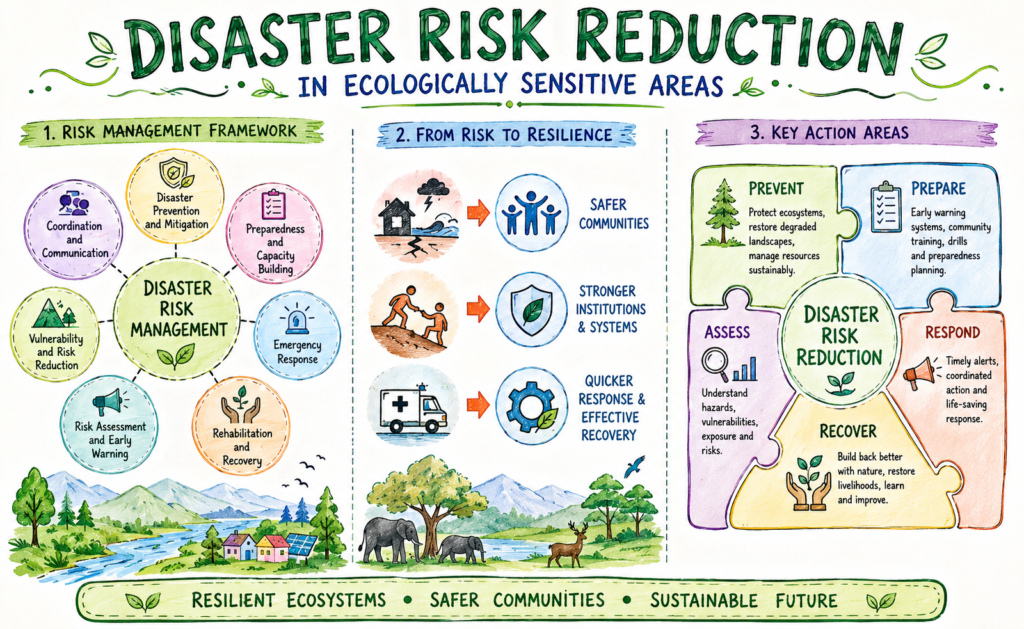
Managing Development with Disaster-Risk Reduction
- Plan according to carrying capacity: Projects should consider the cumulative ecological impact of multiple projects rather than assessing each project in isolation. The Gadgil and Kasturirangan Committees provide useful approaches for the Western Ghats.
- Use safer engineering: Avoid excessive hill cutting and blasting and adopt slope stabilisation, bio-engineering, geotextiles and deep-rooted vegetation wherever suitable.
- Use science and technology: ISRO and GSI landslide-susceptibility maps can guide the location and design of roads, tunnels and other infrastructure, including projects such as Char Dham Pariyojana.
- Strengthen construction and monitoring: Enforce disaster-resilient building standards, scientific tunnelling and safe muck disposal away from river channels. Lessons from events such as the Joshimath subsidence and Teesta-III/Chungthang disaster highlight the need for greater caution.
- Build local resilience: Early-warning systems, evacuation plans and community participation should accompany major infrastructure projects.



Conclusion
India need not choose between connectivity and ecological safety. By combining carrying-capacity-based planning, resilient engineering, technology and local participation, infrastructure can become an instrument of sustainable and disaster-resilient development, in line with the Sendai Framework for DRR (2015–2030) and the Prime Minister’s 10-Point Agenda on DRR.




 Ravi Raaz
 Hassan Khan
 Shadab Ali